Management
Asymptomatic women
Pregnant women with placenta praevia who are asymptomatic throughout pregnancy can be managed on an outpatient basis until they are admitted for elective delivery at 38-39 weeks’ gestation.
Patients who remain asymptomatic are at a lower risk of needing emergency delivery (33). While they remain asymptomatic, it is important to ensure that anaemia is corrected aiming for a haemoglobin concentration greater than 10 g/dL by the time of delivery. It is important to advise these patients to avoid penetrative vaginal intercourse and strenuous physical exercises that could potentially stimulate uterine activity and bleeding. Antenatal fetal surveillance should be dictated by the presence of additional risk factors;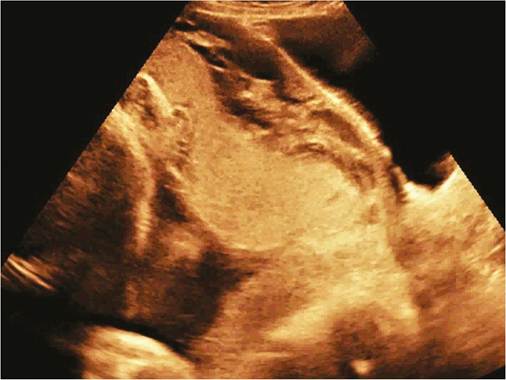
Figure 22.2 Ultrasound scan showing a marginal placenta praevia (not completely covering the os).
however, fetal growth parameters are usually undertaken at the time of ultrasound assessment of placental site. Antenatal care for women with asymptomatic placenta praevia, should be provided in a unit/ centre with ready access to inpatient facilities including blood transfusion and emergency caesarean delivery.
Symptomatic stable women
Conservative management
The majority of pregnant women with placenta praevia who present with a first or second episodes of vaginal bleeding will not require immediate delivery as most initial bleeding episodes will subside with the initial resuscitative measures (34). However, these patients should be managed as in-patients initially on the labour ward for ongoing assessment of maternal and fetal well-being. Once the bleeding settles, the decision to embark on conservative management should be based on the need to prolong the pregnancy. This is most appropriate in those cases that are preterm and where the bleeding subsides.
The components of conservative management include a course of antenatal corticosteroids for pregnancies between 24 and 34 weeks, blood transfusion to correct a significant drop in haemoglobin, anti-D immunoglobulin in unsensitized rhesus-negative patients, fetal assessment with an ultrasound scan, and cardiotocography. Ongoing management could either be inpatient or outpatient in stable patients after the bleeding episode has settled. The decision on whether to offer outpatient or continued inpatient management should be carefully considered, given that it is difficult to predict accurately the likelihood of rebleeding. However, bleeding episodes are more likely when the placenta completely covers the internal cervical os, in placentas with a thick edge (>1 cm), and when the cervical length is less than 3 cm (35, 36). For patients with the first episode of bleeding that settles spontaneously, outpatient management can be considered after at least a 48-hour bleed-free period, provided the patient is able to attend hospital promptly if she develops further bleeding and she must have someone available with her at home. It is important that the patient fully understands and accepts the risks of outpatient management (37).Patients with recurrent bleeding episodes and those with additional pregnancy complications are better managed as inpatients until delivery; however, this decision should be individualized taking into consideration maternal and fetal well-being.
The efficacy of cervical cerclage as an intervention for prolonging pregnancy in patients with placenta praevia is unproven and is not recommended in routine clinical practice (38). The cautious use of tocolysis may be considered in selected cases of placenta praevia, particularly those with preterm contractions with minimal or no bleeding to allow the administration of antenatal corticosteroids (39, 40).
Active management-expediting delivery
Prompt resuscitation and expedited delivery is the management strategy for those patients with severe life-t hreatening bleeding that is refractory to the resuscitation measures, irrespective of the gestational age.
Equally, when active bleeding is associated with onset of labour or fetal distress, delivery should be expedited by caesarean section. When patients present with recurrent bleeding after 34 weeks, delivery may be considered if the patient has completed a course of antenatal steroids. Where such bleeding is nonlife-threatening, other factors including fetal size and maternal risks must be taken into consideration before making the decision.Mode and timing of delivery
Asymptomatic women with major placenta praevia and previously symptomatic patients but stable patients should be admitted for elective delivery by caesarean section at 37-38 weeks' gestation. Consideration for vaginal delivery should be limited to those patients where the lower edge of the placenta is greater than 2 cm from the internal os and who have not experienced episodes of vaginal bleeding (41).
Advance planning is an integral part of management prior to delivery, and in cases of major placenta praevia the use of a preoperative care bundle (Box 22.4) such as the one proposed for placenta accreta is recommended to ensure a consistent approach in the peripartum period (31).
Consideration should be given to the planning and use of cell salvage where such facilities are available, particularly in those patients who decline donor blood.
At caesarean section, a lower transverse skin incision (Pfannenstiel or Cohen's incision) is usually appropriate. Efforts should be made
Box 22.4 Components of the preoperative care bundle
• Senior obstetrician plans and supervises delivery.
• Senior anaesthetist supervises delivery.
• Blood and blood products arranged and confirmed available.
• Multidisciplinary involvement in preoperative planning (midwives, radiologists, haematologists, etc.).
• Discussion and detailed consent to include possible interventions
(e.g. hysterectomy, cell salvage, interventional radiology, balloon tamponade, compression suture).
• Availability of a critical care level 2 bed.
Source data from Royal College of Obstetricians and Gynaecologists. Placenta Praevia, Placenta Praevia Accreta, Vasa Praevia: Diagnosis and Management. Greentop Guideline No 27. London, RCOG, 2011. to avoid a uterine incision that traverses the placenta whenever possible, by making the incision above the upper margin of the placenta. This is not always feasible; hence, it might be necessary to incise through the placenta. This must be performed rapidly to deliver the baby and clamp the umbilical cord. Additional surgical procedures may be required to control bleeding in addition to standard oxytocics. Surgical adjuncts include the use of haemostatic sutures on the placenta bed, balloon tamponade, uterine compression sutures (e.g. B-Lynch sutures), and a low threshold for insertion of peritoneal drain.
During the postoperative period, patients who had massive blood loss should be monitored in the critical care unit with close monitoring of ongoing losses from the vagina and intraperitoneal drain, urine output, haematological parameters (complete blood count, platelets, and coagulation studies), and adequate replacement of blood and blood products. Those patients who have undergone very extensive surgery should be offered an extended period of antibiotic prophylaxis for 24-48 hours after surgery. Thromboprophylaxis should be initiated with a pneumatic compression system and subsequently with low-molecular-weight heparin and compression stockings once coagulation and the platelet count returns to normal. These patients are usually stepped down from the critical care unit within 48 hours. Once the patient is fully ambulating, a thorough and detailed debriefing should be carried out by a senior member of the surgical team, ideally in the presence of the patient's partner particularly if the procedure was performed under general anaesthesia. Adequate discharge planning should include follow-up arrangements and a clear instruction on how to access the service in an emergency.