Patient positioning
Correct positioning during laparoscopic surgery is essential to decrease the risk of pressure-related injury to the anaesthetized woman and improve visualization for the surgeon.
While the incidence of intraoperative positioning-related nerve injury is low, it carries considerable morbidity and legal implication (8). From a prospective cohort study of 616 patients, the incidence of postoperative peripheral neuropathy was reported to be 1.8%, with a median time to resolution of neuropathic symptoms of 32 days (range 1 day to 6 months), with complete resolution observed in all but one patient (91%) (9).There is no accepted standard positioning at gynaecological laparoscopy with a comparative evidence base since this would require far too many women given the low incidence of injury and a pragmatic approach is required. This includes the head being straight, the arms being in a physiologically neutral position, with the arms by the side in medial rotation and no more than 90 degrees of abduction (10). The lithotomy position has been described as hip flexion of 80-100 degrees, abduction of 30-45 degrees laterally, with knees flexed to the point that the lower legs are parallel to the body (Figure 47.1) (11). The woman's legs should be supported in padded stirrups that may be moved and prevent compression in one area of the foot such as the rigid Allen-type stirrups where foot pronation and internal rotation as well as compression of the common peroneal nerve may lead to substantial neuropathic injuries and do not allow intraoperative changes in leg positioning (12). In a large retrospective review of 198,461 patients in the lithotomy position, nerve injury has been reported to be 1 in 3608 cases (78% common peroneal nerve, 15% sciatic nerve, 7% femoral nerve) (13).
The basis of positioning is to reduce the risk of pressure effects since localized stretch or compression results in ischaemic injury and Schwann cell demyelination.
The recovery time is variable with an approximated rate of 1 mm per day (14). Specific nerve injuries have all been reported with the femoral nerve injury affected by excessive hip flexion, abduction, and external rotation and the sciatic nerve affected by knee hyperextension, hip hyperflexion, and external rotation. The upper limbs may also be affected with the brachial plexus affected due to shoulder hyperabduction should the arms be positioned on arm boards intraoperatively. Shoulder braces may lead to nerve compression from the cervical spine and should be avoided, with the surgeon checking the position of limbs prior to beginning surgery and placing additional padding over hands, feet, and arms as needed to reduce risk (15). Increasing procedure duration is associated with increasing nerve injury with an up to 100-fold increase in risk for each additional hour of surgery (13, 16). Periodic repositioning in prolonged procedures is appropriate to avoid sustained pressure on a single segment of the nerve (15).Table 47.1 Randomized controlled trials on the efficacy of preoperative MBP for gynaecological laparoscopy
| First author and year | I No. of patients | I Techniques studied | I Primary study outcomes | I Comments |
| Muzii 2006 (4) | 162 | MBP vs no MBP | Surgical field exposure, operating time, postoperative complication, postoperative discomfort | More postoperative discomfort with MBP. No significant difference in other outcomes |
| Lijoi 2009 (5) | 83 | MBP vs 7-day low-fibre diet | Surgical field exposure, operating time, postoperative complication, length of stay | No significant difference. Low-fibre diet is better tolerated |
| Won 2013 (1) | 308 | MBP + 3-day low-fibre diet vs no MBP | Surgical field visualization, bowel handling, patient discomfort | Improved surgical field visualization and bowel handling with MBP, but of negligible clinical significance. Increased patient discomfort with MBP |
| Siedhoff 2014 (6) | 73 | MBP vs no MBP | Surgical field visualization, surgical difficulty | No significant difference |
| Ryan 2015 (7) | 78 | MBP vs clear fluid diet | Surgical field visualization, bowel handling, ease of operation, gastrointestinal discomfort, patient compliance | No significant difference |
The effect of body mass index (BMI) in nerve injury is variable since women with a low BMI are at increased risk due to less adiposity giving inherent padding; however, women with a high BMI are more likely to move during a procedure with greater stretch-related nerve injury and greater care in both groups is recommended (15).
Friedrich Trendelenburg described the tilted, head-down position with elevated legs in the nineteenth century to improve vision at vesicovaginal fistula surgery (17). The steep Trendelenburg position does allow the bowel to move out of the pelvis and into the abdomen and should only be considered once access to the peritoneal cavity is obtained (see later). However, this physical position is associated with
physiological changes that increase systemic vascular resistance and mean arterial pressure, as well as decreased renal perfusion. There is a linear relationship between the peak airway pressure and the degree of Trendelenburg (18). The combination of pneumoperitoneum and head tilt has been shown to increase peak airway pressure and intracranial pressure decrease pulmonary compliance (19). Therefore, pneumoperitoneum, when used in combination with head-down tilt, may elicit a hazardous haemodynamic response in patients with compromised cardiac function (20). Discussion with the anaesthetic team regarding optimal patient positioning at the instigation of and throughout surgery is mandatory. Devices such as bean bags (21)
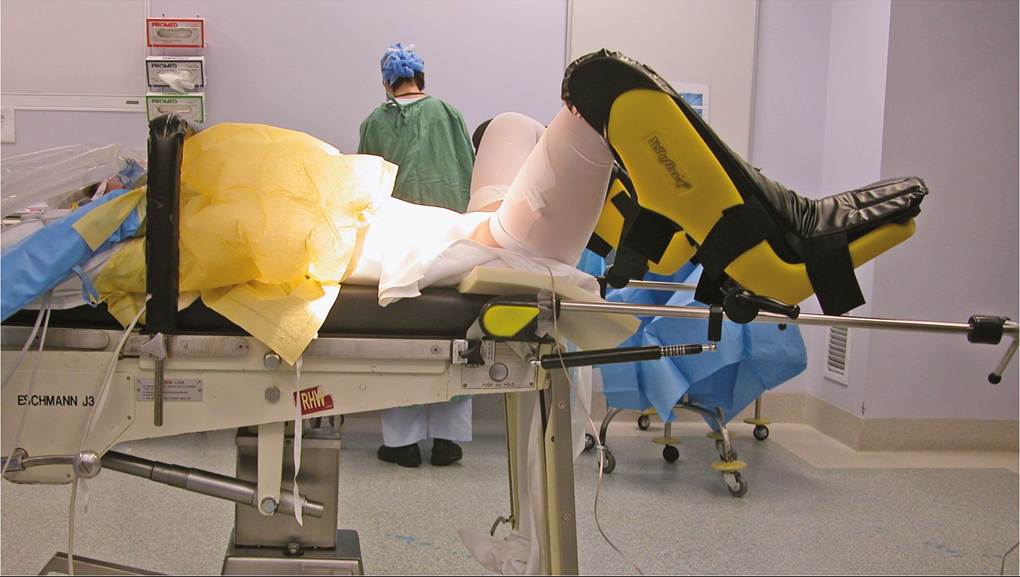
Figure 47.1 The lithotomy position as used for gynaecological laparoscopy.