ALTERNATIVE INFANT FEEDING
While breastfeeding is the best option for early infant feeding in first 6 months of life, sometimes it may be necessary to explore other options in cases when it is either not possible or contraindicated due to any reason.
Three options in these cases include use of: (a) expressed breast milk, (b) milk from human milk banking, and (c) top feeding with animal or formula feeds. Wet nursing by another lactating women is an option, which is rarely feasible in current situation.5.4.1 EXPRESSED BREAST MILK______________________
Expression of breast milk is advised in cases of: (a) painful breast engorgement, (b) any contraindication for breastfeeding (to discard), or (c) separation of mother and baby due to sickness or other causes.
Milk may be expressed manually or with a breast pump, though manual expression is more hygienic, economical and convenient. The mother herself or a relative may express milk in a wide-mouth clean container by applying continuous forward pressure over lactiferous sinuses below the areola.
Manual expression of milk requires following steps:
• Wash the hands and massage the breast gently towards the nipples,
• Place the thumb and index finger opposite each other just outside the areola,
• Press back towards the chest to gently squeeze the milk out of nipple,
• Repeat same steps in different positions around the areola.
This expressed breast milk (EBM) may then either be fed to the baby by a bondla or nasogastric tube or discarded. BM can be stored at room temperature for 8 hours, in refrigerator for 24 hours, or in deep freezers, i.e. breast-milk banks at -20°C, up to 3 months. Stored EBM should be brought to room temperature before feeding by keeping outside, but it should never be heated or stirred to dissolve the fat globules.
5.4.2 HUMAN MILK BANKING________________________
Human milk banking in India was started in 1989 in Mumbai and is now available at many major centers of the country.
It offers a solution to mothers who cannot feed their babies temporarily, especially when they are in hospital or intensive care unit. It involves:• Collection of milk by voluntary donations from lactating mothers,
• Screening of donor's milk for common infections including cultures to detect bacterial contamination,
• Pasteurization of donor's milk by Holder method, before storage in stringent environmental conditions,
• Supply of this stored milk for feeding of sick and small newborns, for whom the mother 's milk is no available.
While donor 's milk from milk bank is inferior to the mother 's own milk due to loss of some immunological and nutritional ingredients during pasteurization and storage, it still retains many advantages of breast milk and is tolerated better than formula milk with lesser risk of (a) infections, e.g. necrotizing enterocolitis (b) feed intolerance as well as risk of (c) metabolic syndromes in later life, with better developmental scores.
5.4.3 TOP FEEDING
Top feeding, i.e. feeding of milk other than the breast milk in early infancy, should be strictly discouraged. However, it may be necessary in rare instances of: (a) true lactation failure, (b) maternal death/serious sickness, or (c) any absolute/relative contraindication for breastfeeding.
Top feeding may be loosely classified as: (a) exclusive top feeding, or (b) supplementary top feeding along with breastfeeding, e.g. in partial lactation failure. Important issues in top feeding are as follows:
• Which milk to use? Milk sourced from human
milk bank is the best option if mother 's own milk is not available, though might be difficult to sustain post-discharge. Although many age-appropriate commercial formula feeds are available, prohibitive cost and risk of incorrect dilution by illiterate and poor mothers render them unsuitable for regular use in India. Dried skimmed milk powders or evaporated/condensed milks are also unsuitable for top feeding due to same reasons as well as unbalanced composition.
Skimmed milk powders have high protein and solute content (risk of dehydration), while condensed milk has excess carbohydrates (risk of diarrhea).Pasteurized or fresh-boiled cow milk remains the most practical, though not the best alternative to breastfeeding in resource-limited population, if top feeding is unavoidable. Composition of the cow's milk is nearest to the breast milk except high protein load, which may be reduced by dilution. It should be diluted with water in 1:1 ratio during first two weeks (longer in preterms) and in 2:1 ratio during next two weeks. Undiluted cow milk may be used after one month of age.
Commercial formulas are specially prepared to bring their composition nearest to BM after dilution and hence, if used at all, should be diluted strictly according to the manufacturer 's instructions.
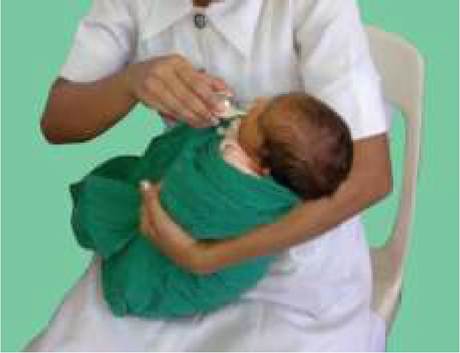
Fig. 5.7: Bondla feeding.
TABLE 5.7: Complications of top-feeding.
Related to the milk/formula:
• Under nutrition (over-diluted milk)
• Dehydration (concentrated formula feeds)
• Oral mucosal scalding (hot feeds)
• Constipation (high solute load)
• Allergic problems (high protein content)
• Recurrent respiratory infections (no immune factors)
Related to the bottle
• Diarrhea (contaminated bottle)
• Overfeeding or underfeeding
• Aerophagia due to wrong bottle position
• Nipple confusion - difficulty in simultaneous breastfeeding
• Weaning problems (refusal to part with bottle)
• Defective dentition/caries (sp. with night feeds)
• How much to give? Quantity of top milk depends on baby's age, gestation and weight. As a general rule, top-milk should provide ~110-120 cal/kg/day. And calculated amount should be divided into 8 rations (3 hourly) during first two month and 6-7 ratios (4 hourly) subsequently, to be given during each feed. A term baby normally accepts ~50 ml feeds during first 2 weeks, ~100 ml between 2-8 weeks and ~150- 250 ml subsequently.
• How to give? Top feeding must be given by katori and spoon, or indigenously designed utensils, e.g. bondla or paladi (Fig. 5.7). Although convenient, risk of infection and other complications is maximum with bottle-feeding, which should be avoided as far as possible.
• Which precautions to take? Important precautions, necessary to prevent complications of top feeding (Table 5.7) are:
- Proper preparation of feeds
#9632; Proper quantity and dilution of feed
#9632; Use of fresh boiled milk/diluted formula
#9632; Proper temperature of feed
- Proper preparation of feeding equipment
#9632; Proper sterilization of feeding utensil/bottle
#9632; Proper teat-hole size to allow drop by drop flow of milk from inverted bottle.
- Correct technique of feeding
#9632; Semi-upright position to avoid aspiration
#9632; Burping after feeding.
- Early vitamin/mineral supplements, as vitamin C and iron are deficient in cow milk.
• How to sterilize feeding bottle/utensils? While bottle feeding is strongly discouraged, proper sterilization is necessary, if unavoidable. Bottle and nipple may be sterilized by boiling[*] [†] or chemical sterilization by dipping for 10 minutes in milton solution (2% sodium hypochlorite). Other feeding utensils, e.g. bondla, katori, spoon, etc. need not be boiled but should be properly cleaned with running or warm water.
*Before boiling, bottle should be properly cleaned with brush and lukewarm salt-water to remove the stickiness. Subsequently, bottle and nipple should be boiled for 15-20 minutes and 5 minutes respectively and left in container itself, till required, to prevent re-contamination.
Infant Milk Substitutes, Feeding Bottles and
Infants Food Act, 1992
Purpose: BM is all that a baby needs till first 4-6 months of life. At this age, introduction of complementary feeds is necessary as:
a. Breast milk output reaches a plateau (600-700 ml/ day) by this age,
b. Growing baby's dietary requirements exceed the supply from mother's milk,
c.
Baby's stomach is ready to receive and digest food, other than the breast milk.• Early introduction of complementary feeding before 6 months is harmful due to reduction in BM intake and higher risk of infections and allergies as well as obesity in later life.
• Late introduction of complementary feeding beyond 6 months affects optimal growth of the baby and may creates difficulties in subsequent weaning due to development of breast-affinity in baby.
Characteristics of complementary foods: Common complementary foods used at different ages in infants and young children are shown in Table 5.8. Ideal complementary foods should be:
• Age-appropriate with consistency appropriate to the developmental readiness of the child in munching, chewing and swallowing. Complementary feeding must begin with soft, homogeneous, thinner and bland feeds, (e.g. Porridge), followed by thicker mashed foods and lastly, the chewable foods. Gut mucosa is relatively permeable to undigested proteins in early infancy, which may induce allergic mechanisms. Hence, eggs should not be introduced in diet before 6 months.
• Energy-dense to account for small stomach size of infants. Meals can be made energy-dense by thickening them and adding ghee/butter/oil or jaggery. Energy value may also be enhanced by using fermented, sprouted or toasted grains for preparation of meals.
• Home-made and less expensive: Complementary foods must be based on staple diet of the family. Commercial foods must be avoided as due to cost and potential risk of harmful additives or high salt content. Fortified foods with iron, iodized salt, vitamin A, etc. must be encouraged. Junk foods should be avoided.
TABLE 5.8: Common weaning foods* for Indian children
Age 6-8 months (2-3 meals/day; 2-3 tablespoonful/meal)
• Thickened fruit juices and soups
• Mashed fruits, e.g. banana, papaya, cheekoo, etc.
• Boiled-mashed vegetables, e.g. carrot, potatoes, etc.
• Milk-cereal porridge (ragi/nachni/suji), kheer, etc.
Age 9-11 months (3-4 meals/day; ~ frac12; cup/meal)
• Cereal-pulse combinations, e.g. khichri, rice-dal
• Chewable foods, softened in dal, e.g. bread, chapati
• Eggs (Not lt;6 months due to risk of allergy in later life)
• Non-veg:, e.g. mashed chicken, fish, by 7-8 months
Age 12-23 months (3-4 meals/day; ~ 1 cup/meal)
• All foods eaten by the family, though less spicy
*Add ghee/oil to increase caloric content
• Culturally and culinary acceptable: Non-vegetarian foods are richer in proteins, though vegetarian foods are equally good, if used in combination of cereals and pulses, e.g. khichadi. While some babies may prefer salty or sweet feeds, addition of salt or sugar in complementary feeds is not recommended till 2 years of age.
• Fresh and hygienic at all levels of preparation, storage and feeding. Handwashing must be encouraged during preparation/feeding of meals and cooked food must be consumed within 1-2 hours, unless refrigerated.
Principles of complementary feeding: Weaning should be a gradual and pleasant experience to the baby and some important principles include:
• Introduction of feeds: Start with one food item at a time and continue it for a week or so, till the baby gets used to it before adding next item. Multiple food items should not be started at same time. Increase the quantity, consistency and frequency of each feed gradually, till desired intake is achieved.
• Mode of feeding: Feed with a katori and spoon and never use the bottle. Older children should be encouraged to feed from separate plate, to assess the exact intake. Self-feeding should be encouraged, with fingers/spoon.
• Dietary diversity: Children should receive complementary foods from at least 4 of the following seven food groups (also termed as minimum dietary diversity): (1) grains, roots and tubers, (2) legumes and nuts, (3) dairy products; (4) flesh foods, e.g. meat fish, poultry, (5) eggs, (6) vitamin-A rich fruits and vegetables, (7) other fruits and vegetables.
• Frequency of feeding (Minimum meal frequency): Babies should be fed complementary feeds at least 2-3 times during 6-8 months and 3-4 times during 9-23 months of age. Those, who are not on breast feeds simultaneously must be fed at least 4 times during 6-23 months. Inter-meals snacks of good nutritive value must be encouraged in addition to regular meals. However, junk foods should be strictly avoided as snacks.
• Supplements: Iron rich/fortified foods or iron supplements should be provided to all infants from 6 months of age.
• Target: Weaning must be complete by 1 year of age, when baby should be qualitatively eating the regular family diet, albeit in quantities about half of the mother 's diet. Breastfeeding should continue as long as possible, as a source of supplementary nutrition.
• Responsive feeding. Young children should be encouraged to take feed by praising them. Forced feeding with threats and punishment interfere with
development of good feeding habits. Minimize the distractions during feeding.
• Breastfeeding should be continued till 2 years of age, along with CF.
• Feeding during sickness: Both, BF and CF should be continued even when the child is sick, if it is tolerated.
Assessment of complementary feeding: All children aged 6 months to 2 years must be assessed for adequacy of CF during each visit with following questions:
• At what age, CF were introduced in diet ?
• Which CFs are being used at present, including the consistency of these feeds ?
• How frequently CF are given in last 24 hours to compare with recommended minimal meal frequency?
• Which CF were given in last 24 hours to compare with recommended minimum meal diversity?
• Whether breastfeeding has been continued and how frequently it is being given ?
• Whether iron supplements are also being given ?
• Whether feeding is/was continued during the sickness of the child.
Mother should be counseled about correct CF practices, as described above under principles of CF. Any deviation from these norms/practices may significantly affect the nutritional status of infant and needs careful monitoring.
5.6
More on the topic ALTERNATIVE INFANT FEEDING:
- Agrawal M.. Textbook of Pediatrics. 3rd ed. — CBS Publishers,2025. — 973 p., 2025
- Sick Finnish Children: A Local Case
- TECHNICAL FACTORS OF NEEDLE ELECTROMYOGRAPHY
- Ventricles
- Chapter 11 Postpartum Care
- Gestational diabetes mellitus
- Drug Therapy in Pregnancy
- 4 Preconception Counseling and Prenatal Care
- CHAPTER 11 After the Overruling of Roe: The Natural Law Moment
- Chapter 24 Infectious Diseases