BASIC CONSIDERATIONS
Diet is the main source of nutrition in children, though some nutrients, i.e. vitamin D and K are also synthesized endogenously in body. An ideal diet should fulfil requirements of all essential nutrients in adequate proportions and composition.
5.1.1 NUTRITIONAL REQUIREMENTS________________
Often used interchangeably, the term Nutritional requirements refers to daily physiological requirements of various nutrients to maintain normal metabolism, while the term Dietary requirements denote need for daily nutritional intake, essential to fulfil these nutritional requirements after considering absorption and other losses.
Recommended dietary allowances (RDA) is defined as the 'minimum daily dietary requirement of a nutrient in normal healthy person along with some additional allowance for individual variations to cover the needs for gt;97.5% of healthy (not sick) population, without the risk of over-dosage'. National Institute of Nutrition under Indian Council of Medical Research (NIN-ICMR) has periodically revised RDA for various nutrients for Indian population, with latest recommendations in 2020 (Table 5.1).
However, there is no specific RDA for energy in 2020 version, instead provided as quot;Estimated Average Requirementquot; (EAR), i.e. median daily intake, estimated to meet requirements of half of the healthy individuals in different age/sex groups.
TABLE 5.1 : Recommended dietary allowances* (RDA) for Indian children and adults
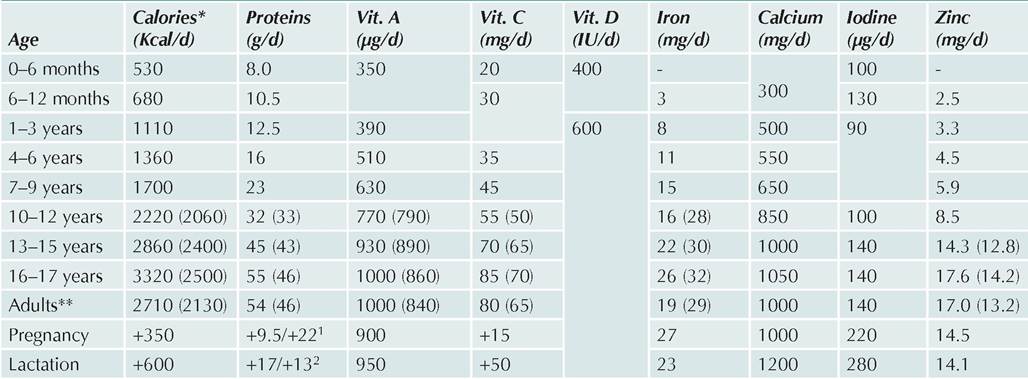
*Denote Estimated Energy requirements for calories instead of RDA, **Moderate worker
1In second and third trimester of pregnancy, 2in first 6 months and during 6-12 months of lactation Figures in parentheses represent RDA in females, wherever different from males.
Source: Dietary Guidelines for Indians, National Institute of Nutrition, Hyderabad, 2020.
Energy is the prime essence of nutrition, required to sustain basal metabolic rate, day-to-day physical activity, normal growth, and to digest and assimilate the nutrients. Basal metabolic rate (BMR), e.g. the minimum energy requirement to maintain essential physiological functions of the body at rest, is highest in infancy (55 cal/ kg/ day) and decreases gradually with advancing age to reach adult values (25-30 cal/kg/day) by late childhood.
A normal child spends ~50% of energy requirements for BMR, 25% for physical activity, 12% for growth, 5% for digestion/assimilation of food and 8% for fecal losses. Sources: Carbohydrates are the main source of energy in diet. An ideal diet should provide 50-60% of calories as carbohydrates, 20-30% as fats and 10-15% as proteins. Each gram of proteins, fats and carbohydrates in diet provide 4, 9 and 4 calories, respectively.
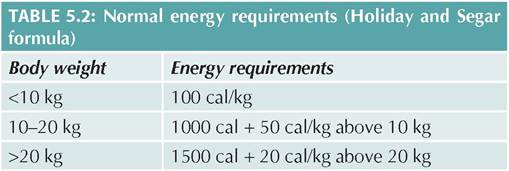
Requirements: Energy requirements in normal children vary according to the age and gender, provided as EAR in Table 5.1. For simplicity, these requirements may also be calculated with body weight by Holiday and Segar formula (Table 5.2).
It should be noted that these are the requirements for normal and not the malnourished children, who need higher calories for catch-up growth and replacement of stores.
5.1.2 ESSENTIAL NUTRIENTS
Nutrients are the active principles in diet, each with different functions and metabolic patterns. These may be classified as:
• Macronutrients or proximate principles, e.g. proteins, fats and carbohydrates.
• Micronutrients, e.g. vitamins and minerals.
Proteins, which constitute ~20% of body weight, are important source of energy as well as required for: (a) body building, e.g. growth of muscles and different tissues, (b) repair and maintenance of tissues, (c) synthesis of substances, e.g. antibodies, plasma proteins, enzymes, hormones, hemoglobin, clotting factors, etc.
(d) maintenance of osmotic pressure in various tissue compartments.
Biochemistry: Proteins are complex nitrogenous compounds made up of smaller units, e.g. amino acids. While some amino acids can be synthesized in body, others cannot and have to be essentially supplied from diet, termed as essential amino acids. In general, there are eight essential amino acids—methionine, threonine, tryptophan, valine, isoleucine, leucine, phenylalanine and lysine (acronym-MeTTVILPLy). Some other amino acids are essential only in infants (histidine) or low birth weight babies (arginine, cysteine and taurine).
Requirements: RDA for proteins in different age groups is given in Table 5.1. Protein requirements are relatively higher in PEM and during recovery from illnesses/ infections, due to endogenous protein breakdown in muscles and liver to provide essential amino acids.
Sources: Dietary proteins are provided from animal sources, e.g. milk, meat, egg, fish, etc. as well as vegetable sources, e.g. cereals, pulses, beans and nuts. Quality of proteins from different sources differ, depending on the digestibility, biological value (% of absorbed proteins retained in the body) and net protein utilization or NPU (% of ingested proteins, retained in the body).
Animal proteins are nutritionally superior to vegetable proteins. Egg is considered as a reference protein due to its high biological value, digestibility and NPU (96%). NPU of other animal proteins is also relatively higher (cow's milk 85%, meat 76%, fish 74%) vs of vegetable proteins (rice 77%, wheat 61%). Soya bean is the richest source of vegetable protein but with lower NPU (lt;60%) due to poor digestibility.
Vegetable proteins also lack in certain essential amino acids, termed ‘limiting amino acids'. Cereal proteins are deficient in lysine and threonine, while pulses are deficient in methionine. Deficiency of limiting amino acids in vegetarian diet may be corrected by using combination of cereals and pulses in diet, e.g.
rice-dal or dal-chapati. Fats are the major source of stored energy (adipose tissue or brown fat) as well as also required: (a) as a vehicle for fat soluble vitamins, (b) as a source of essential fatty acids (c) for temperature regulation and (d) to increase palatability of food. Being the most concentrated source of energy (9 cal/kg), fats are commonly used to increase the caloric content of food without increasing its bulk.Biochemistry: Fats are classified as simple fats, e.g. triglycerides, derived lipids, e.g. cholesterol, and compound lipids, e.g. phospholipids. Over 95% of dietary lipids and ~99% of stored lipids in diet are triglycerides.
Fats yield to fatty acids and glycerol on hydrolysis. Fatty acids may be classified as (a) saturated fatty acids, e.g. palmitic or stearic acid; monounsaturated fatty acids, e.g. oleic acid; and (b) polyunsaturated fatty acids (PUFA), e.g. linoleic acid, linolenic acid or arachidonic acid. Of these, PUFA cannot be adequately synthesized in body and have to be derived from ingested food, thus also termed essential fatty acids (EFA).
EFA are essential for: (a) normal growth and brain development, (b) structural integrity of cell membrane, and (c) inflammatory response to produce various mediators, e.g. prostaglandins. EFA deficiency has been linked with phrynoderma (dry skin), growth failure, developmental retardation, reproductive failure and increased susceptibility for infections.
Circulatory lipids usually exist in bound-form with proteins (lipoproteins), e.g. chylomicrons, high-density lipoproteins (HDL), low-density lipoproteins (LDL) and very low-density lipoproteins (VLDL). HDL has lower fat and higher protein content than LDL/VLDL, hence considered as a good cholesterol/fat.
Requirement: Total and saturated fat intake should not exceed 20% and 10% of total caloric intake per day, respectively. In addition, minimum 2-3% of caloric requirements should be derived from EFAs and 0.3% from linolenic acid.
Sources: Dietary fats are derived from either a visible source, e.g. animal fats (ghee, vegetable oils) or invisible sources (cereals and pulses). In Indian diet, more than half of the fat is consumed as invisible fat.
Animal fats mainly contain saturated fatty acids and are poor source of EFA. Breast milk has enough EFAs to meet the baby's requirements. All vegetable oils, except palm oil and coconut oil, are rich sources of EFA.
Coconut oil is a rich source of medium chain triglycerides (MCT)—the only fat that does not require bile for absorption and directly absorbed into the portal vein. Hence, it is often used in malabsorption states, chronic hepatic disease and low birth weight newborns as a human milk fortifier.
Carbohydrates are most important source of ready as well as stored energy, as well as also essential for oxidation of fats and synthesis of certain non-EFAs.
Biochemistry: Carbohydrates are consumed either as free-sugars, e.g. monosaccharides (glucose, fructose and galactose) and disaccharides (sucrose, maltose, lactose) or as complex-sugars, e.g. polysaccharides, e.g. starch, cellulose, dextrin, etc. However, all carbohydrates are finally converted to glucose for use as metabolic fuel.
Normal glucose homeostasis is maintained by three important metabolic pathways: (a) Glycogenesis, e.g. conversion of free glucose and fat into glycogen for storage in liver and muscles, (b) Glycogenolysis, i.e. endogenous breakdown of hepatic/muscle glycogen to provide free glucose in starvation conditions, and (c) Neoglucogenesis, i.e. conversion of endogenous or dietary proteins and glycerol into glucose, in starvation states. Unlike hepatic glycogenolysis, glycogenolysis in muscles is an anaerobic process with production of lactic acidosis, responsible for starvation ketoacidosis.
Requirements: Carbohydrates should provide minimum 50-60% of caloric intake, preferably as complex-sugars to minimize post-prandial blood glucose fluctuations.
Sources: Starch is the commonest carbohydrate in diet, present in grains, legumes and tubers.
Glycogen is present only in animal sources.Fibers are complex carbohydrates like cellulose, hemicellulose, gums, pectins, and mucilages, etc., present in plant cell walls. Although of little caloric value due to their non-digestibility (2 calories/gram vs 4 calories/ gram for other carbohydrates), presence of adequate fibers in diet is essential for colonic water absorption and softening of stools. While vegetarian diet contains adequate fibers, low-fiber non-vegetarian diet has been linked with higher risk of constipation, colonic cancers and hypercholesterolemia.
Vitamins are non-energy-yielding organic compounds, which act as co-factors in many enzyme systems to catalyze cellular metabolism. Although required in miniscule amounts, vitamins are essential for normal growth and maintenance of various body functions.
Vitamins may be divided into two groups, i.e. fatsoluble vitamins, e.g. vitamins A, D, E, K and water-soluble vitamins, e.g. those of B-complex group and vitamin C. Of these, vitamins D and K is also synthesized in body (endogenous source).
Vitamin-related abnormalities may be broadly divided into: (a) deficiency disorders, (b) hypervitaminosis or excess states, and (c) dependency states, i.e. inherited errors in metabolic/enzyme activity, dependent on related vitamins. See Chapter 6.2-6.7 for normal vitamin biochemistry, functions, sources and deficiency states.
Minerals are non-energy yielding inorganic compounds, which contribute to ~3-4% of body weight and mainly present in bones (~80%), muscles (~10%) and body fluids (~4%). Biologically important minerals are classified as:
• Macrominerals, which are present in substantial amounts and their nutritional requirement usually exceeds gt;100 mg/day. While some of these minerals are concentrated in tissues, e.g. bones and muscles, (e.g. calcium, magnesium, phosphorus, etc.), most of them are major electrolytes in body fluids as cations (Na+, K+, Ca++, Mg++) or anions (P-, S-, Cl-).
• Microminerals (trace elements), constitute lt;250 pg/gm of tissue matrix, e.g. iron, iodine, zinc, fluorine, etc. Minerals present in still smaller amounts (lt;100 ng/g of matrix) are termed as ultra-trace elements. Despite miniscule requirements, trace elements play significant role in human health and disease (Ch 6.8).
Anti-oxidants are important phytochemicals present mainly in vegetables and fruits. These nutrients, also termed free oxygen scavengers, restrict the cellular damage caused by oxygen-free radicals and provide protection against diseases related to free-radical damage, e.g. atherosclerosis, cancer, inflammatory joint diseases, asthma, diabetes, etc. Raw and fresh vegetables like green leafy vegetables, carrots, fresh fruits including citrus fruits and tomatoes have been identified as good sources of antioxidants (Ch 6.9).
5.2
More on the topic BASIC CONSIDERATIONS:
- Agrawal M.. Textbook of Pediatrics. 3rd ed. — CBS Publishers,2025. — 973 p., 2025
- AAP. Guidelines for Air and Ground Transport of Neonatal and Pediatric Patients. 4th edition. — American Academy of Pediatrics,2015. — 488 p., 2015
- Hepatic Lobe Torsion
- Marriage and marriage dissolution
- Conclusion
- FIVE COMPONENTS OF LEGAL COMPETENCIES
- CHAPTER 41 HARMFUL ALGAL BLOOMS INCLUDING Cyanobacterial toxicosis
- Background Context
- Changing Contexts for Harmony versus Adversarial Models
- REVIEW OF FORENSIC ASSESSMENT INSTRUMENTS