Gait Impairments
A wide variety of gait classification systems have been developed to assist in diagnosis, clinical decision-making, and to facilitate communication among health care providers. A systematic review of the literature,
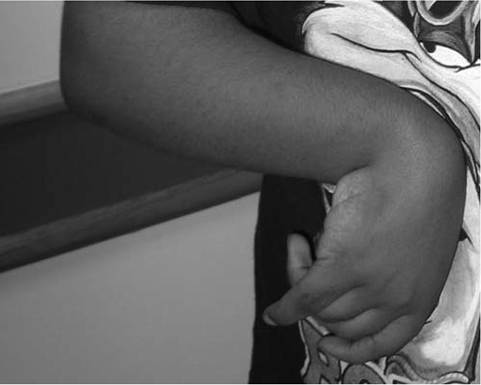
Figure 8.11 Wrist and finger flexion and ulnar deviation in a child with cerebral palsy.
however, concluded that no single classification system appeared to reliably and validly describe the full magnitude or range of gait deviations in CP (66).
The following is a description of the more common gait deviations associated with CP (Table 8.1) At the hip, increased hip adduction tone can cause scissoring and difficulty advancing the limb in swing phase. Increased tone in the iliopsoas can lead to increased hip flexion, resulting in an anterior pelvic tilt and a crouched gait. Increased femoral anteversion can contribute to i n-toeing. At the knee, tight hamstrings can inhibit the knee from extending during stance phase, further contributing to a crouched gait. Spasticity of the rectus femoris may limit knee flexion during the swing phase, causing a stiff-kneed gait pattern. At the ankle,
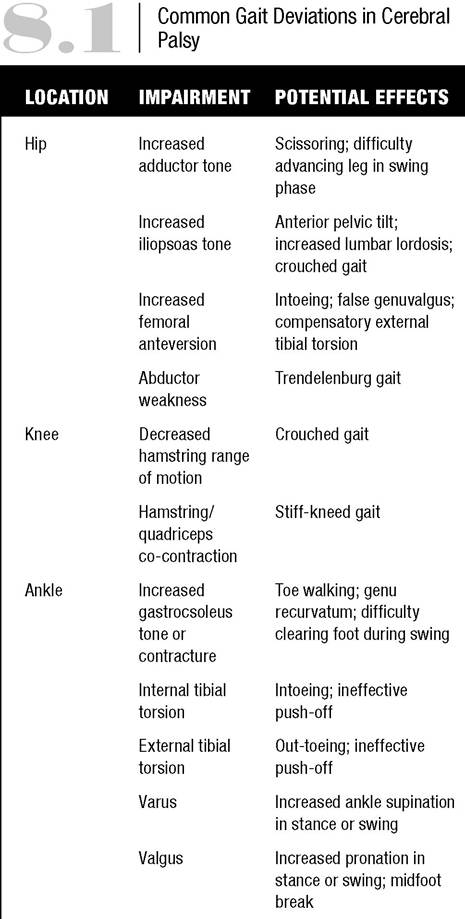
spasticity of the plantarflexors can lead to toe walking, difficulty clearing the foot during swing phase, or genu recurvatum (due to limited dorsiflexion in stance phase creating an extension moment at the knee). Spasticity of the ankle invertors, most commonly seen in spastic hemiparesis, can lead to supination of the foot and weight bearing on the lateral border of the foot. Weight bearing on the talar head is more common in spastic diparesis or quadriparesis, and is associated with an equinovalgus deformity. Malrotation of the leg can interfere with stability during stance phase and effective pushoff. Internal rotation is more common with a varus deformity and external rotation with a valgus deformity.
More on the topic Gait Impairments:
- TECHNICAL FACTORS OF NEEDLE ELECTROMYOGRAPHY
- Orthoses
- INFORMING INTERVIEW
- Physical Examination
- the Oestrous cycle
- Identification of MAP in Cultures
- NEUROLOGICAL DYSFUNCTION ASSOCIATED WITH HIV-1 INFECTION
- PEARLS AND PERILS
- EARLY TREATMENT
- 30 Chronic Pelvic Pain