MACULOPAPULAR DISORDERS
Maculopapular lesions are commonest skin rashes, seen either as primary lesions or as the earliest lesions in other evolving rashes, e.g. Vesiculobullous lesions.
Primary maculopapular lesions may be seen in isolated skin disease or as cutaneous manifestation of infective (exanthematous fevers) or non-infective systemic illnesses (Table 25.5).
Some important causes of maculopapular lesions with primary skin involvement are as follows:Miliaria rubra (Prickly heat) is the commonest cause of macular eruptions during hot and humid season, caused by occlusion of eccrine sweat ducts by a keratin plug. Clinically, it presents as erythematous, itchy, 1-3 mm macules all over body, specially forehead, neck, upper chest and back. Rupture of sweat-glands due to back pressure may lead to leakage of sweat in epidermis/ dermis with inflammatory changes and secondary infection. Local cold compresses are effective to control itching, while regular bath may prevent them.
TABLE 25.5: Causes of maculo-papular rash
• Primary skin lesions
- Hypersensitivity rash
#9830; Urticaria
#9830; Insect bites
#9830; Drug reactions
#9830; Photosensitive rash
- Primary skin infections
#9830; Bacterial: Evolving pyoderma
#9830; Fungal: T. versicolor, candida
#9830; Viral: Molluscum contagiosum
#9830; Parasitic: Scabies, pediculosis
- Miliaria rubra
- Evolving rash in other skin lesions
• Maculopapular lesions in systemic disease
- Infections (Exanthematous fevers)
#9830; Viral: Measles, rubella, dengue
#9830; Bacterial: Scarlet fever, enteric fever
#9830; Spirochetal: Congenital syphilis
#9830; Rickettsial: Epidemic/endemic typhus
#9830; Parasitic: Malaria, toxoplasmosis
- Collagen disorders: SLE, dermatomyositis
- Nutritional diseases: Pellagra
- Miscellaneous: Histiocytosis
Miliaria crystallina (Sudamina rash), is another variant of miliaria, is commonly seen in febrile states or poor hygiene, with sudden eruption of asymptomatic, noninflammatory, pin-point, extremely superficial and clear vesicles, which leave brawny desquamation on healing after 2-3 days.
Drug eruptions: Cutaneous manifestations of drug reactions vary widely, commonly presenting as exanthematous rashes, urticaria/angioedema, fixed drug eruptions, photosensitive rash, vascultis and very severe lesions, e.g. Steven-Johnson syndrome (Chapter 25.6). Most of them are caused by drugs antibiotics, anticonvulsants, NSAIDs, and vaccines.
Morbilliform (Exanthematous) drug eruptions are common after exposure to penicillins or cephalosporins, specially ampicillin. Clinically, these rashes present as acute onset of measles-like generalized macules with or without pruritis, most prominent of chest and proximal extremities. Unlike measles, these rashes are not associated with fever and rarely last for more than 48 hours. Antihistaminics decrease the itching but do not alter the course of eruptions.
Fixed drug eruption, though relatively uncommon in children, present as dusky-red macules after exposure to an offending drug (cotrimoxazole, NSAIDs, ciprofloxacin) that rapidly turn bluish-black and persist for many months (Fig. 25.9). Characteristic feature of these lesions is the recurrence of lesion at the same site after subsequent exposures to the drug. No specific treatment is effective except topical steroids in acute phase and avoidance of drug.
Fig. 25.9: Fixed drug eruption.
Insect bites: Insect-related skin reactions are produced by direct contact or actual bite, due to numerous household or wild insects, e.g. mosquitoes, bees, wasps, bedbugs, spiders and mites, etc.
Clinically, the severity of reaction depends on species of insect, age of child and reactivity of skin. While severe generalized reactions or urticaria may be seen in newborns and hypersensitive children, most older children respond with transient and mild reactions, limited to local papule or wheal formation. Insect bites are typically: (a) seen on exposed parts of body, (b) often pruritic, (c) limited to few lesions, and (d) usually transient.
Urticaria (Hives) is the commonest cutaneous hypersensitivity reaction to any exogenous, endogenous or unidentifiable allergen (Table 25.6), representing an IgE-mediated immune response. Urticaria may be acute or cronic, i.e. episodic attacks for gt;6 weeks. Unlike acute urticaria, chronic urticaria is usually idiopathic, though anti-IgE antibodies are present in ~25-50% cases.
Clinically, these cases present with wide clinical spectrum, ranging from localized pruritic macule
TABLE 25.6: Precipitating factors for urticaria
• Exogenous
- Inhalants: Pollens, animal danders
- Ingestants: Drugs, food, coloring agents
- Injectants: Insect bites/stings, drugs
- Contactants: Insects, mites, dust, danders
• Endogenous
- Infections: Helminthiasis, viruses, malaria
- Illnesses: Cholestasis, SLE
- Vasogenic: Heat/cold urticaria, sun exposure
- Hereditary angioedema (C3 inhibitor deficiency)
• Idiopathic
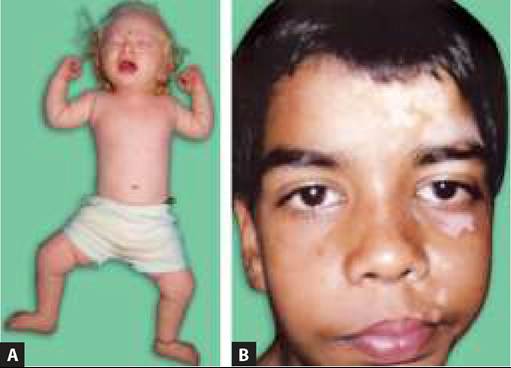
Fig. 25.10: Urticaria.
to severe angioneurotic edema. Typical urticarial lesions begin as pruritic macules or patches, which rapidly enlarge to form coalescing wheels (Fig. 25.10). Characteristically, these lesions do not last for gt;48 hours, though new lesions may continue to appear. Dermographism, i.e. excessive wheal-flare response on stroking of the skin is common.
Angioneurotic edema is the most severe variant of urticaria involving dermis as well as subcutaneous tissue (d/d urticaria involving only dermis) with marked edema of affected parts, e.g. eyelids, lips, scrotum, limbs and sometimes, potentially fatal laryngeal edema. Severe anaphylactic reactions and bronchospasm may develop in some cases.
Diagnosis of urticaria/angioedema is largely clinical, based on: (a) presence of marked pruritis, (b) transient and often recurrent lesions, (c) family history of atopy in many cases, and (d) onset after exposure to a known allergen in some cases.
Laboratory investigations may reveal eosinophilia and/or raised IgE levels in some cases. In vitro skin allergen tests are unreliable. Collage vascular disorders should be excluded in chronic urticaria.Management depends on the severity of lesion. Mild or localized cases may be treated on outdoor basis with oral antihistaminics, cold compresses or topical antipruritic lotions. Severe cases, e.g. angioneurotic edema need hospitalization to supervise for complications, e.g. laryngospasm, bronchospasm or anaphylaxis; and treated with intensive supportive measures, parenteral adrenaline, steroids and antihistaminics.
While drug and foods are most common causes of urticaria in children, some other important types of urticaria are as follows:
• Papular urticaria, seen mainly in early childhood during summer season denotes more diffuse response to common insect bite (id reaction), presenting as widely distributed urticarial or maculopapular lesions all over body in different stages of evolution, even after quiescent bites or minimal local reaction.
• Cold urticaria, i.e. appearance of urticarial lesions on exposure to cold weather or local application of cold (ice, bath, swimming) may be primary or secondary. Secondary cold urticaria is usually seen in adults with cryofibrinogenemia, cryoglobulinemia, cold- agglutinin disease, etc. Primary cold urticaria usually appears and disappears spontaneously, sometimes after a viral illness.
• Episodic urticaria with fever and eosinophilia has been described as a separate clinical entity in children and adults, which unlike other hypereosinophilic syndromes, runs a benign course.
• Solar urticaria presents with generalized wheal and flare reaction after 5-10 minutes of sun exposure that fades after 1-2 hours. Headache, syncope and/or bronchospasm is common during the attack. Primary solar urticaria probably indicates a type I hypersensitivity to some irradiation-induced allergen, while secondary solar urticaria is due to photosensitization by various drugs, chemicals or metabolites (see photosensitive rashes).
Photosensitivity rash: Some children are extraordinarily sensitive to sun exposure, either due to their normal skin type (sunburns, hypopigmentary disorders) or presence of abnormal drugs/metabolites in skin (photoallergic/ phototoxic reactions). Many other skin disorders, albeit of different etiology, may be exacerbated on light exposure (Table 25.7). Some important photosensitive rashes are as follows:
Acute sunburn is the commonest photosensitive reaction in fair-skin children, due to direct effect of ultraviolet
TABLE 25.7: Causes of photosensitive rash
• Acute sunburns (direct effect of ultra-violet light)
• Photoallergic/phototoxic reactions
- Drugs: sulfonamides, barbiturates, NSAIDs
- Chemicals: Cosmetics, perfumed oils, tars
- Phytophotodermatitis*
- Nutritional: Pellagra
- Metabolic errors: Porphyria, hartnup disease
• Genetic photosensitivity syndromes
- Xeroderma pigmentosum or cockayne syndrome
- Bloom syndrome
• Hypopigmentary disorders
- Albinism
- Vitiligo
• Skin diseases exacerbated by light exposure
- Collagen disorders: SLE, dermatomyositis
- Solar urticaria
- Atopic dermatitis
- Others: Pemphigus, psoriasis
*due to consumption of psoralen containing fruits and plants NSAIDs: Non-steroidal anti-inflammatory agents
radiations (290-320 nm) in sunlight. Children vary in their susceptibility to sunburns, depending on their skin color, i.e. amount of pigment. Sunlight radiations lt;300 nm are usually absorbed by epidermis and melanin, whereas that of gt;300 nm are transmitted to dermis, causing sunburns.
Clinically, sunburns manifest after 6-12 hours of exposure as redness, tenderness, edema and skin blistering with peak effect at ~24 hours. After prolonged or repeated exposures, enhanced melanogenesis may reduce skin sensitivity to sunburns. Unduly prolonged and intense sun exposure may lead to premature aging or increased risk of skin cancers, e.g. malignant melanoma.
Local cold compresses, topical steroids and antiinflammatory agents are useful in acute phase, while further damage may be prevented by avoidance of sun exposure and use of protective clothing and sun-screens.
Photoallergic vs Phototoxic reactions: Presence of various photosensitizers in skin/circulation, e.g. drugs, chemicals or metabolites (Table 25.7), may provoke photosensitive dermatitis on exposure to certain wave lengths of light.• Photoallergic reactions are T-cell mediated hypersensitivity reactions to photosensitizers, which require prior sensitization, seen only in selected individuals and are not dose-related.
• Phototoxic reactions are dose-related, seen in all individuals after sufficient dose-intake and prior sensitization is not required.
Genetic photosensitivity disorders are rare, usually autosomal recessive and include: (a) increased propensity to chromosomal breakage on exposure to ultraviolet rays, e.g. Bloom syndrome, (b) defective nucleotide excision-repair, e.g. Xeroderma pigmentosum, and (c) accumulation of photosensitive metabolites in inborn errors of metabolism, e.g. porphyria, Hartnup disease.
Xeroderma pigmentosum is a rare defect in nucleotide excision-repair, characterized by: (a) skin manifestations, e.g., photosensitive dermatitis and tendency for skin malignancies, (b) ocular manifestations, e.g., photophobia, keratitis, etc. and (c) neurological manifestations, e.g. mental retardation or sensorineural deafness in ~20%.
Cockayne syndrome, a variant of xeroderma pigmentosum, presents in late infancy with: (a) photosensitive butterfly facial rash on sun-exposure with secondary changes, (b) short stature, (c) facial dysmorphism, i.e. large ears, pinched nose and premature graying of hair, (d) intellectual disability, (e) limited joint mobility, (f) progressive deafness, and (g) ocular lesions, e.g. cataracts and retinal degeneration. Neurological manifestations due to extensive demyelination develop soon and most patients die in late adolescence due to premature atherosclerosis.
Bloom syndrome is a rare disorder with increased propensity for chromosomal breakages on ultraviolet rays exposure. Clinically, these cases present in infancy with: (a) photosensitive butterfly facial rash, (b) short stature, (c) facial dysmorphism, with small, narrow face with prominent nose and ears, (d) tendency for lymphoreticular malignancies. Susceptibility to infections due to hypogammaglobulinemia is common. Other skin lesions, dental and digital abnormalities, e.g. polydactyly may be present.
25.6