Surgical Approach: General Principles
Adherence to the general principles of childhood amputation surgery guides one to optimal function. The principles are: (a) preserve length, (b) preserve growth plates, (c) perform disarticulation rather than transosseous amputation, (d) preserve the knee joint whenever possible, and (e) stabilize and normalize proximal portions of the limb (126).
The cardinal surgical dictum to conserve all limb length if possible is true for children as well as adults. In growing children who require amputation, disarticulation rather than a transdiaphyseal amputation may
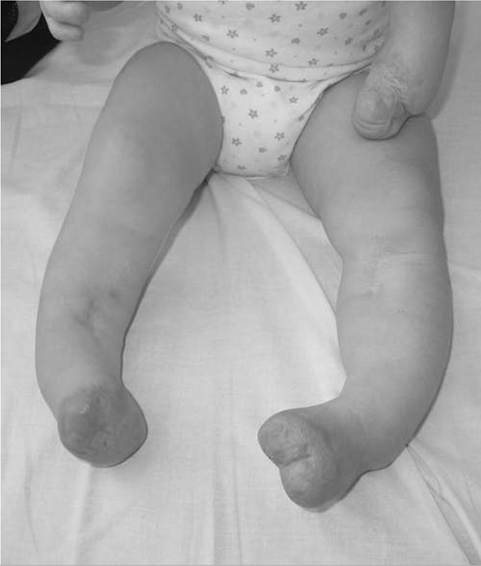
Figure 13.4 Amputations as a result of meningococcemia and subsequent purpura fulminans.
be preferred (69). Disarticulation preserves the epiphyseal growth plates and ensures longitudinal growth (70). Disarticulation also avoids the development of terminal or appositional overgrowth of new bone.
Terminal overgrowth, often referred to as spiking, at the transected end of a long bone is the most common complication following amputation in the immature child (148,149). Diaphyseal overgrowth may also occur in children with congenital anomalies, such as amniotic band syndrome, in which the epiphysis is no longer present. It occurs most frequently in the humerus, fibula, tibia, and femur, respectively. During appositional growth, the distal bone begins to form in the shape of an icicle. As the pointed segment creates insult to the soft tissue, a bursal formation often occurs to protect the distal residuum. During this time, the child may experience significant pain and be unable to tolerate wearing prosthesis. Frequent socket modifications are necessary to accommodate these anatomical changes. Treatments such as aspiration, steroid injections, and stump wrapping are usually ineffective. Unfortunately, the rate of growth may be so vigorous that the bone pierces the skin; at this stage, the treatment of choice is surgical revision. Distal resection and stump capping with the use of autografts or plastic polymers are surgical options (97). Once surgery becomes necessary, the problem is likely to recur until skeletal maturity. Each time that bone is resected, the overall length of the bone is reduced, thereby affecting its mechanical advantage and potential control of the prosthesis. Bone spurs may form at the periphery of the transected bone, and resection may be necessary. The resulting stump scarring, which interferes with weight bearing, requires prosthetic modifications. Plastic surgeons are involved with reconstruction of skin flaps or with complicated repairs of residual limbs (47,71). In Figure 13.5 an example of complicated residual scarring is shown.
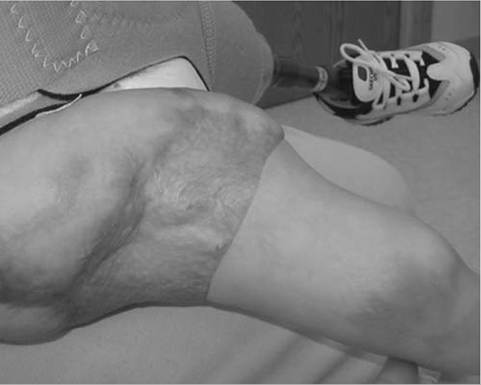
Figure 13.5 Residual limb with reconstructed skin grafts and custom liner.
More on the topic Surgical Approach: General Principles:
- GENERAL PRINCIPLES OF MANAGEMENT
- General Principles
- General Principles
- Beder S.. Environmental Principles and Policies: An Interdisciplinary Approach. UNSW Press,2006. – 312 p., 2006
- Assessment of Nutritional Status General Principles
- General Legal Principles
- General Legal Principles
- GUARDIANSHIP: GENERAL PRINCIPLES
- GENERAL PRINCIPLES INJECTION DEVICES AND ROUTE
- Nutrient Requirements General Principles
- Parenteral Nutrition General Principles