Object and Aims of Earth Science
Earth scientists study the earth, that is to say, its structure, phenomena, processes, and history. What exactly is it that earth scientists hope to achieve with their study of the earth? In his System of the Earth, James Hutton, one of the founding fathers of earth science, proposed
to examine the appearances of the earth, in order to be informed of operations which have been transacted in time past.
It is thus that, from principles of natural philosophy, we may arrive at some knowledge of order and system in the economy of this globe, and may form a rational opinion with regard to the course of nature, or to events which are in time to happen. (1785, 2)Apparently, Hutton saw the main aim of earth science as historical description (acquiring knowledge of the “course of nature”), but the statement contains a suggestion that causal explanation and prediction are aims as well. More recently, Rachel Laudan distinguished two aims:
One is historical: geology should describe the development of the earth from its earliest beginnings to its present form. The other is causal: geology should lay out the causes operating to shape the earth and to produce its distinctive objects. (1987, 2)
This twofold aim arises because some phenomena, like the comet impacts and their effects on the history of life, appear to be understandable only as results of cumulative coincidences, to be inferred and reconstructed from scant evidence, whereas other phenomena, like ocean circulation, appear to have a structure that can be understood on the basis of physical laws.
There are two related issues at stake here (see Kleinhans, Buskes, and de Regt 2005 for more discussion). First is the question of whether earth science is a historical or a nomological (law-formulating) science, or a combination of both. Second is the question of whether earth science aims for description, for explanation, or for both.
The questions are related because historical sciences are typically associated with descriptive aims, while nomological sciences are associated with explanatory aims - the traditional distinction between historical description and nomological explanation. However, this is not a necessary connection: one might alternatively claim that historical sciences can explain as well, or that neither historical nor nomological sciences explain. Incidentally, “real” sciences may feature both historical description and nomological explanation, which implies that the distinction is one between “ideal types.”The second question relates to a long-standing debate on the question of whether there exists a separate category of explanations, so-called narrative explanations, that can be provided by historical descriptions. Those who reject this idea either defend that historical sciences do not furnish explanations at all, or believe that their explanations are of the same kind as those in the physical sciences (choosing the latter option still leaves us with a choice between various rival theories of scientific explanation). In §4, we will argue that while earth science is partly a historical science, it does provide explanations because the historical descriptions provided by earth scientists are narrative explanations that integrate causal explanations, sequential reconstructions of the geological past, observations, and background theories.
While earth science has, at least at first sight, a single object (the earth), a deeper look into any textbook shows a bewildering variety of subdisciplines and approaches. Concepts and techniques are both developed within earth science and borrowed from other disciplines, such as logic, mathematics, physics, chemistry, biology, and computer modeling. A unified body of theory, topics, or techniques seems to be lacking. Earth science is divided into many sub-disciplines with different aims.[113] Sub-disciplines with historical aims ask different questions and use different explanatory strategies than sub-disciplines that focus on causal questions.
This can be clarified with the help of Figure 9.1, which visualizes the distinction between deductive, inductive, and abductive explanation.Scientists are interested in causes, effects, and laws (the three corners of the triangle). Typically, they possess knowledge about two of these and want to infer the third. The three resulting modes of inference are cases of deduction, induction, and adduction, respectively. Employing causes and laws to predict effects is a form of deduction. Combining causes and effects to identify a law or generalization is a form of induction. And inferring causes from knowledge of effects and laws is a case of abduction. For example, geomorphologists claim to be studying general physical processes by deduction and induction, while geologists reconstruct the geological past by abduction. Practitioners associate the former with causal explanation and the latter with historical description, which is believed to be of lesser value by many practitioners of the former. Accordingly, the question of whether historical narratives can be reduced to general process-oriented explanations is a hot topic in institutes which contain both sub-disciplines. (This will be discussed in more detail in §4.1; also see Kleinhans, Buskes, and de Regt 2005 for more discussion.)
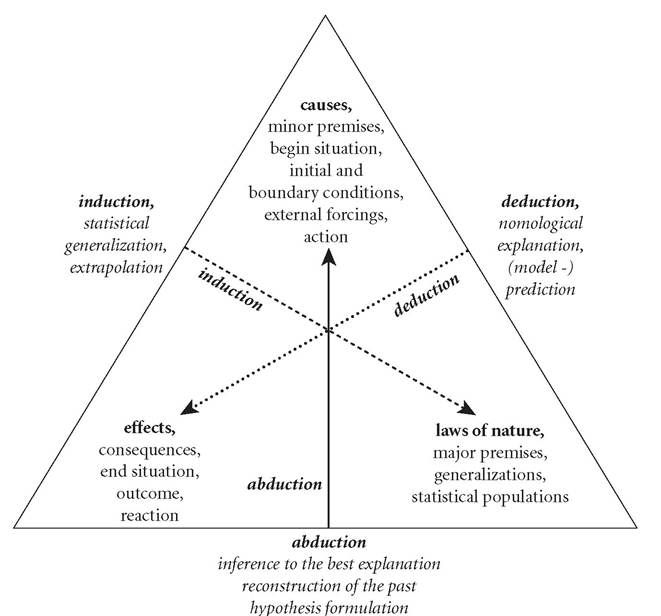
Figure 9.1 Three types of explanation based on causes, effects, and laws, two of which are necessary to arrive at the third. Problems of induction are well known. Abduction is fallible in practice due to problems of underdetermination. Also deductive explanation, particularly in the form of computer modeling, may be hampered by underdetermination problems (see §4.3)
3.