The Autonomy of Earth Science
Can earth science be reduced to lower-level sciences like chemistry and physics? According to the traditional model of reduction (Nagel 1961), this requires that the laws and theories of earth science can be deduced from the laws of chemistry and physics, and this in turn requires bridge principles that connect the terms used in the different laws.
Nagel-type reduction is “global,” in the sense that if a theory is reduced in this fashion all phenomena in the domain of the theory are reduced as well. There are two major obstacles to Nagel's model of reduction: (1) bridge principles often do not exist; and (2) higher-level laws do not conform to the traditional criteria for lawfulness, in particular the requirement that laws are universal and exceptionless generalizations (necessary for global reduction). We first discuss the nature of earth-scientific theories and laws by investigating whether they conform to Nagel's traditional conception of laws or to a recent alternative conception. Subsequently, we consider whether the existence of allegedly emergent phenomena in earth science can be used as an argument against reductionism.3.1 Theories and laws
What is the nature of the theories and laws that earth scientists actually use? First of all, it should be noted that because of the historical aim of earth science, its practitioners often use the term “theory” in cases of hypothetical historical events. The most famous example is the “impact theory” that is proposed to explain the mass extinction 65 million years ago; this “theory” states that about 65 million years ago a meteorite collided with the earth, causing a radical climate change and a mass extinction of species, among which were the dinosaurs. This hypothesis is a theory in the sense that it postulates an event or chain of events in the past (and therefore not directly observable any more) that explains observed phenomena, but it is not a theory in the sense that it specifies laws or a general model for the explanation of phenomena.
An obvious case of the latter kind is the theory of plate tectonics, often hailed as the grand unifying theory of earth science playing a role comparable to that of natural selection in biology. Plate tectonics provides a mechanistic underpinning of continental drift and was originally conceived by Alfred Wegener as a hypothesis explaining mountain building and the shape of the continents. It explains a host of other phenomena and processes, which cover almost all temporal and spatial scales relevant to earth scientists: continental drift and mountain building are long-term processes, whereas earthquakes and volcanic activity are short-term phenomena which may readily occur within a human lifetime.
But what is the precise nature and status of the generalizations that plate tectonics contains? Do they qualify as laws? The theory describes the formation and movement of plates, and postulates an underlying process in the earth's inner parts (mantle convection) that is responsible for the forces that cause the plates to form and move. There have been attempts to model the mantle dynamics of other planets, which lead to the completely different patterns of rigid-lid mantle convection on Venus and mantle superplume dominance on Mars, agreeing with interpretations of various surface observations. Thus, plate tectonics provides a general model of crust formation and movement and of mantle convection that is valid for very different situations and planets. A simple example of a generalization (a candidate law) within plate tectonics is: “Earthquakes are generated in the rigid plate as it is subducted into the mantle.” Is this a law? Not according to the traditional criteria, because it is not universal: it refers to a specific spatiotemporal situation, namely the earth as we know it today. It contains specific earth-scientific terms such as “earthquake,” “plate,” “subduction,” and “mantle.” If we specify bridge principles by translating these terms into the language of chemistry and physics, we see that they refer either to contingent distributions of matter in the earth:
• “Mantle” refers to the stony but slightly fluid layer surrounding the core of the planet, made of minerals rich in the elements iron, magnesium, silicon, and oxygen (as opposed to the core, which is the central metallic part of the planet).
• “Plate” refers to a broken piece of the rigid outermost layer of the earth (at present, the earth contains 12 plates).
Or else they refer to processes related to the specific structure of the earth:
• “Earthquake” refers to the failure of the plate when static friction is exceeded and a movement of one block with respect to the other block occurs, giving rise to oscillations or seismic waves.
• “Subduction” refers to the sinking of heavy material of the crust into fluid material, caused by the collision between two plates (which is, in turn, driven by convection in the mantle).
Although plate tectonics is applicable to other earth-like planets as well (see, e.g., van Thienen, Vlaar, and van den Berg 2004), it is clear that its “laws” differ from the laws of physics and chemistry in the sense that their validity is less universal and more tied to the specific constellation of the planet in question. For example, plate-tectonic models would not apply to the gas giants of the outer solar system. In other words, the model does not contain laws in the traditional sense of universal, exceptionless regularities; it merely describes contingent phenomena, dependent on the particular configuration of the earth's structure.
In this respect, plate tectonics fits the analysis that Beatty (1995) provides for the case of biological generalizations. Beatty specifies his “evolutionary contingency thesis” as follows: “All generalizations about the living world: (a) are just mathematical, physical, or chemical generalizations (or deductive consequences of mathematical, physical, or chemical generalizations plus initial conditions), or (b) are distinctively biological, in which case they describe contingent outcomes of evolution” (1995, 46-7). We claim that Beatty's evolutionary contingency thesis applies equally well to earth-scientific generalizations such as plate tectonics. This entails that plate tectonics does not contain autonomous, irreducible laws. Moreover, there is no reason not to assume that the plate-tectonic model and its laws can be reduced to lower-level physical or chemical theories.
Earth-scientific generalizations, such as the cited example regarding earthquakes, describe contingent distributions and processes which can be reduced “locally” because they can be exhaustively translated in physical and/or chemical terms.But perhaps there are autonomous, irreducible earth-scientific laws to be found elsewhere? A candidate might be the set of principles used in the ordering of rock and sediment layers in historical explanations. The most important of these are the principles of superposition and of cross-cutting (Kitts 1966). Superposition means that a layer on top of another layer must have been formed after the lower layer was formed. The lower layer is a necessary temporal antecedent but not a cause of the formation of the upper layer. For instance, it is very unlikely that a sediment layer was deposited below another layer, because it would involve breaking up, eroding, and redepositing of the upper layer, which obviously destroys it. Likewise, a layer cross-cutting other layers means that the cross-cutting layer was formed after the other layers. However, examples can be given in which these principles lead us astray. A set of layers may have been overturned in severe folding during mountain building; volcanic activity or fluvial channels may form a cross-cutting layer at the same time of the deposition of the planar sediment; and so on. Earth scientists are aware of these pitfalls and deliberately seek for evidence for such exceptions when applying the general principles. But the examples show that these geological principles cannot be regarded as laws in the traditional Nagelian sense: they have many exceptions. Consequently, these principles cannot be reduced globally, that is, according to the Nagelian model of reduction. However, this is an argument against Nagel's model rather than an argument against the reducibility of earth-scientific principles. As in the case of plate tectonics, there is a more liberal sense of “local” reduction that applies to generalizations and principles that are less universal than physical laws.
We conclude that earth science does not have irreducible laws, and that the theories of earth science are typically hypotheses about unobservable (past) events, or generalized - but not universally valid - descriptions of contingent processes. In contrast to physics and chemistry but analogously to biology, an important part of theories of earth science consists in descriptions of contingent states of nature (Beatty 1995). The traditional account of reduction (Nagel's model) fails to apply because earth-scientific generalizations do not conform to the traditional criteria for lawfulness. This implies that reductionism is still a viable option (though not in the strict Nagelian sense), because Beatty's account does not entail that higher- level laws are autonomous and is therefore compatible with reductionism.
Incidentally, not only do earth-scientific generalizations resemble biological ones, but there is a close interaction between earth science and biology. Indeed, many earth-scientific phenomena would not exist without interaction with life. Figure 9.2a provides a random selection of examples of earth-scientific phenomena from very small to very large length and time scales. This typical reference to the length and time scales of such phenomena is discussed later. Figure 9.2b gives examples of earth-scientific phenomena which would not exist without biological elements. For example, the composition of the atmosphere of the earth compared to that of Venus and Mars has much more oxygen and much less carbon dioxide. This so-called oxygen revolution was largely caused by photosynthesizing organisms (mostly algae) about 2 billion years ago. The presence of oxygen, in turn, led to increased oxidation of minerals, weathering of rocks, and chemical changes in the oceans. A second example is the variety of effects of life on rivers. Plant roots may stabilize the banks of rivers, which may actually cause rivers to change from a wide, shallow “braided” planform with many mid-channel bars to a narrow, deep “meandering” planform with only one or a few channels.
Animals burrowing in or treading on the banks may initiate diversions of the flow and completely new courses of the river. At a larger scale, vegetation in the upstream catchment of a river may strongly damp the surface runoff from rain storms, leading to a much more regular water discharge regime than in unvegetated catchments, with all sorts of consequences for the morphology and geology.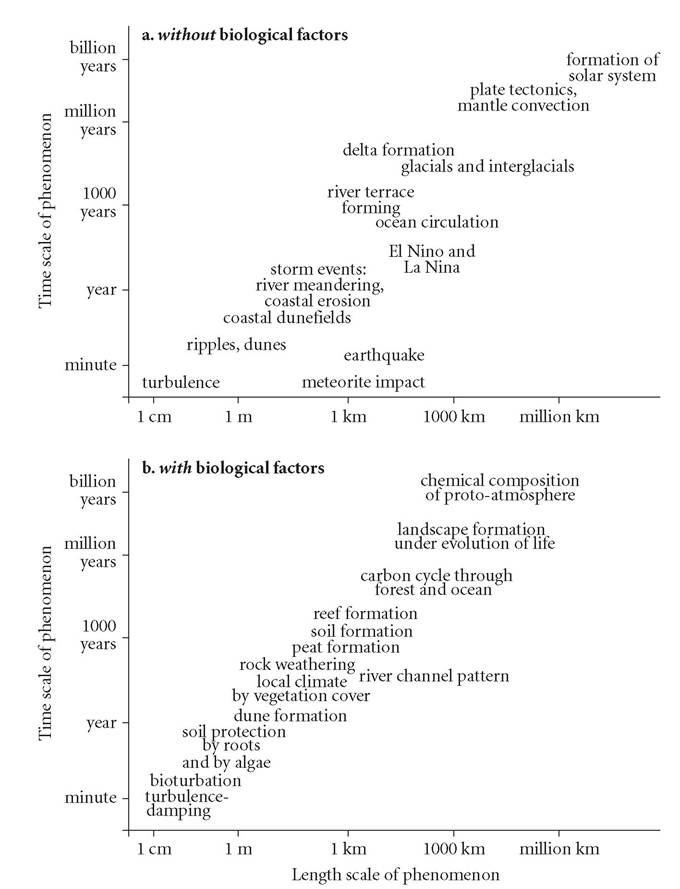
Figure 9.2 The correlation of time and length scale of earth-scientific phenomena, split out between phenomena where biological factors are not important (a) and where these are important (b). The correlation is caused by the limited range of energy available to do work at the earth’s surface. Two major exceptions are earthquakes and meteorite impacts; the former because it uses energy from within the planet and the second because it brings extraterrestrial kinetic energy
3.2 The emergent nature of the earth-scientific phenomena
In the previous section, it was argued that reductionism fails in the strong Nagelian sense, but a weaker (local) sense of reduction may still be applicable to earth science. Anti-reductionists might reply by invoking the alleged “emergence” of earth-scientific phenomena as an argument against their reducibility. What precisely is emergence? Humphreys (1997, 341-2) lists the following possible criteria for emergence: emergent properties are novel; are qualitatively different from the properties from which they emerge; could not be possessed at a lower level; have different laws apply to them; result from an essential interaction between constituent properties; and are holistic in the sense of being properties of the entire system (see Kleinhans, Buskes, and de Regt 2005 for more discussion). There is no agreement among philosophers on the question of whether or not emergence is compatible with reduction. Below we investigate whether emergence in earth science provides an argument against reducibility.
A first glance at earth science suggests that it is replete with emergence in one of the senses mentioned above: current ripples, rivers, deltas, volcanoes, mantle plumes, and continents consist of matter that is organized in such a way that novel, qualitatively different properties arise that do not directly follow from physico-chemical laws but seem to comply with higher- level laws. The literature on emergent phenomena with scale-independent characteristics is extensive and focuses mainly on self-organization, selfsimilarity, and chaos (for examples and details, see Smith 1998, Ball 1999). For earth science, we identify two classes of phenomena.
The first class consists of self-similar, chaotic phenomena. These are characterized by a repeated basic pattern lacking a dominant length scale; the basic pattern occurs at a large range of length or time scales in the phenomenon, which is then called self-similar. The self-similarity at many scales is novel and qualitatively different from the microscopic properties of the constituent properties. Commonly the largest scales occur much less frequently than the smaller scales, which is referred to as 1/f (f = frequency) scaling (Bak, Tang, and Weisenfeld 1987). There are many examples of this class in earth science. Clouds and river drainage networks are well known for self-similarity (Ball 1999), as are river discharge records (Mandelbrot and Wallis 1969), sizes of avalanches on sand piles and sizes of forest fires (Bak, Tang, and Weisenfeld 1987), elevation of landscapes and coastlines (Burrough 1981), and iron ore deposits, fault lengths, and fault surfaces (Lam and De Cola 1993). In some cases, self-similarity has been explained on the basis of lower-level physical laws (e.g., sand avalanches, crystal growth, and rock fault lengths), but in many other cases this has not (yet?) been accomplished.
The second class consists of emergent phenomena with a dominant length or time scale. Such a macroscopic regularity emerges from microscopic physical or chemical processes. The microscopic processes may initiate at random or fractal length or time scales, but only one or two frequencies become dominant in the macroscopic pattern. The dominant frequency, or period or length, is in many cases enforced by a boundary condition that is independent of the microscopic processes. Such phenomena are common in earth science. For example, a turbulent water flow in a river provides a chaotic forcing to the sand bed below the current. Out of this chaotic forcing emerges a pattern: a train of large underwater dunes. Despite the enormous variety in current velocity and sand characteristics these dunes (when in equilibrium with the flow) have roughly constant length/height ratios and have a height that is about 20 percent of the water depth. This is an empirical fact for water depths ranging from 0.1 to 100 m and grain sizes from 0.4 to 100 mm. So, in practice, dune height and length are predicted from empirical relations (derived from data by induction) with the water depth as the most important independent variable. Yet, there have been a few promising attempts to predict sizes and behavior of real-world dunes from physics-based models for flow turbulence and sediment transport, so this phenomenon is not emergent in the sense that it cannot be predicted from a lower level.
It should be clear by now that many earth-scientific phenomena possess emergent properties. The question is now whether these properties are also irreducible. At present, this question is hotly debated within earth science. Some earth scientists try to reproduce emergent patterns (e.g., a train of dunes or a braided river pattern) with simple models based only on macroscopic rules. By contrast, others attempt to reproduce these patterns with highly sophisticated mathematico-physical models. The former claim that the phenomena are irreducible, while the latter claim that given enough computing power and detailing of initial conditions the phenomena can be explained (in a mathematical model) on the basis of physical laws only. Accepting emergence as a given fact, debates about reductionism continue among philosophers as well as among earth scientists themselves. Meanwhile, philosophers have generally rejected the traditional Nagelian model of reduction, and rightly so, since in most higher-level sciences, the model is of little use. But this does not imply that in these sciences reduction is completely absent. Accordingly, we need an alternative account of reduction. Wimsatt (1997, S373) suggests that “a reductive explanation of a behaviour or a property of a system is one showing it to be mechanistically explicable in terms of the properties of and interactions among the parts of the system.” If one adopts this view of reduction, it appears that many emergent phenomena of earth science may be explained reductively in the future.
4.