PERRIN'S DETERMINATION OF AVOGADRO'S NUMBER AND HIS ARGUMENT FOR MOLECULAR REALITY
Perrin's strategy is first to derive the law of atmospheres for gases.[147] He considers a volume of gas contained in a thin cylinder of unit crosssectional area and very small elevation h.
The density of molecules making up the gas will be greatest at the bottom of the cylinder and decreases exponentially with increasing height. The pressure p at the bottom of the cylinder is more than the pressure p’ at the top (just as air pressure at the bottom of a mountain is greater than at the top). The very small difference in pressure p - p’ balances the downward force of gravity gmc on the mass mc of gas in the cylinder. So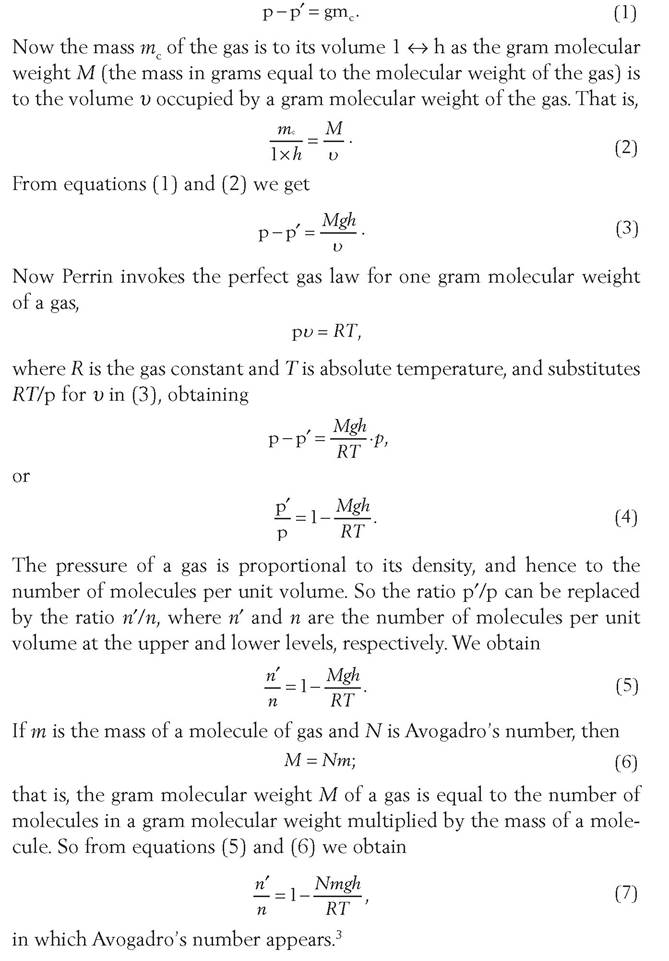
3. A mathematically more rigorous derivation using differential calculus yields nV n = e'Nmgh/RT where e is the natural log base. For tiny particles and small h the exponent becomes much smaller than 1, and the exponential factor can be expanded in a series whose first two terms are given on the right side of eq. (7). In his 1909 article, by contrast to his book, Perrin employs the more rigorous derivation.
Perrin proposes to use equation (7) to determine a value for Avogadro's number experimentally. The problem is that the molecular quantities n, n', and m are not directly measurable. So he makes a crucial assumption, namely, that visible particles making up a dilute emulsion will behave like molecules in a gas with respect to their vertical distribution. In 1827 the English botanist Robert Brown discovered that small, microscopic particles suspended in a liquid do not sink but exhibit rapid, seemingly haphazard motions—so-called Brownian motion. Following Leon Gouy, Perrin assumed that the motions of the visible particles are caused by collisions with the molecules making up the liquid in which the particles are suspended.
He also made the assumption that just as a set of invisible molecules that make up a gas obey that gas laws, so do the visible particles exhibiting Brownian motion in a liquid. Among other things, he assumed that the law (eq. [7]) derived for molecules in a cylinder of gas could be extended to Brownian particles distributed in a dilute emulsion.This means that just as the molecules making up a gas are all identical in mass and volume, so will the Brownian particles have to be. However, in the latter case, the gravitational force acting on a particle will not be its weight mg, but its “effective weight,” that is, the excess of its weight over the upward thrust caused by the liquid in which it is suspended. This is

where D is the density of the material making up the particles and d is the density of the liquid. Replacing the weight mg in equation (7) by the expression in equation (8), we obtain

In this equation, n' represents the number of Brownian particles per unit volume at the upper level and n the same at the lower level; m is the mass of a Brownian particle; N is Avogadro's number.[148] Equation (9) contains quantities for the suspended particles (not molecules) which Perrin attempted to determine experimentally.
This required the careful preparation of emulsions containing particles equal in size and determining the density of the material making up the particles, the mass of the particles, and (with microscopes) the number of suspended particles per unit volume at various heights—all difficult procedures. Experiments were performed with different emulsions, particles of different size and mass, different liquids, and different temperatures. With various values obtained experimentally for the quantities n, n', m, h, and T in equation (9), Perrin could use equation (9) to determine whether Avogadro's number is really a constant, and if so what its value is.
He writes, “In spite of all these variations, the value found for Avogadro's number N remains approximately constant, varying irregularly between 65 1022 and 72 1022 [i.e., 6.5 1023 and 7.2 1023]” (Perrin 1990, p. 105).Immediately after this sentence Perrin draws a broader conclusion: “Even if no other information were available as to the molecular magnitudes, such constant results would justify the very suggestive hypotheses that have guided us, and we should certainly accept as extremely probable the values obtained with such concordance for the masses of the molecules and atoms,” (Perrin 1990, p. 105; italics his).[149]
Perrin's “suggestive hypotheses” include, of course, the assumption that molecules exist. He continues by noting that the values for Avogadro's number obtained through his experiments agree with the number (6.2 1023) given by kinetic theory from considerations of viscosity of gases. And he concludes, “Such decisive agreement can leave no doubt as to the origin of the Brownian movement.... The objective reality of the molecules therefore becomes hard to deny” (Perrin 1990, p. 105; italics his).
Perrin's conclusions concerning the value of Avogadro's number and the reality of molecules are drawn form his experiments on Brownian particles suspended in a column of fluid. After drawing them Perrin goes on to consider the theory of Brownian motion developed by Einstein ([1905] 1956), which generates an equation relating Avogadro's number to the mean square of the displacement of the Brownian particles in a given direction during a given time. Perrin conducted experiments on such displacement, and using Einstein's equation he generated a value for N close to that achieved by his law-of-atmosphere experiments.[150]
At the end of his book Perrin notes that the value(s) he determined for Avogadro's number are approximately the same as ones obtained by a variety of different methods, including ones from experiments on radioactivity, blackbody radiation, and the motions of ions in liquids. And he writes, “Our wonder is aroused at the very remarkable agreement found between values derived from the consideration of such widely different phenomena. Seeing that not only is the same magnitude obtained by each method when the conditions under which it is applied are varied as much as possible, but that the numbers thus established also agree among themselves, without discrepancy, for all the methods employed, the real existence of the molecule is given a probability bordering on certainty” (Perrin 1990, pp. 215-216; see also Perrin 1984, pp. 598-599).
3.