Scientific Realism
As I conceive it, selective scientific realism maintains that some non-observational statements belonging to scientific theories are true or false in virtue of the existence of external things and further that we are at times in a position to provide good reasons to believe in the truth of these statements even if they speak of things whose properties are accessible only by means of instruments.
Thus defined, scientific realism involves two main claims. At the ontological level, the scientific realist is committed to the existence of external things, i.e. things whose existence is independent of our language and internal states of mind such as thoughts, beliefs, representations, wishes and so on. At the epistemological level, the scientific realist contends we have good reasons to believe in the reality of some unobservable objects which actually possess some of the properties attributed to them by our theories. The challenge for the realist is to formulate criteria for selecting the objects posited by our theories which deserve to be called “real”.I broadly construe theories as having two major components: models and statements. Scientific models are artifacts. They are possible representors of concrete objects. Typically, models are mathematical structures composed of a set of elements which make up the domain of the structure and the relations which stand between the elements of the domain. Given some conventions, a two-dimensional curve functions as a representation of a specific object. Its elements are points which are meant to correspond to couples of properties specified by the coordinates, such as the number of deer in some area at some time, instantiated by the target, like the deer population in a defined area around Princeton. Here, the relations between the points of the curve are spatial and its shape provides some information on the variation of the deer population in time.
In order to construct the graph, we have to measure some selected properties of the object clipped out of the targeted thing. Generally, we manage to construct data models by means of measuring operations with the help of instruments. These instruments deliver data, that is, observable items such as digits on a screen, coincidences of a needle with black lines associated with numbers on a screen, colored surfaces (e.g. microscope images) etc. These data must be interpreted such that they might provide information on the properties possessed by the targeted thing. In the process of measurement, we can distinguish four steps, at least: the identification of the target, the observational interaction with the target, the production of a data model and finally the information the data model delivers about the target. Let us briefly discuss these four steps through the example of the determination of Avogadro's number by Jean Perrin.
In Perrin's experiments, the targeted things are emulsions, which are mixtures of liquids and small grains in Brownian motion. The realist at this stage presupposes that the grains and the liquid exist. The grains are identified by—indirect—observation by means of an instrument: the microscope. Once the target has been identified, we collect the data, which are the microscope images at different heights of the emulsion. Here, the interaction obviously is optical. Then, and this is the third step, we must select the properties which will be measured. We aim to give an answer the following question: is the liquid continuous or is it composed of discrete particles, namely molecules? (Molecules are considered to be indivisible, i.e. atoms in this context). More precisely, we want to measure the concentration of those grains in function of their height in the recipient. The distribution of the grains and their height are properties which are both observable by us (through a microscope) and measurable. We are then in a position to produce a graph (as in the case of the deer population) which represents the variation of the concentration of the grains in function of height.
This graph is an exponential function which expresses in a precise way how the concentration of the grains decreases with height (the figure below (Perrin 1913, 144) shows the decrease in concentration of the grains with height). At this stage, we have a data model, namely a set of measurement results organized by an exponential function.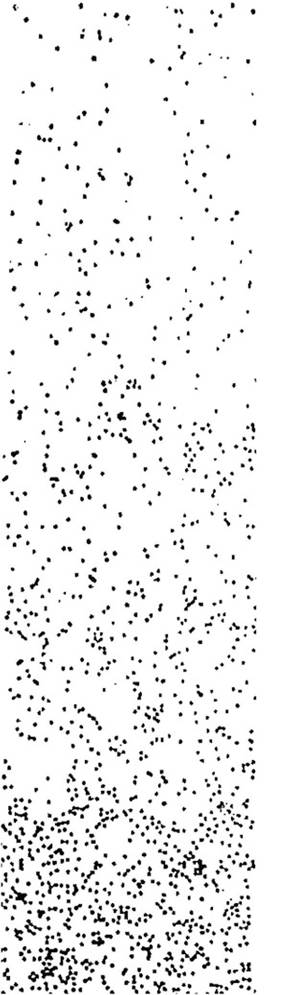
What does this data model teach us about the emulsion, and crucially about the nature of the liquid? Making a long story short (see Psillos' papers (2011) and (2014) for a detailed reconstruction of Perrin's reasoning), the data model permits to determine the value of Avogadro's number, which is a finite number. Consequently, the liquid is composed of molecules which can be counted. Matter is not continuous and the atomic hypothesis has been vindicated.
But what is so special about Perrin's experiments and arguments? What is it that makes them so convincing? Does Perrin rely on the inference to the best explanation (IBE) which is the favorite lever used by realists to boost our confidence in the existence of unobservable concrete objects? Yes, but not only, as I'm going to argue. The existence of molecules certainly explains, together with additional other hypotheses, why the data are organized by an exponential function. But what is more, the explanation is causal. The distribution (and the motion) of the grains is caused by the collisions with the molecules of the liquid. The presence of such a causal link is certified by showing that there is no other reasonable explanation of the distribution of the grains, because the alternative explanations have a very low degree of probability. Why? Because the value of N obtained by Perrin concords with the values obtained by different, independent, methods of measuring Avogadro's number. Perrin speaks of the “miracle of concordance”: it is very unlikely that these methods would give roughly the same result if matter were continuous.
However, objections have been addressed by antirealists and realists alike against the force of IBE (of which the “no-miracle argument” NMA is a particular instance) even in its stronger—causal—version.[42] Some of these objections are a direct consequence of a staunch empiricist position, such as van Fraassen's, which eliminates from the domain of knowledge any statement about entities unobservable by our unaided senses. Perrin was quite aware of this kind of objection:
“Sensation is the only reality provided all possible sensations are adjoined to the actual sensations” (1903, p. X)
Since the word “sensation” habitually refers to internal mental items, I will rephrase Perrin's advice thus: we are entitled to believe in the existence of objects only if they are in principle accessible to observation or perception. Such constraint is in line with rather strict empiricist requirements. It implies that we can rationally believe in the existence of an entity only if it possesses at least one perceptible property: it is not enough that the existence of this entity is an indispensable ingredient of the only possible explanation of some data. Even if we have somehow managed to prove that a proposed explanation is the only acceptable one (and a fortiori the best available one...), this is not sufficient to ground our belief in the existence of unobservable entities and true statements about them. Those entities must possess properties which are the same as—or at least similar to—the properties possessed by ordinarily observed things. Otherwise, it would be impossible to make, as Perrin contends, molecular agitation visible. Visible, but not actually seen through the microscopes available at Perrin's time. As he says, the behaviour of grains observed through the microscope makes molecular agitation visible in the same way as a floating cork follows the motion of sea waves better than a ship (1909, 353).
To avoid confusion I introduce a distinction between two categories of unobserved properties.
The first category contains properties which are identical or similar to the perceptible properties of everyday things, but which cannot be observed because of the unavailability of appropriate instruments or other obstacles. Let's call them “observable in principle” (OP). Indeed, molecules are supposed to have properties such as size, velocity, acceleration etc. which were in principle perceptible at Perrin's time and also possessed by observable things such as billiard balls. Such properties are observationally accessible and measurable nowadays by means of more powerful scientific apparatuses. The second class of properties, which I will call “purely theoretical” (PT)[43] is composed of properties which are beyond the reach of any possible perception, even with the aid of the most powerful instruments, such as the properties of strangeness and charm in elementary particle physics. They might be measurable, but they are too remote from our ordinary perceptual experience.Such version of scientific realism seems quite restrictive. The existence of unobservable objects can be defended only if they possess some (though not necessarily only) properties which are of the same type as the properties of ordinary observable things, namely the OP properties. Scientific realism is defensible with respect to objects which are unobservable only if their unobservable character results from the fact that the reach of our direct perception is limited and that we don't have today apparatuses sufficiently powerful to bring these properties within perceptual access. I'm aware that such a position casts a doubt upon the existence of properties such as strangeness, charm, baryonic number, internal spin etc. since those properties have no analogue in ordinary experience. Yet, the scientific realist is still allowed to rationally believe in the existence of such objects to the extent that they possess some OP properties. Thus, the existence of quarks with a specific mass can be defended since (as I will argue) mass is an OP property.
But one may remain sceptical about their having some exotic properties such as charm, strangeness etc. which are PT properties. If this is correct, the version of scientific realism I advocate is not that restrictive after all. In physics, which is the discipline that postulates explanatory objects endowed with properties most distant from ordinary experience, the vast majority of posited objects do have one or more OP properties.To conclude this section, let's summarize the philosophical lessons drawn from Perrin's experiments and reasonings by stating four conditions or requirements that a solid argumentation in favour of the existence of unobservable objects must satisfy:
1. Requirement of observability in principle: objects that are not directly perceptible must possess some OP properties (at least one...) which are identical or similar to the immediately observable properties of commonly perceived things (such as the velocity of a billiard ball) and as a consequence are in principle amenable to observation with the help of suitable scientific instruments.
2. Requirement of measurability: the OP properties must be quantitatively measurable by means of adequate instruments (such as the microscope).[44]
3. Requirement of causality: the OP properties of these objects are causally responsible, and thus provide an explanation, of the observed data.[45]
4. Requirement of concordance: distinct and independent experimental methods of measuring these properties must deliver results that are concordant (within acceptable approximation).
Taken together, these four requirements are a necessary and sufficient condition for the justification of the belief that a scientific object possesses a given property. They are jointly satisfied by Perrin's argumentation in favor of the existence of molecules and the truth of the atomic hypothesis. One might first object that some properties taken to be observable in principle, such as having a mass, cannot be considered to be so. True, the history of science teaches us that scientists came to agree on a precise definition of mass with much difficulty. However, once mass has been defined (and also before that.), it is easy to empirically ascertain that it is more difficult to set in motion a ball made of lead than a ball made of wood. Such difference is manifest because a ball made of lead has a larger inertial mass than a ball made of wood (with equal volumes). Such immediate observations allow to defend that the property of inertial mass is a OP property. Moreover, we observe that a ball exerts a stronger pressure on the hand if it is made of lead rather than wood. This shows that they have different gravitational masses. From these simple experiences, we can immediately conclude that there is a relation between the inertial and the gravitational mass without getting into an elaborate theorizing about gravitation.
The four requirements mentioned above provide grounds for a defensible version of selective scientific realism. How can we go beyond Perrin's experiments and establish the generality of these four requirements? The answer is straightforward: on the basis of our ordinary perceptual experience. Our next task is to show that these four requirements form the backbone of any argumentation in favor of the reality of commonly observable entities, but which have not been observed yet.
5
More on the topic Scientific Realism:
- Scientific Realism
- Scientific Realism, Theories and Models
- Introduction
- Robustness and Hacking’s Scientific Realism
- Do Electrons Exist? that is not the Question
- Agazzi E. (ed.). Varieties of Scientific Realism: Objectivity and Truth in Science. Springer,2017. — 411 pp., 2017
- Objections to the Nonrealist—and Replies
- Abstract
- Realism of Properties, Realism of Entities and Their Role in Microphysics