Weak Versus Strong Emergence
Let us now add some empirical knowledge to the previous section’s rather abstract discussion.
The first fact I want to draw upon is that our world can be described to good precision by a metric manifold in which matter occupies space.
That the manifold is metric means we can measure distances and, with that, extensions.Any experiment has an uncertainty on the measurement of distances, which I will refer to as the resolution of the experiment. For non-quantum (“classical”) matter (say, a brick) this resolution can be identified with the actual extension of the matter. For matter with quantum properties (say, electrons) we can instead use the (center of mass) energy of the interaction that facilitates the measurement and define the resolution from the inverse of this energy.
As previously acknowledged, the description by ways of a manifold or quantum mechanics might break down on distances much shorter or much longer than we have
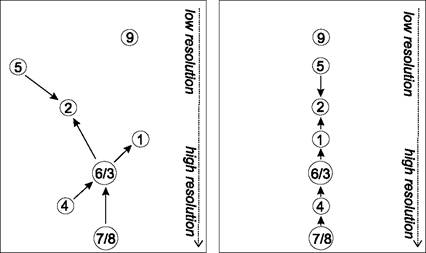
Fig. 2 Left: Theories can be assigned a resolution at which they are valid. A theory’s range of validity is indicated by the size of the node and arrows extending from it. Right: Since two theories at the same resolution must agree on all predictions, the graph of theories becomes one-dimensional
tested. But this will not concern us in the following because for the present purposes we are interested only in what happens in the range we have tested already.
We can then assign a resolution to every measurement and, since every physical theory allows the computation of measurement outcomes, we can assign a resolution to theories through the measurements which they (correctly) describe. This allows us to order the graph of theories as illustrated in Fig. 2, left.
The second fact I want to draw upon is that nature does not allow mathematical inconsistencies.
I consider this empirical knowledge because we have never witnessed a case in which we observed an inconsistency; indeed I am not even sure what this would mean. The consequence is that if we have two theories that are valid at the same resolution, they must be physically identical. This means that at any given resolution there can be only one (correct) physical theory, up to equivalence. This is illustrated in Fig. 2, rightOf course this statement greatly oversimplifies the real situation because we often have theories at the same resolution but for different systems. Say, a theory for bricks and a theory for water both at a resolution of a micrometer. To picture this, you can imagine qualifiers for different systems as additional dimensions on the graph, which has the consequence that it is much rarer that two theories must be equivalent due to consistency. However, it is of little use trying to picture all these additional dimensions.
In the previous Sect. 1 defined weakly emergent by the possibility of a mathematical derivation. As the dedicated reader will have anticipated, this is complemented by a notion of strong emergence which we can now define:
A physical theory is strongly emergent if it is fundamental, but there exists at least one other fundamental theory at higher resolution.
An example for this is theory nine in Fig. 2. The rationale for this nomenclature is that loosely speaking going to lower resolution means going to larger extensions and hence larger objects. The existence of a strongly emergent physical theory then would mean that a large object could follow laws of nature which cannot be derived from any theory at higher resolution. Such laws, therefore, would be equally fundamental as the fundamental laws at high resolution that physicists are so proud of.
If a strongly emergent theory existed, it would imply that “more is different” as Anderson put it [5]. Your behavior, then, would not just be a consequence of the motion of the elementary particles that you are made of. It would mean that believing in free will would be compatible with particle physics. It would mean that reductionism is wrong.
(If you are bothered by the downward arrow in Fig.2, hang on, I’ll get to this in Sect.5.)
3