What is Fundamental?
This essay contest posed the question “What is fundamental?” but I don’t find it insightful to ask for the meaning of a word. One could just answer such a question by writing down a definition, and where’s the fun in that? A somewhat more interesting approach to answer the question would be to instead explain how the word is commonly used.
But answering such a question requires a mix of history, linguistics, and sociology, none of which I know much about, and none of which I suspect this contests’ audience wants to know much about.Let me therefore move on by just defining what I mean by “fundamental” and then using this definition to instead answer a different question, one we argue about much better, namely whether it is rational to believe that you have free will. I promise I will get to this before the essay is over, but first I must clarify how I refer to physical theories:
A physical theory is a set of mathematically consistent axioms combined with an identification of some of the theory’s mathematical structures with observables.
If two physical theories give the same predictions for all possible observables they are physically equivalent.
That having been said, the definition of “fundamental” that I will use here is:
A physical theory A is more fundamental than B if B can be derived from A, but not the other way round. In this case, the theory B is weakly emergent from A. A physical theory is fundamental (without qualifier) if it is to best current knowledge not emergent from any other theory.
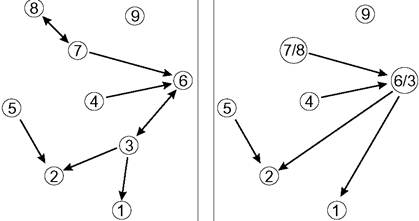
This definition I think captures how the word is used in the foundations of physics today, though I will admit to not having polled my colleagues, so I may be mistaken. In Fig. 1, I have depicted an example of a directed graph of theories with oriented links between them indicating possible derivations.
Some comments on these definitions.
First, I am aware that other people have defined terms differently. For example what I call “weakly emergent” is sometimes referred to as “reducible,” and the word “emergent” doesn’t seem to have any agreed upon definition (see e.g. [1, 2]). But
Fig. 1 Left: Example of a graph of theories. Arrows indicate a known mathematical derivation. Right: Physically equivalent theories can be collected to one node
please let us not quibble about the use of words. I have chosen these definitions because they will allow me to make my case sharply.
Second, note that according to the above what is fundamental depends on current knowledge. A theory considered fundamental today might be derived from another theory tomorrow, and would then cease to be fundamental. A theory that is emergent today, however, will remain emergent (Leaving aside that a derivation might have been in error). The standard model is, for all we currently know, fundamental. A good example for a weakly emergent theory is Fermi’s theory of beta-decay, which can be derived from the standard model of particle physics but not the other way round.
Third, not in every pair of theories one must be derivable from the other. Some theories might not have any known connection to each other.
Fourth, several theories can be equally fundamental if they can mutually be derived from each other, in which case they are mathematically equivalent. A good example for this are duality relations, like those between the Thirring model and the sine- Gordon model [3]. But there is no particular reason why only two theories should be derivable from each other. In principle there could be infinitely many theories that start from different axioms and yet can be derived from one other.
Mathematically equivalent theories are also physically equivalent, though the opposite might not necessarily be the case: Two theories might give rise to all the same prediction without there being any (known) way to derive one from the other (which is the current situation for the AdS/CFT duality [4]).
Since we care only about the physics, we can collect physically equivalent theories to one node in the graph of theories (Fig. 1, right). Note that this will remove loops only if they have an orientable component (plus possible further equivalences), so the graph doesn’t have to be simple (though the depicted example is).
2
More on the topic What is Fundamental?:
- Cicero on Gyges’ ring and how Plutarch deals with the Puzzles
- North Korea's Cultural Revolution in 1972
- ADDENDUM
- Reviewers
- CASE 29: Marriage, Dowry, and Public Policy
- The Idiomorphic Constitution of Cyprus
- REVIEW OF FORENSIC ASSESSMENT INSTRUMENTS
- CONCEPTS OF LANGUAGE, PEACE, AND CONFLICT RESOLUTION