Avian skeleton
The skeleton of birds has been especially adapted for flight (Fig. 6.31), resulting in many significant differences compared to mammals. The neck consists of a large number (12-17) of cervical vertebrae, with the joint between the vertebrae being synovial.
The increased length of the neck also allows it to absorb shock that can be associated with landing and thus protect the brain.The atlas articulates with a single occipital condyle, thus allowing great mobility. The extensive mobility in the atlanto-occipital joint and the neck allows the beak to be used in many motions. All but the atlas bear ribs.In some species adapted to sudden short burst of flight (Galliforms, chicken-like birds such as chickens, turkeys, pheasants, and quail), the last cervical vertebra and first several thoracic vertebrae fuse to form the notarium. This structure, along with the synsa- crum, provides rigidity to the spine in order to help with flight while minimizing musculature and thus reducing body weight. Caudad to the notarium, a species-specific number of free thoracic vertebrae are present. The synsacrum is formed from the fusion of the last few thoracic, all of the lumbar, all of the sacral, and the first few caudal vertebrae. The synsacrum is also fused to the ilium. The chicken has six free caudal vertebrae, allowing flexibility of the tail. The caudal end of the tail, called the pygostyle, consists of four to six fused caudal vertebrae and provides the site of attachment of the flight feathers of the tail.
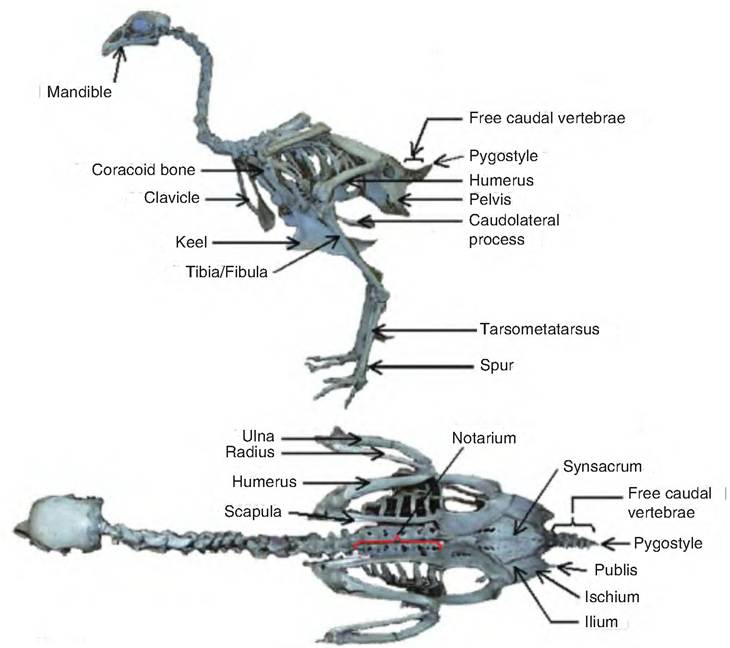
Fig. 6.31. Chicken skeleton.
The pectoral girdle consists of the scapula, coracoid bone, and clavicle. Fusion of the right and left clavicles forms the furcula (wishbone). The latter two bones are either missing or rudimentary in most mammals.
The coracoid braces the shoulder joint against the sternum to prevent collapse of the thoracic cavity (and hence lungs) during the powerful downstroke of the wing during flight. The sternum has ligamentous attachments directly to the ribs to further brace the shoulder from the sternum. Thus, the shoulder is not pulled toward the sternum as the pectoralis muscles pull the wings downward during flight.The ribs have been modified with the inclusion of the uncinate processes, meaning hooked or barbed. These processes extend from the vertical portion of each rib and overlap with the rib behind it, thus providing more strength. This morphology assists with both respiration and maintaining rib cage strength during flight.
The ulna is larger than the radius and the two are separated by a relatively large space; together they form a unit with a slight mediolateral convex configuration. The increased distance between these two bones adds strength that resists bending of these two bones during flight. The distal row of carpal bones fuses with the metacarpus, forming the Carpometacar- pus. The Carpometacarpus articulates with the radial and ulnar carpal bones at the wrist. Finally, there are three digits, including the alular digit with two phalanges, the major digit with two phalanges, and a minor digit with one phalanx.
The avian pelvic girdle consists of a partly fused ilium, ischium, and pubis. The ilium is joined to the synsacral portion of the vertebral column. The pelvic girdle has no pubis symphysis (in birds other than the ostrich), which is presumably an adaptation for passing large, fragile eggs.
Two sites articulate the femur and the pelvis. Similar to mammals, the head of the femur articulates with the acetabulum. The tarsal bones are fused with other bones, giving the Hbiotarsus and Iarsometatarsus. Four digits are present in most species, and an accessory structure, the metatarsal spur, develops in males.
Laying hens of all species possess a special type of bone, called medullary bone.
This bone serves as a reservoir to store calcium necessary for eggshell production. Produced only when the birds are producing eggs, medullary bone grows from the inner endosteal surface of the shaft of certain bones, forming interlacing spicules that fill the marrow space. Medullary bone is found in bones possessing a good blood supply, and is formed under the influence of estrogen. Large amounts of medullary bone are found in the femur and tibia, with a smaller amount present in the skull and cervical vertebrae. The humerus, metatarsus, and toes lack medullary bone.Eggshell formation occurs largely at night, a time when laying hens are not eating and therefore are not absorbing dietary calcium. During the time of eggshell deposition, osteoclasts surround the trabeculae of medullary bone and actively reabsorb this bone in order to deliver calcium to the blood necessary for eggshell formation. Approximately 20 hours are required to form one eggshell. During the last 15 hours of eggshell formation, the shell gland of the hen secretes calcium at the rate of 100-150 mg∕h, a rate that would deplete blood calcium in 8-18 minutes. Thus, medullary bone provides an essential source of blood calcium necessary for shell deposition without causing the death of the hen.