BIBLIOGRAPHY FOR FUNGAL INFECTIONS
See “General References for Infectious Diseases”
Dermatophytosis
Booth, B.H. (1952) Mouse ringworm. Archives of Dermatology and Syphilology 66:65-69.
Cetin, E.T., Tahsinoglu, M., & Volkan, S.
(1965) Epizootic of Trichophyton mentagrophytes (interdigitale) in white mice. Path- ologia et Microbiologia 28:839-846.Dolan, M.M., Kligman, A.M., Koylinski, P.G., & Motsavage, M.A. (1958) Ringworm epizootics in laboratory mice and rats: experimental and accidental transmission of infection. Journal of Investigative Dermatology 30:23-25.
Mackenzie, D.W.R. (1961) Trichophyton mentagrophytes in mice: infections of humans and incidence amongst laboratory animals. Sabouradia 1:178-182.
Papini, R., Gazzano, A., & Mancianti, F. (1997) Survey of dermatophytes isolated from the coats of laboratory animals in Italy. Laboratory Animal Science 47:75-77.
Systemic, Pulmonary, and Gastric Mycotic Infections
Austwick, P.K. (1974) Apparently spontaneous Candida tropicalis infection of a mouse. Laboratory Animals 8:133-136.
Bingel, S.A. (2002) Pathology of a mouse model of X-linked chronic granulomatous disease. Contemporary Topics in Laboratory Animal Science 41:33-38.
Dixon, D., Goelz, M.F., Locklear, J., Myers, P.H., & Thigpen, J.E. (1993) Diagnostic exercise: gastritis in athymic nude mice. Laboratory Animal Science 43:497-499.
France, M.P. & Muir, D. (2000) An outbreak of pulmonary mycosis in respiratory burst-deficient (gp91(phox-/-)) mice with concurrent acidophilic macrophage pneumonia. Journal of Comparative Pathology 123:190-194.
Goetz, M.E. & Taylor, D.O. (1967) A naturally occurring outbreak of Candida tropicalis infection in a laboratory mouse colony. American Journal of Pathology 50:361-369.
Lacy, S.H., Gardner, D.J., Olson, L.C., Ding, L., Holland, S.M., & Bryant, M.A. (2003) Disseminated trichosporonosis in a murine model of chronic granulomatous disease.
Comparative Medicine 53:303-308.Mayeux, P., Dupepe, L., Dunn, K., Balsamo, J., & Domer, J. (1995) Massive fungal contamination in animal care facilities traced to bedding supply. Applied Environmental Microbiology 61:2297-2301.
Mullink, J.W. (1968) A case of actinomycosis in a male NZW mouse. Zeitschrift fur Versuchstierkunde 10:225-227.
Sacquet, E., Drouhet, E., & Valee, A. (1959) Un cas spontane de cryptococcose (Cryptococcus neoformans) chez la souris. Annales de l'Institut Pasteur, Paris 97:252-253.
Savage, D.C. & Dubos, R. (1967) Localization of indigenous yeast in the murine stomach. Journal of Bacteriology 94:1811-1816.
Encephalitozoon cuniculi Infection
Al-Sadi, H.I. & Al-Mahmood, S.S. (2014) Pathology of experimental Encephalitozoon cuniculi in immunocompetent and immunosuppressed mice in Iraq. Pathology Research International 2014: e857036.
Didier, E.S., Varner, P.W., Didier, P.J., Aldras, A.M., Millichamp, N.J., Murphey-Corb, M., Bohm, R., & Shadduck, J.A. (1994) Experimental microsporidiosis in immunocompetent and immunodeficient mice and monkeys. Folia Parasitoligica 41:1-11.
El-Naas, A., Viera, R., Valeria, L., Monica, H., & Stefkovic, M. (1998) Murine encephalitozoonosis and kidney lesions in some Slovak laboratory animal breeding centers. Helminthologia 35:107-110.
Innes, J.R.M., Zeman, A., Frenkel, J.K., & Borner, G. (1962) Occult endemic encephalitozoonosis of the central nervous system of mice (Swiss-Bagg-O'Grady strain). Journal of Neuropathology and Experimental Neurology 21:519-533.
Lallo, M.A. & Bondan, E.F. (2005) Experimental meningoencephalo- myelitis by Encephalitozoon cuniculi in cyclophosphamide-immunosuppressed mice. Arquivos de Neuro-Psisquiatria 63:246-251.
Liu, J.J., Greeley, E.H., & Shadduck, J.A. (1988) Murine encephali- tozoonosis: the effect of age and mode of transmission on occurrence of infection. Laboratory Animal Science 38:675-679.
Niederkorn, J.Y., Shadduck, J.A., & Schmidt, E.C.
(1981) Susceptibility of selected inbred strains of mice to Encephalitozoon cuni- culi. Journal of Infectious Diseases 144:249-253.Sak, B., Kvac, M., Kvetonova, D., Albrecht, T., & Pialek, J. (2011) The first report on natural Enterocytozoon bienusi and Encephalitozoon spp. infections in wild East-European house mice (Mus musculus musculus) and West-European house mice (M.m. domesticus) in a hybrid zone across the Czech Republic-Germany border. Veterinary Parasitology 178:246-250.
Pneumocystis murina Infection
Bray, M.V., Barthold, S.W., Sidman, C.L., Roths, J., & Smith, A.L. (1993) Exacerbation of Pneumocystis carinii pneumonia in immunodeficient (scid) mice by concurrent infection with a pneumovirus. Infection and Immunity 61:1586-1588.
Chabe, M., Aliouat-Denis, C.M., Delhaes, L., Aliouat, el M., Visco- gliosi, E., & Dei-Cas, E. (2011) Pneumocystis: from a doubtful unique entity to a group of highly diversified fungal species. FEMS Yeast Research 11:2-17.
Macy, J.D., Weir, E.C., Compton, S.R., Shlomchik, M.J., & Brownstein, D.G. (2000) Dual infection with Pneumocystis carinii and Pasteurella pneumotropica in B cell-deficient mice: diagnosis and therapy. Comparative Medicine 50:49-55.
Powles, M.A., McFadden, D.C., Pittarelli, L.A., & Schmatz, D.M. (1992) Mouse model for Pneumocystis carinii pneumonia that uses natural transmission to initiate infection. Infection and Immunity 60:1397-1400.
Soulez, B., Palluault, F., Cesbron, J.Y., Dei-Cas, E., Capron, A., & Camus, D. (1991) Introduction of Pneumocystis carinii in a colony of scid mice. Journal of Protozoology 38:123S-125S.
Walzer, P.D., Powell, R.D., Jr., & Yoneda, K. (1979) Experimental Pneumocystis carinii pneumonia in different strains of cortison- ized mice. Infection and Immunity 24:939-947.
Walzer, P.D., Kim, C.K., Linke, M.J., Pogue, C.L., Huerkamp, M.J., Chrisp, C.E., Lerro, A.V., Wixson, S.K., Hall, E., & Shultz, L.D. (1989) Outbreaks of Pneumocystis carinii pneumonia in colonies of immunodeficient mice. Infection and Immunity 57:62-70.
Weir, E.C., Brownstein, D.G., & Barthold, S.W. (1986) Spontaneous wasting disease in nude mice associated with Pneumocystis cari- nii infection. Laboratory Animal Science 36:140-144.
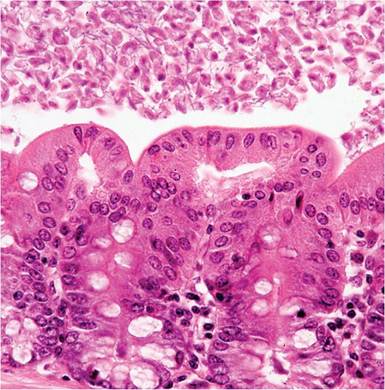
FIG. 1.85. Cecum from a transgenic mouse with overgrowth of Tritrichomonas muris within the lumen. Note the absence of inflammation.