Blood supply to the lungs
The pulmonary and bronchial arteries supply blood to the lungs. The pulmonary artery carries deoxygenated blood through the pulmonary trunk and into the right and left pulmonary arteries.
Oxygenated blood returns to the left atrium via the pulmonary veins. In most vessels, hypoxia causes dilation of blood vessels in order to increase O2 delivery. However, in the pulmonary blood vessels, hypoxia causes vasoconstriction. This is called ventilation-perfusion coupling, which allows pulmonary blood to be diverted to well- ventilated areas.Bronchial arteries arise from the aorta and deliver oxygen to the lungs. They mostly perfuse the bronchi and bronchioles. Their blood returns mainly via the pulmonary veins, but some returns via the superior vena cava.
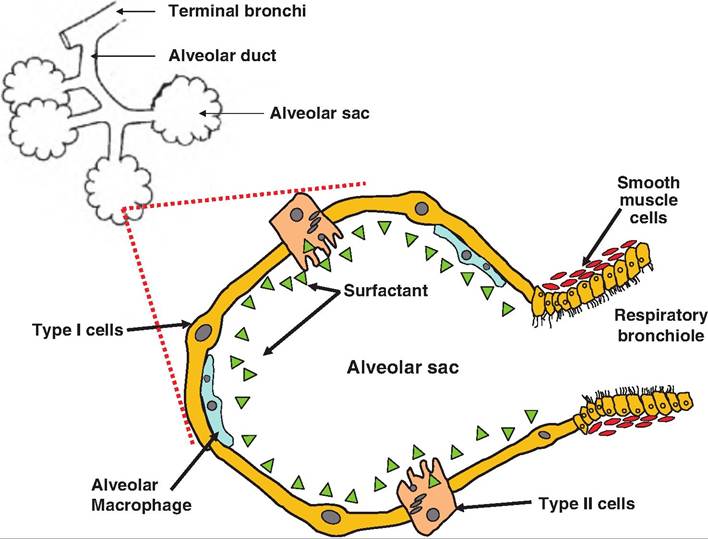
Fig. 14.7. Alveolar sacs and respiratory membrane. Within the alveolar sac are several alveoli. The alveoli contain type I alveolar cells that are the site of gas exchange. Type Il alveolar cells produce surfactant. (Adapted from http://php.mecl.unsw.edu.au/embryology/images/cl/d4/ Alveolar-sac-01.jpg.)
During exercise, cardiac output can increase by as much as eightfold. During this time, blood flow to the lungs must increase in order to collect oxygen. Pulmonary blood vessels dilate. In the horse, pulmonary arterial pressure can be so high as to cause erythrocytes to leak from pulmonary capillaries, a condition called exercise-induced pulmonary hemorrhage. This is a significant problem in athletic horses.