A Comparison of CO2 and Diode Laser Energy
CO2 laser energy is primarily absorbed by water and must therefore be used in a relatively dry ear. When CO2 laser energy interacts with tissue, the intracellular water is rapidly heated to boiling, and the cell ruptures.
When this vaporization occurs, a smoke plume is generated that must be removed by an appropriate evacuation system.The CO2 laser energy is usually delivered through a semiflexible hollow tube (Figure 19-4) that guides the energy to the target through the operating channel of the endoscope. CO2 laser energy is most useful in the ablation (vaporization) of abnormal tissue. It can also be effectively used to provide hemostasis. In cases where the base of the auricular mass is visible, the laser can be used in an incisional mode to remove these structures more quickly.
The limitations of CO2 laser energy are primarily related to the wavelength itself. Because it is absorbed by water, it cannot be used in an ear that has been flooded with fluid (saline) to increase visualization.
Diode laser energy is absorbed by hemoglobin, oxyhemoglobin, and melanin. This selective absorption may aid in treatment if the abnormal area is more pigmented than the surrounding tissue. Lesions can be treated in a contact or noncontact mode. The noncontact mode is usually used only on pigmented lesions on the pinna. The noncontact mode has not been proven to be useful in a fluid environment. Diode laser energy is delivered by a shielded flexible quartz fiber (Figure 19-5). This system allows for the precise delivery of laser energy in a fluid environment in a contact mode. The fiber delivery system of the diode laser may become extremely hot when energized for a prolonged period. This depends on the fiber size, the energy setting (wattage), and the vascularity of the tissue (thermal diffusion). If the fiber becomes overheated, peripheral thermal damage results. It is vital to keep the fiber cool. This can be accomplished by limiting the exposure time (pulse duration) and by cooling the fiber with an irrigant such as saline. The ability to operate immersed in fluid makes the diode laser extremely useful in otoendoscopy. Continual irrigation during the procedure increases visualization and decreases unintentional iatrogenic damage. Irrigation also removes debris and helps control any heat from the laser or the endoscope.
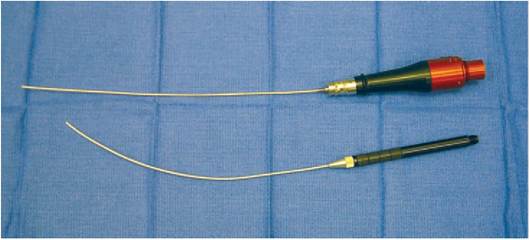
Figure 19-4
CO2 delivery systems.
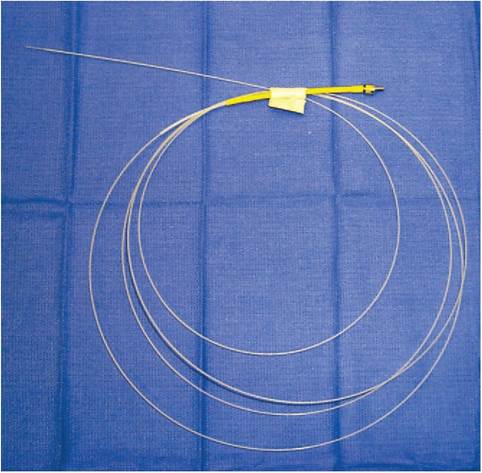
Figure 19-5
600-Micron diode laser fiber.