Feedback systems
Homeostatic regulatory mechanisms consist of either negative or positive feedback systems. Negative feedback systems are far more common than positive feedback systems.
Negative feedback system
In negative feedback systems, the control system initiates changes that counteract the stimulus (Fig.
1.5). This either reduces or eliminates the stimulus, thereby reestablishing the variable near its set point to maintain homeostasis. Using body temperature regulation as an example, every animal has a set point for body temperature, with the control center residing in the hypothalamus, a region of the brain. When the body temperature of an animal rises, possibly due to exposure to the sun, the warmth receptors located in the skin and hypothalamus sense a rise in temperature and send a signal to the hypothalamus. The hypothalamus compares these signals to the set point and then activates heat loss mechanisms (effector) such as sweating and vasodilation. Sweating results in evaporative cooling, while vasodilation increases the blood flow to the skin where heat is lost to the environment through radiation, conduction, and convection. The effector response results in a decrease in temperature back toward the set point.While the negative feedback system acts to correct changes from the set point, it is also common for the set point to change under various conditions periodically throughout the day. When an animal gets a fever, the set point for body temperature increases. This results in the activation of heat production pathways, including shivering and vasoconstriction (Fig. 1.6). When the set point returns to normal, the animal activates heat loss mechanisms.
Positive feedback system
In response to a stimulus, the animal elicits regulatory mechanisms that augment or exaggerate the effect. This creates a regulatory cycle in which the response
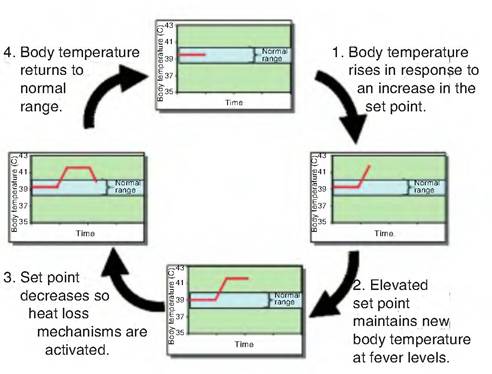
Fig. 1.6.
Alterations in the homeostatic set points. The set point for a variable can change. For example, the development of a fever involves a change in the body temperature set point. (1) The control center responds to an increase in the set point for body temperature caused by a pyrogen (i.e., something that causes a fever) and activates heat production pathways. (2) After being raised to the elevated set point, body temperature is maintained at this new level. (3) The set point decreases either because the animal fights off the cause of the fever or has been given an antipyretic, so the set point decreases to the original value. The control center now detects that body temperature is elevated, and it activates heat loss mechanisms. (4) Body temperature is returned to normal.causes an augmentation of the stimulus, which further increases the response. While positive feedback systems are rare, there are situations where they prove beneficial. In the case of blood clotting, an injured blood vessel secretes factors that attract platelets to that site. These platelets secrete factors that attract more platelets, and thus a positive cascade begins to occur. While this is beneficial in preventing the loss of blood, if left unchecked, the clotting process would continue until all the blood in the body was clotted, resulting in death.
Childbirth is another classic example of a positive feedback system. Near the time of parturition, oxytocin is produced by the fetus, which, along with prostaglandins, initiates uterine contractions. The uterine contractions cause the hypothalamus of the mother to release more oxytocin, causing greater uterine contractions. Thus, a positive feedback loop is initiated.