INTRODUCTION
inactivation is slowed by embedding in proteinaceous material. Morbilliviruses are stable at temperatures of around 0°C or lower, as long as freeze-thaw events do not occur. They are relatively labile at room temperature, but survive longer in the air at this temperature at low relative humidity.
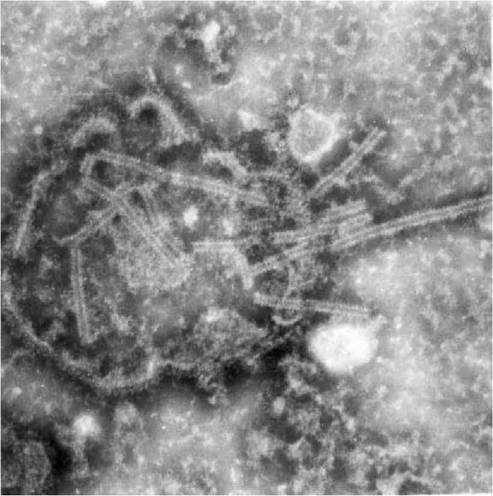
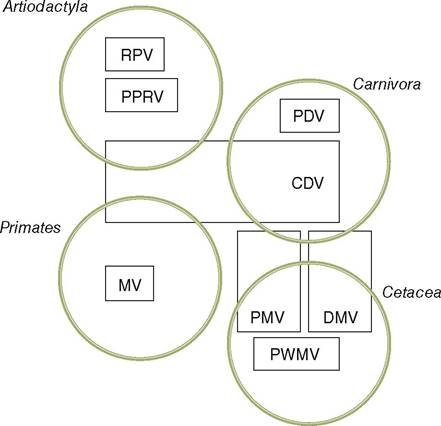
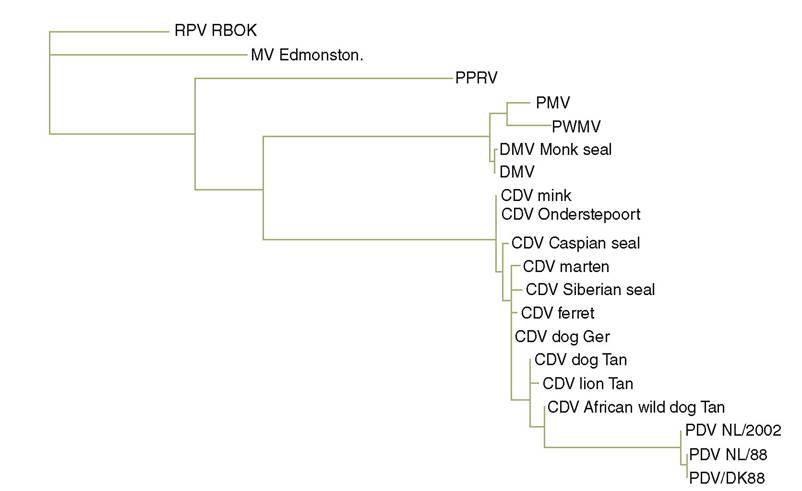
Morbilliviruses are rapidly inactivated at high temperatures. They are stable in a broad pH range. Being enveloped, morbilliviruses are readily inactivated by lipid solvents.Eight species of the genus Morbillivirus have been identified to date: Measles virus, Rinderpest virus, Peste-des- petits-ruminants virus, Canine distemper virus, Phocine distemper virus, Dolphin morbillivirus, Porpoise morbillivi- rus and Pilot whale morbillivirus. The latter three are sometimes considered a single species, called Cetacean morbillivirus[12] [13]-[14]'1. Species can be distinguished genetically, e.g. by divergence in gene sequences (Figure 7.2), and antigenically, e.g. by differential binding to monoclonal antibodies. Although each morbillivirus species is considered serologically monotypic, they cross-react in serological tests, and antibodies to one morbillivirus can protect to some extent against infection from another morbillivi- rus. Morbilliviruses are capable of infecting multiple species, sometimes from different orders (Figure 7.3). However, only one or two of these species may be crucial in maintaining the infection over time, such as cattle in rinderpest. Infectious Diseases of Wild Mammals and Birds in Europe, First Edition. Edited by Dolores Gavier-Widen, J. Paul Duff, and Anna Meredith. © 2012 Blackwell Publishing Ltd. Published 2012 by Blackwell Publishing Ltd. FIGURE 7.1 Negatively stained electron microscope photograph of phocine distemper virus, demonstrating herringbone-like structure of nucleocapsid. FIGURE 7.3 The orders to which host species infected by the eight known morbillivirus species belong. FIGURE 7.2 Phylogeny of morbillivirus species based on phosphoprotein gene fragments. The maximum likelihood tree was generated with the SEQBOOT and DNAML programs of the Phylip package with 500 bootstraps. GenBank accession numbers are given in parentheses. RPV RBOK = rinderpest virus RBOK strain (X68311), MV Edmonston = measles virus Edmonston strain (M89920), PPRV = peste des petites ruminants virus strain Nigeria 75/1 (AJ298897), PMV = porpoise morbillivirus (Barrett et al., 1993)(3), PWMV = pilot whale morbillivrus (AF200817), DMV Monk seal = DMV strain MSMV WA (Osterhaus et al., 1997)(4), DMV = dolphin morbillivirus (Z47758), CDV Mink = CDV European mink (AY130856), CDV Onderstepoort (AF305419), CDV Caspian Seal (Kennedy et al., 2000)(5), CDV Marten Ger = CDV marten Germany (AJ582389), CDV Siberian Seal (AF259551), CDV Ferret = CDV ferret Germany (AF259550), CDV Dog Ger = CDV dog Germany 1990 (AF259549), CDV Dog Tan = CDV dog Tanzania isolate A9411/15 (U53715), CDV Lion Tan = CDV lion Tanzania isolate 94-52.10 (U53712), CDV African wild dog = CDV African Wild dog Tanzania 2001 isolate LP/Tan/01 (FJ011000), PDV NL/2002 = phocine distemper virus, Netherlands 2002 (AF525288), PDV NL/88 = phocine distemper virus, Netherlands 1988 (AF525289), PDV/DK88 = phocine distemper virus, Denmark 1988 (X75960). Courtesy of M.W.G. van de Bildt. In the individual host, morbillivirus initially is lympho- tropic, resulting in lymphoid depletion and immunosuppression. This allows facultative pathogens to cause secondary disease, which is often the proximate cause of death. Later in the infection, morbillivirus can become neurotropic, causing primary neurologic disease. It also becomes epitheliotropic, resulting in the formation of aggregates of nucleocapsid- like structures in the nucleus and cytoplasm of infected epithelial cells. These aggregates are visible as intranuclear and intracytoplasmic inclusion bodies, which are an important diagnostic feature in histopathologic examination. At the population level, morbilliviruses require large populations to remain endemic, because they are highly contagious, cause infections of short duration and induce long-lasting immunity in survivors. In populations where morbillivirus infection is not endemic and there is no herd immunity, infection typically leads to so-called ‘virgin soil’ epidemics with high mortality, and these are among the most severe die-offs known in wildlife.
More on the topic INTRODUCTION:
- 1 Introduction
- Introduction
- Introduction
- 19 Introduction
- Introduction
- Introduction
- INTRODUCTION
- Introduction
- Introduction
- Introduction
- Introduction
- Introduction: Hegel, Marx and the Dialectic
- INTRODUCTION: OVERVIEW OF COMPLICATIONS ASSOCIATED WITH HIV THERAPY
- Introduction
- Introduction
- Introduction
- Introduction
- Introduction
- INTRODUCTION