Levels of organization
The animal body has a complex organization extending from the most microscopic levels up to the macroscopic (Fig. 1.2). Beginning with the smallest microscopic units of stability, the levels of organization are as follows:
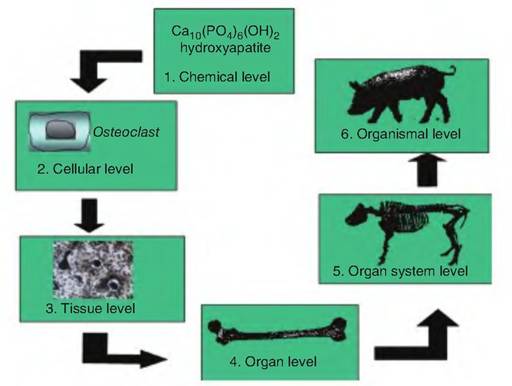
Fig.
1.2. Levels of organization. (1) Atoms interact to form molecules, which combine to form complex chemicals. (2) Chemicals combine to form cells that can display specific functions depending on the proteins expressed. (3) Cells having a common function combine to form tissue. (4) Tissues combine to perform a common function. (5) Organs can work together for a common function. (6) All the organ systems combine to produce a living animal.• Chemical level. Atoms are the smallest units of matter that have properties of an element. They combine with covalent bonds to form molecules such as molecular oxygen (O2), glucose (C6H12O6), or methane (CH4). The properties of various chemicals have a major influence on physiology. For example, at a low pH, a chemical may not be ionized and can thus cross a cellular membrane whereas above a certain pH, the same molecule may become ionized and thus unable to cross a lipid bilayer.
• Cellular level. As the smallest unit of life, cells have various sizes, shapes, and properties that allow them to carry out specialized functions. Some cells have cilium that allow them to move materials across their surfaces (i.e., the epithelial lining the bronchioles or cells lining the oviduct), whereas other cells are adapted to store lipids, produce collagen, or contract when stimulated.
• Tissue level. A tissue is a group of cells having a common structure and function. The four types of tissue include muscle, epithelia, nervous, and connective tissue.
• Organ level. Two or more tissues working for a given function form an organ. All four tissue types combine to form skin, the largest organ of the body, or the cochlea in the ear, the smallest organ of the body.
• Organ system level. Organs can work together for a common function. For example, the alimentary canal works with the liver, gallbladder, and pancreas to form part of the digestive system. The pancreas also functions as part of the endocrine system because of the pancreatic islets that produce insulin and glucagon. The organ systems include the integumentary, skeletal, muscular, nervous, endocrine, respiratory, digestive, lymphatic, urinary, and reproductive systems (Fig. 1.3).
• Organismal level. The organismal level, or the whole animal, includes all of the organ systems that work together to maintain homeostasis.