Megakaryocytes
The maturing megakaryocyte undergoes several rounds of nuclear endomitosis and endoduplication, resulting in progressively larger cells with greater cytoplasmic volume and increasingly lobulated nuclei.
Mature megakaryocyte nuclei are composed of individual round lobules that remain connected to each other. With progressive age, megakaryocyte nuclear lobules condense and become folded. In general, megakaryocytes with large nuclei and a small amount of cytoplasm have replicative ability, while those with abundant cytoplasm give rise to platelets and no longer divide. Cytoplasmic maturation involves the production of granules that are imparted to platelets when they are released as cytoplasmic fragments. Granules impart a progressively pinker and stippled appearance to the cytoplasm of mature megakaryocytes. Mature megakaryocytes are very large (50–200 µm) and polyploid (up to 128N ploidy) and are best enumerated at low magnification (Figure 19.15). In animals without hematological disease, 3 to 8 megakaryocytes per particle are typical. 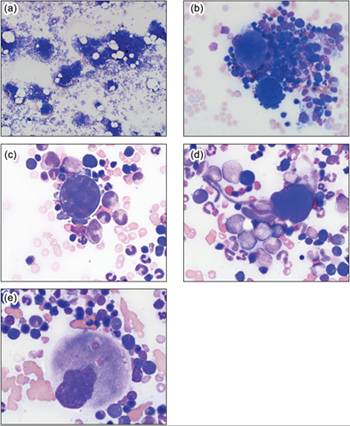
Figures 19.15 (a) Megakaryocytes are best enumerated at low magnification. This sample is from a dog with megakaryocytic hyperplasia and immune-mediated thrombocytopenia, 100? magnification. (b) Immature megakaryocytes have large nuclei and a moderate amount of cytoplasm, 200? magnification. (c) Megakaryocyte in endomitosis, 400? magnification. (d) Release of elongated proplatelets from the megakaryocyte, 400? magnification. (e) Mature megakaryocyte with condensed and fused nuclear lobes and abundant pink granular cytoplasm, 400? magnification.