Other Bacterial Infections Corynebacterium spp. Infections
Corynebacterium kutscheri has been isolated from the oral cavities of clinically normal adult Syrian hamsters. In addition, the organism has been recovered from sites such as esophagus, cecal contents, submaxillary lymph nodes, and upper respiratory tract.
In 1 study, Syrian hamsters were inoculated subcutaneously or intramuscularly with C. kutscheri. Localized granulomatous and suppurative lesions were observed. Another species, Corynebacterium paulometabulum, was isolated from a hamster with respiratory signs, but its role as a primary pathogen is uncertain.Francisella tularensis Infection: Tularemia
Tularemia, due to F. tularensis infection, is rare in laboratory hamsters, although it has been reported in a hamster breeding colony, resulting in 100% mortality. Hamsters were hunched, had ruffled fur, and died within 48 hours. Lungs were mottled with hemorrhage, livers were pale and swollen, and spleens were enlarged. Gut- associated lymphoid tissue was prominent and pale. Microscopic findings included lymphoid necrosis, focal hemorrhages, and bacteria. Others have noted the predominant gross lesion to be enlarged spleens with multiple pale foci in European hamsters, and similar findings have been noted in naturally infected Syrian hamsters (Fig. 3.20). Tularemia is endemic among many species, particularly the rabbit (see Rabbit Chapter 6, "Francisella tularensis Infection”) and is regionally endemic among wild European hamsters (C. cricetus). Zoonotic infections have been documented among hunters of European
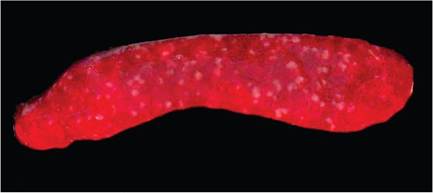
FIG. 3.20. Enlarged spleen with multiple pale foci from a hamster with tularemia, caused by Francisella tularensis infection. Splenic involvement is a predominant feature of this disease in hamsters. Source: A. Wuenschmann, University of Minnesota, Minneapolis, Minnesota.
Reproduced with permission from A Wuenschmann.hamsters. Zoonotic infection has been documented following exposure to infected pet hamsters in the United States (Centers for Disease Control) and Canada (Public Health Agency of Canada).
Leptospira ballum Infection: Leptospirosis
Hamsters have been inadvertently infected with L. bal- lum by inoculation with contaminated tissue from sub- clinically infected mice. The hamsters developed severe hemolytic disease, jaundice, hemoglobinuria, nephritis, and hepatitis within 4-6 days. Hamsters are highly susceptible to experimental inoculation with a number of Leptospira spp., and thus can be potentially susceptible to severe natural disease, although never reported.
Mycobacterium spp. Infection
Mycobacteriosis has been documented in both laboratory and pet hamsters, but it is apparently quite rare. Laboratory hamsters have been inadvertently infected with Mycobacterium tuberculosis following inoculation of human tissue, with one outbreak of disseminated tuberculosis occurring among multiple hamsters resulting from a contaminated inoculation needle. A pet hamster was reported to have severely enlarged feet and lymph nodes due to granulomatous inflammation associated with Mycobacterium chelonai infection.
Pasteurella pneumotropica Infection
The nasal cavity of hamsters may be colonized by P. pneumotropica without clinical effect, but there is a single report of hamsters developing prolapsed rectums, fecal discharge, and enteritis at day 7 after parturition. Prior to whelping, P. pneumotropica was isolated from the nasal cavity, but not from other organs, whereas during the epizootic, pure cultures of P. pneumotropica were isolated from the bowels of affected hamsters. Since P. pneumotropica is not known to be a primary enteric pathogen, the findings suggest an underlying dysbiosis, possibly related to C. difficile.
Yersinia pseudotuberculosis Infection
Hamsters have been known to incur infections of Y.
pseudotuberculosis via contaminated food or bedding.This organism produces chronic emaciation with intermittent diarrhea. Necropsy findings include necrotic caseous nodules in the intestine, mesenteric lymph nodes, liver, spleen, and lungs.
Miscellaneous Bacterial Infections
Upper respiratory disease, otitis, and bronchopneumonia in hamsters have been associated with a number of bacteria, including P. pneumotropica, Pasteur- ella spp., Streptococcus pneumoniae, Streptococcus agalac- tiae, and Streptococcus spp. The primary roles of these bacteria in respiratory disease in hamsters have not been definitively established. Mycoplasma pulmonis has been isolated from hamsters, but its pathogenic potential in hamsters is not known. Mastitis has been associated with beta-hemolytic Streptococcus, P. pneumotropica, and E. coli. Cutaneous and cervical abscesses have been found to be colonized with a variety of organisms, including Actinomyces bovis, Staphylococcus aureus, Streptococcus spp., and P. pneumotropica. Pseudomonas aeruginosa septicemia has also been observed in this species. Enteritis in postpartum dams has been attributed to P. pneumotropica, but a cause and effect relationship was not established.
Fungal Infections
Dermatomycosis
Spontaneous dermatophyte infections due to Trichophyton sp. and Microsporum sp. are rare in laboratory hamsters, and there are few reports of confirmed cases in the literature.
Encephalitozoon cuniculi
There is relatively little information on E. cuniculi infections in hamsters. One report describes Encepha- litozoon infection of a transplantable ascites-plasmacytoma of hamsters, but details of pathologic findings were not included (for additional information, see Rabbit Chapter 6, "Encephalitozoon cuniculi Infection”).