Production of ATP
For essentially all physiological activities, the most useful and available form of energy comes from ATP. When the terminal phosphate group is cleaved to produce adenosine diphosphate (ADP), each mole of ATP yields 7400 cal.
There are other similar high- energy-yielding molecules but most are similar to ATP, for example, GTP or creatine phosphate. Indeed, the formation of creatine phosphate (which acts as a storage form of energy in muscle cells because of its capacity to regenerate ATP from ADP) gains this capacity only when ATP is produced in excess of immediate demand as in the following reaction:ATP + Creatine ÷÷ ADP + Creatine phosphate.
This means that production of ATP is vital. The structure of ATP is shown in Figure 3.2. Mitochondria are critical because the final stages of oxidation of several coenzymes occur within these organelles. When the reduced coenzymes are oxidized, a portion of the energy produced is utilized to drive the synthesis of ATP from ADP as shown below:
ADP + Phosphate + Energy → ATP
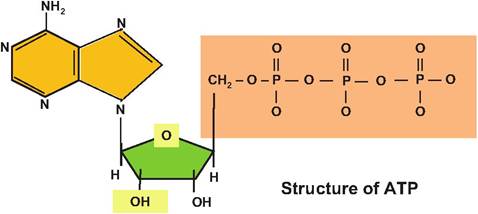
Fig. 3.2. Structure of adenosine triphosphate (ATP) is presented. It is the most important labile energy carrier in the body. Hydrolysis of the terminal phosphate bond yields an exceptionally high level of free or (available) energy. The nitrogenous group should be familiar as adenine, linkage with the ribose produces adenosine, and addition of a single phosphate moiety gives adenosine monophosphate or AMP and two adenosine diphosphate or ADP.
| Table 3.2. Common terms associated with the metabolism of carbohydrates. | |
| Term | Definition |
| Glycolysis | Anaerobic oxidation of a molecule of glucose via 10 enzymatic reactions to produce two molecules of pyruvate. The reactions occur in the cytoplasm. |
| Glycogenolysis | The breakdown of glycogen to produce glucose for utilization in the glycolysis catabolic pathway. |
| Glycogenesis | Synthesis of glycogen from glucose. |
| Gluconeogenesis | The formation of glucose from noncarbohydrate substrates. Important in times of stress, makes glucose available from nonessential amino acids. Critical in ruminants due to fermentation of dietary carbohydrates. |
ADP + Phosphate + Energy —> ATP.
As you might guess, since many different feedstuffs can be used to produce energy, a host of nutrient molecules under the appropriate circumstances can be modified to enter the biochemical pathway for ATP production. Although some ATP can be generated in the absence of oxygen through substrate-level phosphorylation (essentially the regeneration of ATP from ADP as with creatine phosphate), production rates are minor compared with oxidative phosphorylation. In a nutshell, this explains the critical need for oxygen. Within the mitochondria, where reduced coenzymes are oxidized, oxygen serves as the final acceptor of electrons in this cascade of reactions. Without oxygen available, the electron transport chain fails, and the energy normally available to drive phosphorylation of ADP to regeneration ATP also fails. Needs for continuous supplies of ATP are so acute that unless oxygen is quickly returned, death occurs in a matter of minutes. To understand the pathways for ATP generation, we will focus first on the catabolism of carbohydrates and specifically on the catabolism of glucose. Once we have this core of information, we will then discuss how other nutrients can be diverted for use as fuels to drive ATP generation.