Reproduction in birds
It is apparent even to the casual observer that there are dramatic reproductive differences between mammals and birds. Chickens (gallus domesticus) are familiar as domesticated birds in the poultry industry.
These birds are believed to be descended from Red Jungle fowl found in southeastern Asia. We take advantage of the prodigious egg production of these animals to provide a breakfast staple around the world and meat for our tables. Indeed, the world population of chickens is approximately 24 billion (Whittow, 2000).Before World War II, most egg production came from farm flocks of only a few hundred hens. Beginning in the 1950s and 1960s, changing technology and creation of specialized equipment shifted production from these small farm flocks to larger, vertically integrated (direct association between growers and producers and egg or meat wholesalers) large enterprises. In the major egg-producing states, flocks of 100,000 laying hens are not unusual and some flocks number more than 1 million. Each of the 235 million laying birds in the United States produces between 250 and 300 eggs a year. Our purpose is to provide some highlights and comparative aspects with a focus on the domestic chicken.
Mature male chickens are called roosters and cocks or cockerels if immature. Castrated roosters are called capons. Young females are called pullets and mature females called hens. Roosters are usually differentiated from hens by their striking plumage and often bright feathers on their necks.
Given the opportunity, flocks of chickens are gregarious and maintain a distinct social or "pecking" order. A mature rooster that finds food may call the other chickens by making a clucking sound and by picking up and dropping the food. This behavior also occurs in hens calling their chicks. As a part of a courting ritual the rooster may drag the wing opposite the hen and turn in a circle around her.
When she becomes acclimated to responding to his vocalization the rooster may mount the hen and proceed with the fertilization. Similar behaviors can be observed during the spring-summer mating season with various song birds.Most wild birds usually lay one of more eggs in a group called a clutch, then stop laying additional eggs to incubate eggs in the nest. These birds display yearly breeding cycles. On the other hand, domestic chickens are continuous breeders and under the best conditions are reproductively active throughout the year. Seasonal disruption of reproduction in birds is an adaptive response to ensure that newly hatched chicks can be cared for under conditions most suitable for survival. A common mechanism for ending the breeding season of wild birds in northern latitudes depends on hypothalamic signaling and subsequent hormonal response of the birds to increasing photoperiod. In other words, the birds become refractory to normally stimulating long days. This results in regression of the gonads. Recovery or the ability to respond positively to long day photoperiods is only reestablished after birds are exposed to short photoperiods for 40-60 days.
Avian reproduction is best understood in domestic chicken and turkeys. In fact, the modern poultry industry depends on a well-developed understanding of the reproductive cycle and how best to manipulate and control it for maximum egg production. Birds lay eggs in groups or clutches of one or more eggs. This is then followed by a rest period, then another cycle. Clutch size, as well as the numbers of clutches laid in a breeding season, varies with species, but the principle is the same. Domestic hens usually lay five or more eggs in a clutch, with a day break between clutches.
Hens ovulate in the morning, and almost never after 3:00 pm under normal photoperiod. The final stages to prepare the terminal egg for laying takes between 25 and 26 hours. This period includes approximately 3.5 hours to add the layers of albumen (egg white) around the yolk, 1.5 hours for shell membranes, and 20 hours for shell formation.
Ovulation of the next egg in sequence (part of the clutch) begins within an hour of laying the previous egg. What this means is that the hen starts to slowly get behind as each day passes. After several days she gets so far behind that she would have to ovulate after 3:00 PM. Since this does not happen, the next ovulation is delayed and the clutch cycle is broken. After a couple of days the sequence begins again with a new clutch of eggs.Sometimes a hen will stop laying additional eggs and begin to focus on the incubation of eggs. This is called broodiness or going broody. A broody chicken will doggedly sit on her nest and protest or peck if disturbed. While brooding, the hen maintains constant temperature and humidity, and also turns the eggs regularly. At the end of the 21-day incubation period, if the eggs are fertilized, they will hatch and the broody hen will take care of her chicks. Since individual eggs do not all hatch at the same time (the hen only lays one egg approximately every 25 hours), the hen will usually stay on the nest for about 2 days after the first egg hatches. During this time, the newly hatched chicks live off the egg yolk they absorb just before hatching. The hen can sense the chicks peeping inside the eggs, and will gently cluck to stimulate them to break out of their shells. If the eggs are not fertilized and do not hatch, the hen will eventually lose interest and leave the nest.
Avian female reproductive system
The right ovary and oviduct are present during early embryonic development in birds, but asymmetrical migration of precursor germ cells to the left ovary ultimately results in regression of the right ovary in most species. Thus, the mature reproductive system consists of a single left ovary and its oviduct. The ovary of a chick embryo contains ~500,000 oocytes at time of hatching when oogenesis ends. The ovary in immature birds exhibits a mass of small ova, many of which are visible to the unaided eye. It is typical that 250-500 ova are ovulated during the life of most domesticated birds.
Figure 19.23 gives the parts of an avian reproductive tract.Follicle growth is characterized into three phases: (1) slowly growing small (60 to 100 μm) follicles that occur over periods of months or years; (2) growth over a period of months with rapid deposition of yolk protein; and (3) very rapid growth during the typical 6-11 days prior to ovulation, when the majority of yolk proteins and lipids are deposited in the egg. During phase 3 in the chicken, the follicle adds 2 g of protein per day and increases in diameter from 8 to 37 mm. Yolk proteins are made in the liver. The ovary enlarges greatly during the breeding season. The chicken ovary is divided into two lobes, each with follicles. The ovary in a hen exhibits a clear hierarchy of progressively developing follicles (Fig. 19.24). This explains the cycle of egg laying to create the clutch of eggs.
The follicles in birds bear little resemblance to those in mammals. There is no antrum or follicular fluid but the follicle is filled with yolk. The mass of yolk grows very rapidly, which is important because it provides all of the nourishment for the developing embryo. This mass progressively decreases as the embryo grows. In chickens, posthatching nutrition is also mostly from the yolk for a short time since it is not completely absorbed when the chick hatches.
Ovulation causes release of a mature egg. The egg, with its extensive nutrient reserves, is picked up by the infundibulum and carried into the magnum, which is the largest segment of the oviduct. Over about 3 hours, the egg receives a coating of albumen. The egg then passes into the isthmus, where the shell membranes are deposited. This takes about 1 hour. The egg
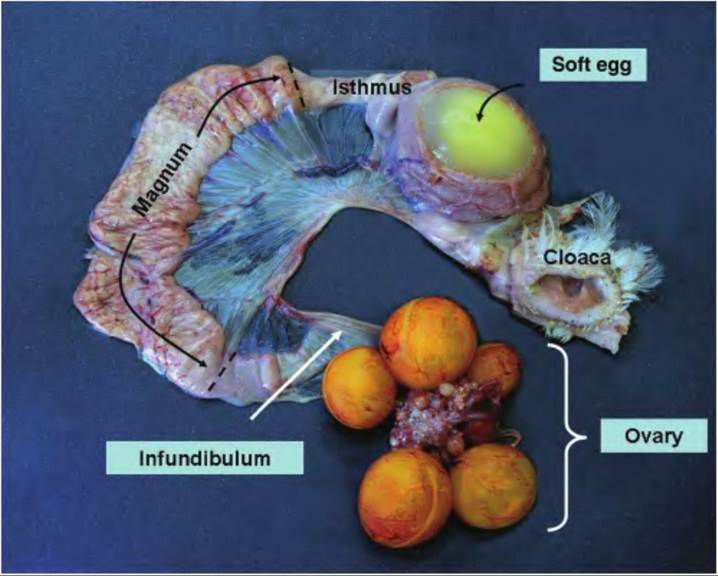
Fig. 19.23. Structures of female chicken reproductive tract. The ovary with multiple oocytes in various stages of development is apparent. After ovulation, the egg progresses through segments of the oviduct, infundibulum, magnum, and isthmus.
In this illustration, a mature egg after albumin deposition (soft egg) but before shell formation is shown. The mature egg is subsequently laid after passage into the cloaca. Original photograph provided courtesy of Dr. Frank Robinson, University of Alberta.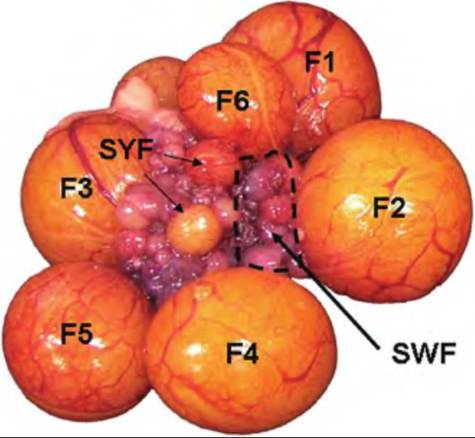
Fig. 19.24. Progressively developing follicles of a laying hen ovary. F1-F6 illustrate sequential development of follicles and thus eggs destined for ovulation. Small yellow follicles (SYF) are those that are beginning to sequester yolk proteins. Small white follicles (SWF), some of which appear in the area bounded by the dashed box, are follicles in still earlier stages of development. Original photograph provided courtesy of Dr. Frank Robinson, University of Alberta.
then moves to the uterus, or shell gland, where the shell is added, and in some birds, pigment is added in characteristic patterns. The egg then passes into the vagina and cloaca for laying.
The shells of newly deposited eggs are completely filled. The air cell forms by contraction of the contents during cooling and by the loss of moisture. A high- quality egg has only a small air cell. The yolk is positioned in the center of the albumen and is surrounded by the colorless vitelline membrane. The germinal disc is the site of fertilization and is attached to the yolk. On either side of the yolk there are two twisted, whitish cord-like structures called chalazae. These structures support the yolk in the center of the albumen. Most of the albumen is thick. Surrounding the albumen there are two shell membranes and the shell itself. The shell contains several thousand pores that permit gas exchange.
The yellow of your breakfast egg is the true oocyte. The yellow of the egg is a single cell and the yolk represents a massive lipid inclusion in its cytoplasm. The largest single cell in existence is the yolk of an ostrich egg, which can have a diameter of 6 inches.
An average hen egg weighs about 60 g. Of this weight, the shell constitutes 11%; the white, 58%; and the yolk, 31%. These proportions are generally consistent for small or large eggs. Figure 19.25 illustrates the structures of a chicken egg.
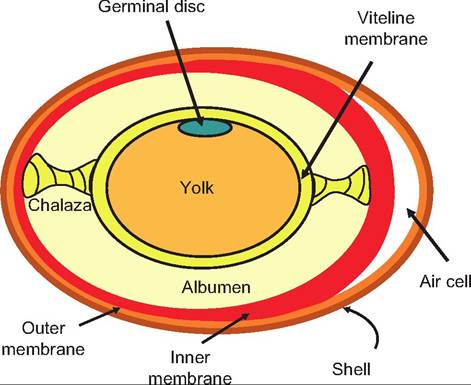
Fig. 19.25. Parts of a chicken egg.
Avian male reproductive system
Fundamentals are similar to male mammals in that male birds have two testes that produce sperm. A bird's testes (or ovaries for that matter) greatly increase in size during the breeding season. Their small size during the rest of the year lightens the load for flight. The cloaca is the outlet for eggs and sperm.
Male birds have paired abdominal testes located anterior to the cranial lobe of each kidney. The vas deferens emerges medially and passes caudally alongside the ureters to the cloaca where it has a common opening with the ureter in the urodeum. The distal portion of the vas deferens becomes straightened, then abruptly widens at the point where it joins the cloaca. This enlarged structure has a bean-shaped appearance when it is filled with stored semen during the breeding season.
Sperm production occurs in the seminiferous tubules of the testes. As in mammals, sperm formation is temperature sensitive. Thus, maturation is improved with reduced temperatures typical of evening and night hours and in some cases by the development of scrotal-like external thermoregulatory swellings that house the seminal glomera. Accessory organs include the paracloacal vascular bodies, dorsal proctodeal gland, and lymphatic folds. These structures are either directly adjacent to the cloaca or a part of its structure. Few male birds have a penis-like structure. Thus, most achieve fertilization via a cloacal kiss. This involves positioning the male on the back of the female with a twisting of his tail under hers and the touching of the cloaca of each. During copulation or in response to massage, a phallic-like swelling occurs in the accessory lymphatic folds of the cloaca. The paracloacal bodies are essential to this event because they act to store lymph fluid, which promotes swelling.
In chickens after copulation or turkeys after insemination, spermatozoa are stored in specialized storage tubules located in the uterovaginal region of the female. These cells remain viable for up to two weeks in chickens and three weeks or more in turkeys. Most evidence suggests that spermatozoa fill these glands sequentially and that there is no mixing between successive copulations or inseminations. However, sperm cells from the most recent copulation are most likely to fertilize an ovum. After each egg is laid, spermatozoa are released from these glands where they migrate to the infundibulum of the oviduct, where fertilization occurs.