The basic plan of the body
The body is made up of a number of systems and each of them has a specific job. enabling the body to function effectively. These systems can be placed in one of three groups depending on their function:
1.
Siriu Iiinii systems - provide the basic ‘framework' and transport system for the body2. CtHmIinatiny systems - the control mechanisms of the body
L Visceral systems - includes all the basic functional systems that do the general duties for the body: found within one of the three body cavities:
W
thoracic, abdominal and pelvic.
Structural systems
Skeletal system - the supporting frame upon which the bof membrane-lined interconnected tubes and cavities within the cytoplasm of the cell. There are two types of endoplasmic reticulum:
- Rouι∣h endoplasmic reticulum is so called because it has numerous ribosomes attached to its surface and thus appears rough’ when viewed under a microscope. The function of rough ER is to transport the proteins which have been synthesised by ribosomes. Someof these proteins arc not required by the cell in which they are made but are ‘exported’ outside the cell, c.g. digestive enzymes and hormones.
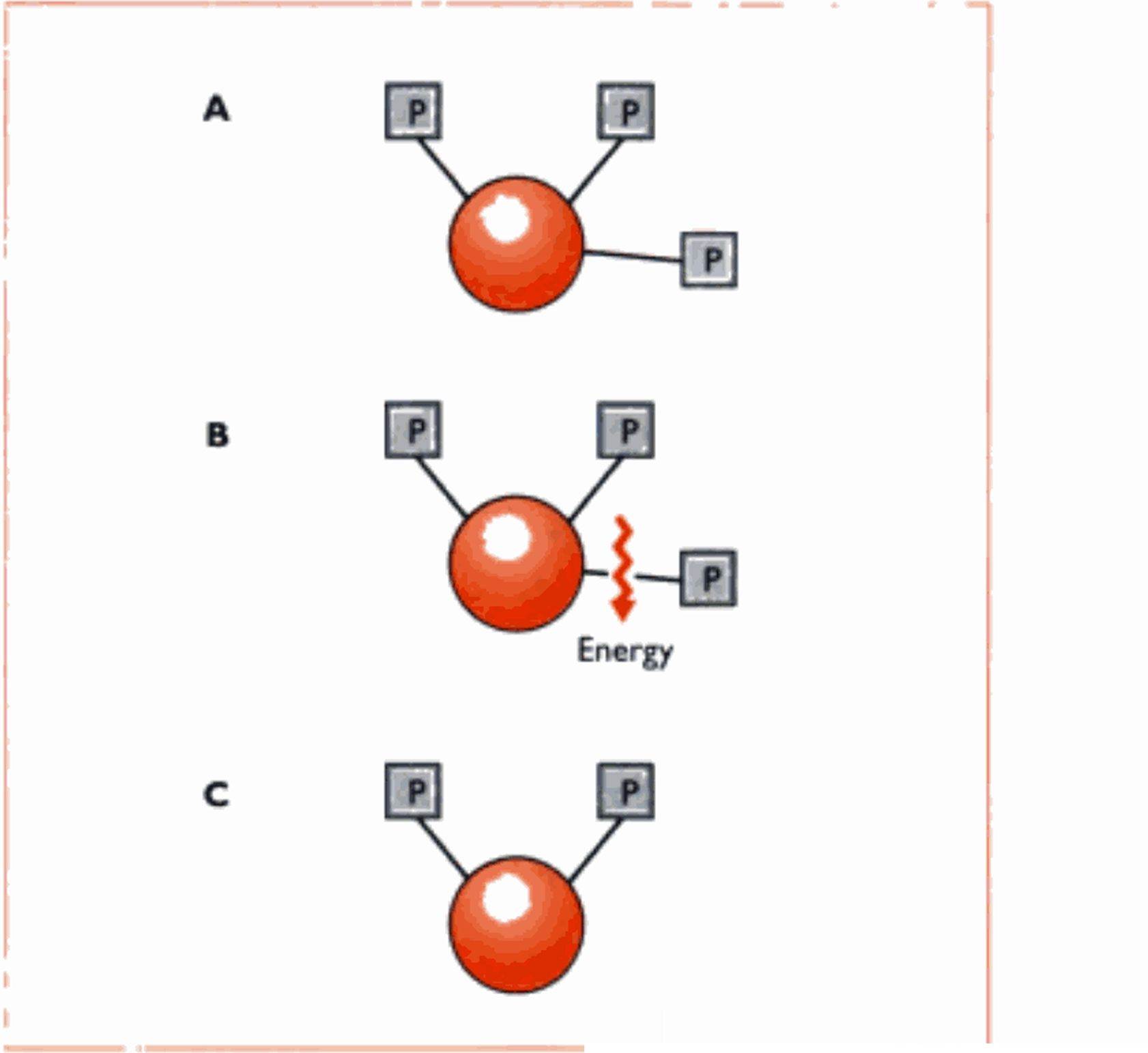
Fig. 1.4 The conversion of AT P to ADP to release energy A t he At P molecule Kis three phosphate groups (P) attached by chemical bonds; energy is stored wvth∣n the bonds. B O∏e o< the phosphate groups ∣s snapped off’, releasing energy. CThc remaining molecule (ADP with tΛ>o phosphate groups} goes back into the mctabo∣< cycle.ι∏d has a phosphate group reattached, becoming ATP again.
- Smooth endoplasmic reticulum is so called because it does not have ribosomes on its surface: its functions include the synthesis and transport of lipids and steroids.
4. The (iolchromosomes mav become
* entangled and pieces of one chromosome may become attached to another - this process is known as "crossing over’ and may influence the characteristics of the offspring.
2. Metaphase I - the homologous pairs of chromosomes come to lie along the line of the equator of the cell and the Iibrous spindle starts to form.
3. Anaphase I - the pairs separate and the chromatids migrate along the spindle fibres towards the poles of (he cell.
4. Tcloplitise I - the cytoplasm begins to divide but the nuclear membrane does not reform. In some cells, the cytoplasm does not divide completely and a dumb-bell shaped cell is seen - this is known as a sι∣ιuι∣liιιιn. Telophase I is the first Hiciotic division.
5. Proplitise Il - this may be transitory as there is no need Io replicate the chromosomes.
6. Metaphase Il - the chromosomes arrange themselves along the equator and the spindle Iibres appear.
7. Anaphase Il - the chromatids pull apart and migrate towards the poles of the cells.
8. Tclophtisc Il - the cytoplasm begins to divide, the nuclear membrane reforms and four identical daughter cells are formed. Ielophase H is the second ιneio(it' division.
Meiosis results in the production of four identical daughter cells, each of which is non-identkal to the parent cell and conuins the haploid number of chromosomes.