The cells, and therefore the tissues and organs which are all made of cells, are compost'd of chemicals.
It is important to be able to understand these chemicals and the reactions in which they take part within the body. Chemical compounds can be divided into two groups:
Orpanic compounds are those that contain the element carbon
lιιorf∣anic compounds arc all those compounds (hat do not contain carbon.
Both groups are found in (he bfrom areas of high concentration to those of tow, until equ∣l∣bnum is reached- Diffusion occurs when there ∣s no bar∏er to free movement and it occurs more rapidly in hot kju∣ds than in cold ones as molecules ane more actr√e at higher temperatures. (Repnnted from Ciimcal Anatomy and Physology for Veterinary Iechnicians. T Col v lie and ]M BassetL p 24, Copynght 2002. with permission from Ekevier Science.)
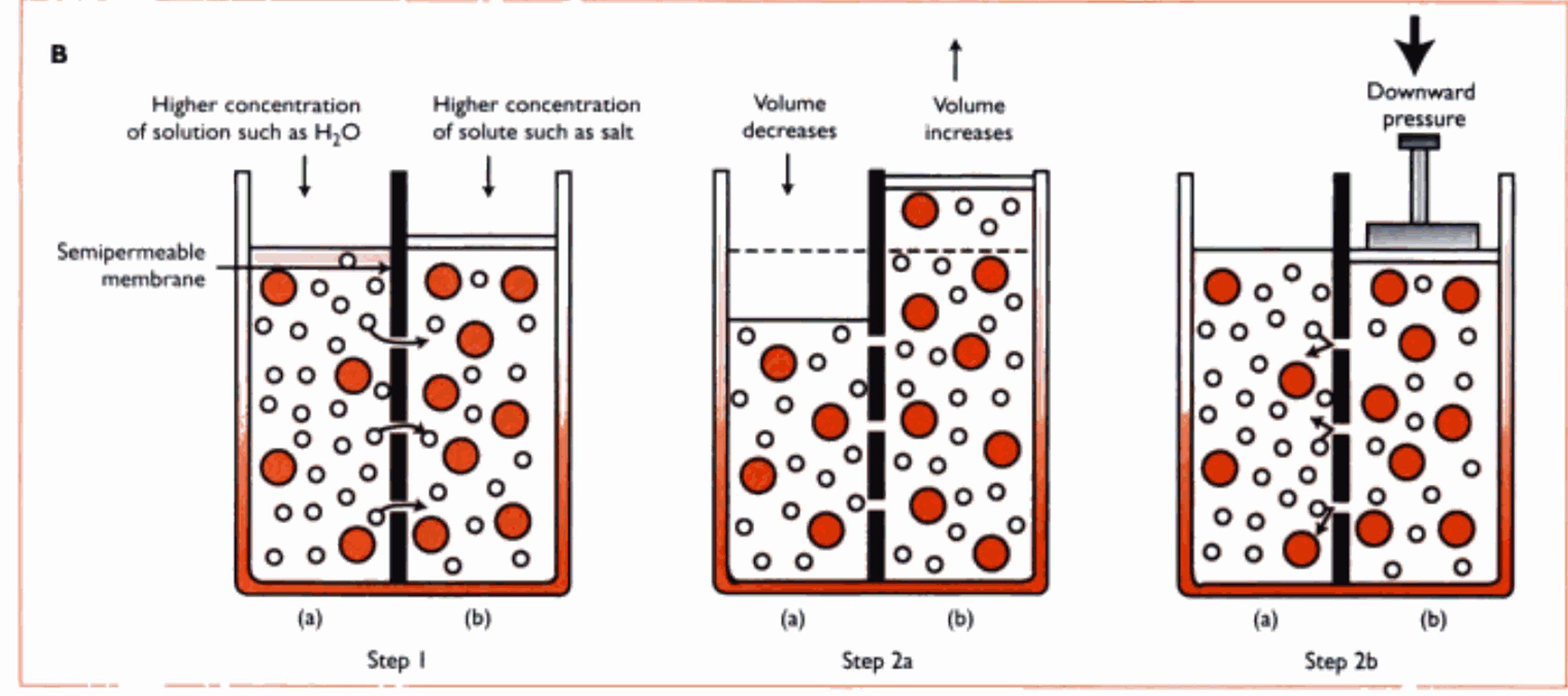
Fig. I.8B Osmose. Step I: Smaller molecules of solution in side (a) can pass through the sem∣-permeab∣e membrane into s∣de (b). but the larger molecules of solute can not Step 2a. As solution moves from sκJe (a) to side (b). the volume of s*de (b) increases until the concentration of solute is the same on both sides Step 2b Osmosis can be reversed by filtration, wħen hydraulic pressure is placed on ⅛de (b).T⅛s forces solution back through the semi-permeable membrane to side (a). (Repnnted from Clinical Anatomy and Phy⅛o∣ogy for Veterinary Technicians.! Cohnlie and JM Bassett, p 25. Copyright 2002. with permission from Elsevier Science.)
through drinking fluids and from the waler content of food.
Fluid losses may be increased in sick or injured animals, e.g. vomiting, diarrhoea, vaginal discharge (as seen with an open ρyometra ) or blood loss. This can lead to dehydration, which may cause serious consequences such as reduction of the circulating blood volume, known as hypovolaemic shock. In a normal adult animal, about 60% of the total bodyweight is water. This percentage will be slightly lower if the animal is old or very obese (fatty tissue contains little water) or slightly higher in young or thin animals.
Typical daily water loss is: 20 mL per kg bodyweight in the urine; 10-20 mL per kg bodyweight in the faeces; and 20 mL per kg bodyweight through the loss of water vapour in expired air and panting and in body secretions - a total of 50-60 mL of water per kg of bodyweight daily.Thus an adult healthy animal should take in 50-60 mL of water per kg bodyweight per day to balance the normal fluid loss. e.g. an animal weighing 20 kg will need 1000-1200 mL of water each day.