USUTU VIRUS INFECTION
Herbert Weissenb ock and karoly erd elyi
Pathology and Forensic Veterinary Medicine, Department of Pathobiology, University of Veterinary Medicine, Vienna, Austria
Central Agriculture Office, Veterinary Diagnostic Directorate, Budapest, Hungary
Usutu virus (USUV) is a member of the Japanese encephalitis group among the mosquito-borne flaviviruses.
Prior to 2001 USUV had only been found in certain mosquito and bird species in Africa and it had not been associated with disease. In 2001 a more virulent strain of USUV emerged in Central Europe, causing considerable avian mortality and affecting wild birds of the order Passeriformes (especially blackbirds (Turdus merula)) and birds of the order Strigiformes (especially great grey owls (Strix nebulosa)) kept in captivity(12) (Table 9.1).
Currently, one USUV strain is endemic in several locations of Central Europe, where it has been involved in episodes of bird mortality since 2001. Emergence of this strain started in Eastern Austria, and spread to Hungary (Budapest, 2005), Northern Italy (Milan area, 2006) and Switzerland (Zurich, 2006)(13). According to a serological survey in Austria a large number of bird species were infected with USUV, but only certain vulnerable species developed clinical disease and died(17). The factors that predispose a host to develop severe disease are unknown. In owls, vulnerability seems to be limited to species native to Northern Europe. Single USUV seropositive birds have also been found in European countries that have not experienced USUV-associated bird mortality so far, such as the UK, Czech Republic, and Poland. As virus has not been recovered it is not known whether it is the previously mentioned strain or different, less-virulent strains of USUV that are present in these countries. A different USUV strain has been detected by RT- PCR from Culex pipiens mosquitoes in Spain (Catalunya)(18) that has not been associated with bird mortality.
USUV infection and associated disease is seasonal, occurring between July and September within the temperate climatic zone of Central Europe. This seasonality is related to vector abundance and activity. Although no thorough studies on vector preference and vector competence of USUV have been undertaken so far, preliminary results point towards the ornithophilic mosquito species
TABLE 9.1 Bird species affected by documented USUV infection-associated mortality in Europe.
| Order | Common name | Scientific name | Number of reported cases | References |
| Passeriformes | Eurasian blackbird | Turdus merula | 165 | 12, 13, 14, 15, 16 |
| House sparrow | bgcolor=white>Passer domesticus31 | 12, 13 | ||
| European robin | Erithacus rubecula | 3 | 13, 15 | |
| Blue tit | Parus caeruleus | 2 | 12, 13 | |
| Great tit | Parus major | 2 | 15 | |
| Nuthatch | Sitta europea | 1 | 15 | |
| European greenfinch | Carduelis chloris | 1 | 13 | |
| Songthrush | Turdus philomelos | 1 | 15 | |
| Strigiformes | Great grey owl | Strix nebulosa | 11 | 12, 13, 16 |
| Tengmalms owl | Aegolius funereus | 6 | 13, 16 | |
| Hawk owl | Surnia ulula | 2 | 13 | |
| Pygmy owl | Glaucidium passerinum | 1 | 13 |
Culex pipiens as the principal vector(19).
Culex pipiens prefers to use human-made larval breeding sites, such as water-holding containers, ornamental pools or used tyres. The abundance of virus-positive Culex pipiens is proportional to certain environmental factors, in particular to prolonged periods of very hot and dry weather. Such conditions decrease the time span of mosquito development and allow more mosquito generations to be generated. The maintenance of viral activity within endemic areas is established by overwintering infected female mosquitoes. Birds do not seem to play a role in the maintenance of the virus over cold weather periods, as persistent infections have not been noticed so far. Virus transmission is most likely due to infected, competent mosquitoes that excrete the virus in their salivary glands while taking a blood meal. For the related WNV, however, there is also experimental proof of direct transmission between birds. It is currently unknown if direct transmission could also be relevant for USUV.I n vulnerable bird species USUV has a broad tissue tropism, and viral replication occurs in the central nervous system (CNS), striated and smooth muscle cells, fibroblasts, epithelial cells of intestinal, respiratory and urinary tracts, lymphatic tissue, cells of the ovary and testis and other tissues. The organ manifestation phase seems to be preceded or accompanied by viraemia, as USUV has been detected by RT-PCR in blood samples or peripheral blood mononuclear cells (PBMC) from clinically ill birds. The widespread viral replication in the body of the birds leads to multi-organ failure. The course of the disease is usually acute to peracute, and in these cases the immune response is not relevant. However, less vulnerable bird species, which seem to be infected subclinically, seroconvert and generate haemagglutinating or neutralizing antibodies. The seroconversion of a high percentage of susceptible birds may result in the development of flock immunity, which reduces the USUV- r elated mortality within wild bird populations.
Gross pathology is characterized by hepato- and splenomegaly (Figure 9.3), but other findings such as hyperaemic lungs or seromucous enteritis are inconsistent and probably not directly linked to USUV infection.
The most prominent histological lesions are present in the brain (neuronal necrosis, glial nodules and occasionally mild perivascular cuffs around cerebral vessels) (Figure 9.4), myocardium (myocytolysis and non-suppurative inflammation), spleen (necrotizing splenitis) and liver (multifocal necrosis). Using IHC, viral antigen can be found in many cells and tissues, such as neurons and glial cells in the brain, myofibres of the heart, smooth muscle cells, fibrocytes and endothelial cells of blood vessels, dendritic cells and macrophages of the spleen and smooth muscle cells and fibrocytes of the splenic capsule, glomeruli and tubular epithelial cells of the kidney, glandular epithelial cells and smooth muscle cells of the intestine, alveolar and endothelial cells of the lung, and intravascular monocytes. In the liver, only Kupffer cells are labelled, although this is infrequent.
Most of the birds that succumb to USUV infection are found dead, and thus clinical signs are reported infrequently. Observed clinical signs include apathy, ruffled plumage, inability to fly, incoordination and neurological disturbances.
Laboratory diagnosis is usually requested from dead birds. As avian mortality can be due to a number of
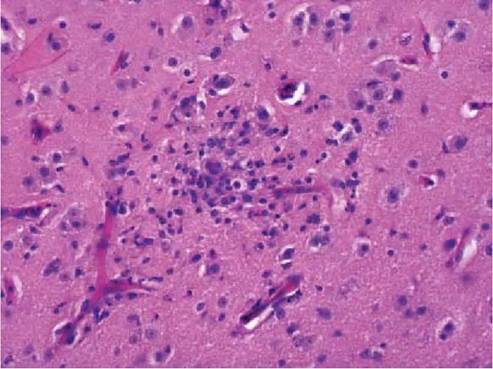
FIGURE 9.4 Non-suppurtaive encephalitis, predominantly characterized by glial nodules is present in some cases of lethal USUV infections. Cerebral cortex, blackbird, haematoxylin and eosin.
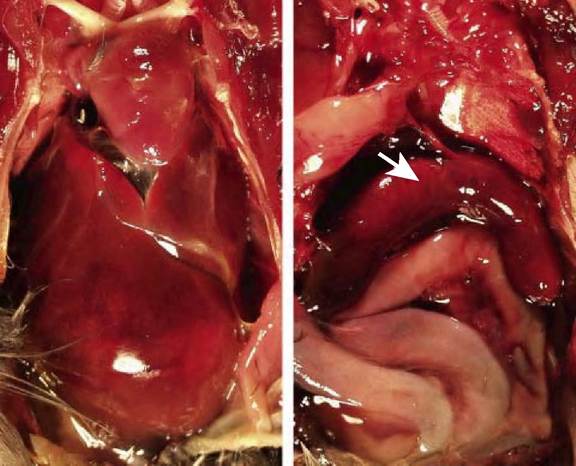
FIGURE 9.3 Blackbird with USUV infection: severe enlargement of (A) liver and (B) spleen.
reasons, including infections with the related WNV, diagnostic assays for discrimination of these two flaviviruses are necessary.
Lesions of USUV and WNV infections are similar, and even the use of IHC will not provide entirely clear results because of potential cross-reactivity of the antibodies used. The most frequently used and reliable method is RT-PCR, both conventional or in a real- time set-up. With this method, viral RNA can be reliably amplified from various tissues. PCR amplification has been complemented by nucleotide sequencing, in order to prove the identity of the virus and to gain information about the virus strain involved. PCR diagnosis using blood samples from sick birds has been proven to be successful1-14). As the course of the disease is short, serological methods are not useful for diagnosis. However, they have provided valuable data on the prevalence and distribution of the infection in various regions of Europe. When performing serological tests it has to be kept in mind that there is a high degree of serological cross- reactivity with other flaviviruses and that only tests based on virus neutralization are able to provide convincingly specific results.No specific control measures of USUV activity are considered necessary, as even in areas with high wild bird mortality epidemics tend to be regionally restricted and to occur only seasonally.
So far there is no significant public health concern regarding USUV. Serological data confirm a relatively large percentage of human infections in endemic areas, but clinical cases presenting as transient rashes are exceptional findings1-19). However, there are two human case reports of immunocompromised individuals diagnosed with neu- roinvasive disease. Experimental infections of chickens and geese could not demonstrate the pathogenicity of USUV in these avian species.