Critical study of business models of music education in the context of hyper-competition
S. Setiadi & S. Dwikardana
Magister Administrasi Bisnis, Universitas Katolik Parahyangan, Bandung, Indonesia
ABSTRACT: At present, competition in the music education business in Indonesia, especially Bandung, can be categorized as a hyper-competition condition characterized by competition that has gone crazy.
The competitive advantages of each company are irrelevant because of the aggressive and innovative movements of competitors. The purpose of this study is to see the assumption that under hyper-competition conditions, businesses will be very difficult to compete if they do not have good competitive advantages, including in the music education business in Bandung. By examining 3 business models in Bandung, namely local school model, course model, and international certification model, this study found that despite the hyper-competition conditions, each of these music school businesses still survives because of the different adjustment factors of consumer needs. This is different from the hyper-competition theory assumption which states that the possibility of a business not surviving if it does not form a new strategy and top management cannot see the changes in market direction that occur, thereby reducing the flexibility of changes is needed in hypercompetition.1 INTRODUCTION
In the music education business, there is a rapidly changing environment, so that to become a market leader in this fast-changing environment, business people must determine the right strategy, especially in hyper-competition conditions, because competition will usually not survive in this condition, thus demanding companies to think more. According to Murthy in his research, it is very difficult to survive in a hyper-competition situation where the worst companies can go bankrupt or experience a drastic decline in income. Therefore, to determine the strategy, Murthy points out that there is top management awareness about current competitive conditions and current markets that can determine competitive advantage with information seeking, information diagnosis, and behavioral choices (Murthy 2014).
These are all aimed at answering strategic problems, where the success alone is a change from top manager cognition (Shang et al. 2010), where competitive strategies relate to questions about how to create competitive advantage in each business and the units in which companies compete (Salavou 2015). This strategy can also be enhanced by competitiveness potential that offers two basic strategies for survival by maintaining strength in a well-known business environment and progress secure all possibilities in the future.On the other hand, three sets of strategy development tools are proposed for competitive market analysis. The principle underlying strategic action is that companies must try to disrupt their own benefits and those of competitors. There are four analyzes that look at how competition accumulates in each of the fields below to identify patterns and predict future strategic actions. The areas of analysis are Cost and Quality, Timing and Know-how, Strongholds, and deep pockets (D’Aveni 2010), and also use a 7-S framework (adapted from the McKinsey framework by D’Aveni) which proposes a series of hypercompetitive approaches to harmonizing strategy. The objective is to develop strategies in three categories, namely vision for disruption - creating temporary advantage, capabilities for disruption - sustaining competitive momentum, tactics for disruption - maintaining the equilibrium.
The hyper-competition concept and the above theory can help us mapping the existing market competition. Some studies that have used the hyper-competition concept found that competitive advantage has no effect if it is not adaptive to the existing changes. However, this study shows that despite the imbalance of power among education business, the models still survive and even grow in this hypercompetition situation.
The study of hyper-competition like Murphy, Sal- avou, and also D’Aveni has an assumption that if competing in hyper-competition market is very hard, it requires a lot of effort from top management and will not be able to survive if it does not have sufficient competitive advantage.
On the other hand, this study found a different result that is even though under hyper-competition conditions, each of these music school businesses persisted. They have their own strengths and weaknesses and can be an initial reflection of the difference strategy in each model to compete.The aim of this study is to answer the question: Does the company in the music education business residing in the hypercompetitive business environment have a particular model that enables them to survive and continue to innovate and create new competitive advantages? Or a hypercompetitive situation does not require companies to have a particular business model as such model can potentially make the company become less innovative and inflexible particularly in creating competitive advantage? Thus, from this research, we can learn what model or strategy has been taken by the companies is what that make them able to compete and continue to survive.
2 RESEARCH METHOD
This study evaluates three business models, namely Efata Cantata-Trinity College (open system model), Yamaha (closed system model), and Do to do Music Edutaiment (local model) to find out how they survive in business competition in the same market share and also in hyper-competition. The following is a hyper-competition framework used to identify strategic actions and patterns of competition among business models.
This framework explains that in the hyper-competition situation, it is required for a company to have awareness from Top Management that can produce the best survival strategy as well as necessary advancement. This strategy coupled with top management cognition will be split into four arenas of analysis. But in this case, the strategy will be more focused on the arena, which becomes a strategy to generate enterprise performance.
The research method is done qualitatively with data collection technique through in-depth iinterview and a six-month observation with Owner of Efata Cantata-Trinity College; Owner of Do to Do Music Edutaiment; and Owner of Yahama Music School Mekar Wangi.
Data analysis for this research uses triangulation. The multiple perspective was also obtained from in-depth interview with customers (parents & students) as a user of music education business. Data triangulation involves using different sources of information to increase the validity of a study (Patton 2002).3 RESULTS
From this research, in terms of the map, there are three types of business models, namely: Open System; Half System; and Closed System. On the one hand, the business model of Local music education embraces Open system, which is characterized by the ability to maintain the flexibility side so that it can adjust to the willingness of consumers; on the other hand, other schools cannot provide it, they survive because the investment is not too large, and the cost of payroll is based on the number of students. In contrast, music schools like Trinity with embraced Half System can survive because of the name of the Centre of Trinity College, and as it offers the level of education of formal music up to S3 level, which cannot be given by other music schools, and do not spend much investment because it emphasizes on cooperation that benefits both parties.
The strengths of Yamaha’s hyper-competition market winners can be categorized as Closed System models, mastering the flow of music business from upstream to downstream independently, providing all the needs with completeness ranging from musical instrument, internationally qualified teachers, curriculum, to its internationally standardized certification as well. This strength makes consumers feel ease and make Yamaha the winner in the market. Nevertheless, in this study, it is found out that the winner in the hypercompetitive market in the music education business in Indonesia does not necessarily have to “kill” their competitors, even though it is the fact that some competing schools show good development.
Mapping of each music school business with hyper-competition framework as well as the 7-Ss framework (adapted from the McKinsey framework by D’Aveni) is provided in Table 1.
This map proposes a set of hypercompetitive approaches to realign strategy. From the tables, it can be concluded that Yamaha seems to be really well prepared with a long-term strategy, which shows that Yamaha has prepared all of the 7-Ss framework and mastered all elements of music from upstream to downstream, which make Yamaha being a leader in the market, but it can be seen that other music school models do not have a strategy like the one by Yamaha still can survive because they answer the needs of customers. This mapping is indeed very necessary to get what is potential and what should be prepared to formulate a strategy in dealing with existing markets.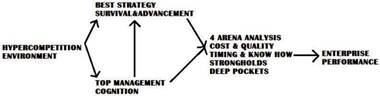
Figure 1. Hyper-competition framework.
4 CONCLUSION
In conclusion, the results of the study state that the theory of hyper-competition using the 4 arenas and 7s strategies can only map competition of the existing competition in the business of music education
Table 1. Four areas analysis of Yamaha, Trinity, and local model.
| Yamaha | Trinity | Local | |
| Cost and | Offering excellent quality and the | When compared to its | The quality offered is not as high as |
| quality | price is equivalent to the quality | competitors, it is still cheaper for | Yamaha and Trinity; however, |
| (C-Q) | offered | the same quality as competitors in the same model business | comparing the price offered, it is cheaper |
| Timing and know-how (T-K) | Very masterful and deep-seated so that mastery is fully controlled from upstream to downstream | Not too concerned about this | Not too concerned about this |
| Strongholds | Mastering upstream to downstream | Nothing, because similar | For its uniqueness, mostly puts |
| (S) | by maintaining its own brand | competitors have what Trinity has | forward the uniqueness of teachers and curriculum but in reality, one teacher does not teach only in one place, so this cannot be a force that can be imitated by competitors |
| Deep | The source of funds used is very | Has a university so that it will be | More to the owner’s investment |
| pockets (D) | large and scattered everywhere, as the funds have many sources, especially coupled with the form of business model Yamaha | a source from the university itself | directly to the source of funds used |
Table 2.
7-Ss Framework of local model, Trinity, and Yamaha| Local | bgcolor=white>TrinityYamaha | |||
| Vision for | Stakeholder | Raises the | Convenience for consumers ranges | |
| disruption | satisfaction | school’s music brand that works or join it | from learning to facilities provided to buying a musical instrument | |
| Strategic | Increases the uniqueness of | In collaboration | Becomes the ruler of the music industry | |
| soothsaying | songs and local music, traditional musical instruments | with high- quality local schools | because it controls from upstream to downstream | |
| Capabilities for disruption | Speed | Low, but flexible as needed | Low | Very highly prepared for the possibility of change |
| Surprise | Low, nothing unique and can distribute competitor | Low | Many strategies that greatly disrupt competitors such as the emergence of new cooperation that can enhance the brand YAMAHA | |
| Tactics for disruption | Shifting rules | Makes a number of musical instrument innovations that are then offered primarily to the music school students, so Yamaha will benefit from school music through the sales of musical instruments | ||
| Signaling intent of selective strategies | - | - | Yes | |
| Simultaneous and sequential strategy thrust | - | - | Very attentive and always want to lead the market | |
in Bandung yet cannot predict companies to remain silent in market competition. The study found that in a highly competitive business environment, the music education business still survives and nothing collapses. Each has a model and excellence because each model can answer specific customer needs. This is in stark contrast to previous research which said that in very tight competition, it would be very difficult to survive and competitive advantage must be replaced.
REFERENCES
D’Aveni, R.A. 2010. Hyper-competition. New York: Simon & Schuster.
Murthy, V. 2014. Learning from praxis: How high-profile winners and losers inform business’s extant theories on longevity, environment, and adaptation. World Journal of Entrepreneurship, Management and Sustainable Development 10(1): 33-47.
Patton, M.Q. 2002. Qualitative Research & Evaluation Methods. 3rd edition. Sage Publications, Inc.
Salavou, H.E. 2015. Competitive strategies and their shift to the future. European Business Review 27(1): 80-99.
Shang, H., Huang, P. & Guo, Y. 2010. Managerial cognition: the sources of sustainable competitive advantage in hyper-competition: A case study. Nankai Business Review International 1(4): 444-459.