The impact of entrepreneurial orientation and business environment towards business performance: Small and medium fashion Moslem industry in Bandung
B. F. Putria & T. Gunawan
Parahyangan Catholic University, Bandung, Indonesia
ABSTRACT: This study aims to investigate the effect of entrepreneurial orientation (EO) and business environment (BE) on business performance (BP).
This research will explore the important aspects that may improve the BP of Moslem fashion small and medium enterprises (SMEs) in Bandung. Differently from previous studies, EO and BP were studied separately. In this study, we try to comprehend the collaboration between EO and BP. This study is important to be conducted because it may provide insight for these businesses in dealing with intense competition in Moslem industry. Thus, firms need to understand their position and competitive environment. This is a quantitative study which involves 60 SMEs of Moslem fashion industry in Bandung. The data will be processed by using ordinary least square (OLS). The result of this paper shows that there is a positive relationship between EO and BE, and BP; thus, SMEs must begin to improve EO since, based on research, EO factor greatly influences BP.1 INTRODUCTION
The fashion industry in the world has evolved and managed to changed people’s perception of the prime function of clothing into a way of expressing identity, creating the welfare of creativity, and linking global society (Pratt et al. 2012). Besides, fashion is regarded as a unique reflection of social, cultural, and environmental characteristics and it also plays a crucial role in complementing one’s self-image (Azuma & Fernie 2003). The Moslem fashion industry is a creative industry sub-sector that is interesting to be studied in Indonesia. Along with the emergence and development of creative industries in Indonesia, the Moslem fashion industry also emerges as important industry that has great potential to be developed in Indonesia. By the fact, Moslem fashion industry has a very tight competition, especially in Bandung which is known as fashion city in Indonesia.
A general tendency in today’s business environment (BE) is the shortening of product and business model life cycles (Hamel 2000). Consequently, the future profit streams from existing operations are uncertain and businesses need to constantly seek out new opportunities. Based on previous studies, we found that one of the factors that may improve firms’ performance is through applying entrepreneurial orientation (EO) (Gunawan et al. 2015). Therefore, they may benefit from adopting an “entrepreneurial strategic orientation”. This involves a willingness to innovate and rejuvenate market offerings, take risks to try out new and uncertain products, services, and markets, and be more proactive than competitors toward new marketplace opportunities (Covin & Slevin 1991). EO refers to a firm’s strategic orientation, capturing specific entrepreneurial aspects of decision-making styles, methods, and practices. As such, it reflects how a firm operates rather than what it does (Lumpkin & Dess 1996). Miller (1983) summarizes the definition of an entrepreneurial firm as “firm that engages in product market innovation undertakes somewhat risky and proactive ventures”. Based on this, several researchers have agreed that EO is a combination of the three dimensions: innovativeness, reactiveness, and risk-taking. Thus, EO involves a willingness to innovate and rejuvenate market offerings, take risks to try out new and uncertain products, services, and markets, and be more proactive than competitors toward new marketplace opportunities. The BE can also affect business performance (BP). In a research, Wispandono (2010) argued that the BE includes factors outside the company that may cause opportunities or threats to the company. Therefore, this study will show whether the EO and BE have a significant effect on BP. The findings of this research will give some contribution to entrepreneurship literature, as well as new views for small and medium business actors in designing business strategy for the future.
2 LITERATURE REVIEW
2.1 Orientation of entrepreneurship
Researchers have agreed that EO is a combination of three dimensions: innovation, proactive, and risktaking. Thus, the entrepreneurial orientation involves a willingness to innovate and rejuvenate market supply, take risks to try uncertain, new, and more proactive products, services and new markets, rather than competitors against new market opportunities (e.g. Covin & Slevin 1991, Miller 1983, Wiklund 1999, Zahra and Covin 1995).
2.2 Business environment
Glueck and Jauch in Wispandono (2010) argued that the BE includes factors outside the company that may cause opportunities or threats to the company. Environmental analysis is defined as the process used by strategic planners to monitor the environmental sector in determining opportunities or threats to the company. Based on the results of research from Wispandono (2010), there are 4 indicators of BE: (1) Business Costs, (2) Availability of Labor, (3) Competitor Level, and (4) Market Dimensions.
2.5 Hypothesized research model
Figure 1 shows the conceptual framework that explains the relationships proposed in our hypotheses, depicting how the interplay between EO and BE affects BP.
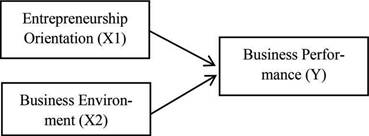
Figure 1. ResearchModel.
3 RESEARCH METHOD
2.3 Business performance
Performance is a multidimensional concept. According to Rivai (2004), BP is something that is produced by a company within a certain period with a certain standard. BP is an assessment of the indicators owned. According Hadjimanolis in Ratna Kusuma- wati (2010), the indicators are: (1) Total Sales, (2) Number of New Products, (3) Amount of Profit. Performance (BP) is at the performance level. The variables in this study were also developed by Lee & Tsang (2001).
2.4 Relationship of entrepreneurial orientation and business environment to business performance
Miller (1983) argues that entrepreneurial-type strategies tend to be more successful when handling customers who are premium on unique innovations and services.
This is consistent with a dynamic environment. The dynamic environment is associated with uncertainty height of customers and competitors as well as high levels of market and trend changes industry innovation (Dess & Beard 1984, Miller 1983). In such a dynamic environment where demand continues to shift, opportunities result in abundant firms that should have higher entrepreunerial orientation to pursue new opportunities. Thus, entrepreuner- ial orientation and BE performance are aligned to be able to work together to change BP. In other words, we would expect the alignment of EO and dynamic environment to have a positive implication on firms performance. Study of Zahra (1993) suggests it is important firms to apply EO in a dynamic growth environment. Thus, we hypothesized:Hypothesis 1: Orientation entrepreneurship has a significant influence on business
performance.
Hypothesis 2: Business environment has a significant influence on business performance.
3.1 Research design and data collection
We collected data in 2018 based on extensive surveys, using questionnaires and interviews with business owners. We selected owners as respondents to this research because they are the souls of small organizations and their “rational analysis” and “creative intuition” are directly reflected in the SME’s decision and its performance (Van Gils 2005). We used convenience sampling, because we consider it fast and appropriate to test hypotheses in the initial stages, with 60 owners representing 60 Muslim fashion stores in Pasar Baru Trade Center Bandung taken as sample members. We combed each floor at Pasar Baru Trade Center Bandung and collected contact addresses. We then distributed questionnaires to all Muslim fashion store owners we found, and followed them with interviews.
3.2 Analytical approach
In processing our data, we used validation test of questioner entrepreneurial orientation variable (X1), BE (X2), and company performance (Y), and then we checked the test reliability.
This test aims to show errors extending consistent measurement results and multiple regression analysis. Data analysis method used in this research is multiple regression analysis. In relation to this research, independent variables are entrepreneurship orientation (X1), BE (X2), and company performance variable (Y). Then, we also performed hypothesis testing by using F-test, to determine the effect of all independent variables simultaneously to the dependent variable.4 RESULTS AND DISCUSSION
The results of research and data analysis are obtained by distributing questionnaires to 60 SMEs clothing businessmen in the city of Bandung. The method of data analysis used is descriptive analysis method.
4.1 Analysis descriptive
In this study with the number of respondents as many as 60 companies, the maximum score that may be obtained is 5 ? 60 = 300 and the minimum score that may be obtained is 1 ? 60 = 60. If divided into five categories, then the score range of each category is 48.
Interpretation interval amount of respondent response score can be seen in Table 1.
Based on Table 2, it can be seen that the average total score of respondents on statements on variables EO 232.5, BE 218.846, and BP 225, and when referring to the categorization guidelines contained in the interval interpretation table, the number of respondents’ scores can be categorized as Agree.
4.2 Test validity and reliability
Validity test result using the correlation of the validity index of the question item is considered valid if the validity of the question index ≥0.2108. The reliability test used the Cronbach’s alpha method and
Table 1. Respondents answer recapitulation against variables.
| No | Interval | Categories |
| 1 | 60-108 | Very Much Disagree |
| 2 | 109-156 | Disagree |
| 3 | 157-204 | Neutral |
| 4 | 205-252 | Aggre |
| 5 | 253-300 | Very Much Agree |
Table 2.
Score of respondents.| Means Variable | Total Score |
| Means Variable EO | 232.5 |
| Means Variable BE | 218.846 |
| Means Variable BP | 225 |
Table 3. Validity and reliability test results.
| Questions | Validity index | Info | Questions | Validity index | Info |
| 1 | 0.6004 | Valid | 5 | 0.8100 | Valid |
| 2 | 0.6231 | Valid | 6 | 0.8022 | Valid |
| 3 | 0.6219 | Valid | 7 | 0.6814 | Valid |
| 4 | 0.7144 | Valid | 8 | 0.6729 | Valid |
Cronbach alpha > 0.70
| Questions | Validity index | Info | Questions | Validity index | Info | ||
| 9 | 0.2907 | Valid | 16 | 0.6635 | Valid | ||
| 10 | colspan=2 bgcolor=white>0.3834Valid | 17 | 0.4332 | Valid | |||
| 11 | 0.3919 | Valid | 18 | 0.5253 | Valid | ||
| 12 | 0.3180 | Valid | 19 | 0.6869 | Valid | ||
| 13 | 0.2407 | Valid | 20 | 0.5636 | Valid | ||
| 14 | 0.2660 | Valid | 21 | 0.6447 | Valid | ||
| 15 | 0.5197 | Valid | |||||
Cronbach alpha > 0.70
| Questions | Validity index | Info | Questions | Validity index | Info |
| 22 | 0.7842 | Valid | 26 | 0.8134 | Valid |
| 23 | 0.8262 | Valid | 27 | 0.8032 | Valid |
| 24 | 0.7301 | Valid | 28 | 0.8315 | Valid |
| 25 | 0.6870 | Valid | 29 | 0.7458 | Valid |
| 30 | 0.7511 | Valid | |||
| Cronbach alpha > 0.70 | |||||
the result is considered reliable if the reability coefficient is greater than 0.70.
Based on Table 3, all items of question has a validity index greater than 0.2108. It means the questionnaires submitted are all valid and the data can be used for further analysis. Then, the value of reevaluation variable coefficient is greater than 0.70, and thus can be concluded that the questionnaire is reliable.
4.3 Multiple regression analysis
By using SPSS software, the results obtained from multiple linear regression analysis are as follows:
Table 4. Coefficients
Coefficientsa
| Model | Unstandardized Coefficients | Standardized Coefficients | t | Sig. |
| B Std. Error | Beta | |||
| (Constant) | 9.316 | 6.374 | 1.462 | 0.149 |
| EO | 0.605 | 0.139 0.496 | 4.351 | 0.000 |
| BE | 0.120 | 0.114 0.119 | 1.048 | 0.299 |
a Dependent Variable: BP.
| Table 5. | Model summary. | |||
| Model | R | R Square | Adjusted R Square | Std. Error of the Estimates |
| 1 | 0.529a | 0.279 | 0.254 | 3.867 |
a Predictors: (Constant), BE, EO.
Based on Table 4, EO has a significant effect on BP but BE has no significant effect on BP. However from Table 5, the coefficient of determination or R square is obtained as 0.279 or 27.9%. This shows that EO (X1) and BE (X2) is simultaneously contributing to influence BP (Y) (27.9%). While the rest of 100% - 27.9% = 72.1% is the influence of other variables that are not researched. The finding of this study is quite interesting because the BE does not have a significant effect. Based on our observation, this may occur because entrepreneurs have a high EO, especially seen from their desire to achieve goals and belief that success is an effort from within themselves, and the attitude of the entrepreneurs who are always proactive and innovate that make them more confident in running their business. The entrepreneur characteristics have greatly affected the success of the BP (Idrus, 1999). These characteristics are: self-confidence, task result-oriented, risktaker, originality, future-oriented. The success of a business is largely determined by how much of these traits are inherent in the spirit of the entrepreneur.
4.4 Simultaneous hypothesis testing (F-statistic test)
Table 6. Annova.
| Annovaa | |||||
| Model | Sum of Squares | df | Mean Squares | F | Sig. |
| 1 Regression | 330.693 | 2 | 165.347 | 11.055 | .00b |
| Residual | 852.557 | 57 | 14.957 | ||
| Total | 1183.250 | 59 | |||
a Dependent Variable: BP. b Predictors: (Constant), BE, EO.
Based on Table 6, the calculated F-value is 11.055 > F-table (3.16). In accordance with the result, H1 is accepted and H2 is rejected, thus both EO and BE significantly influence the company performance.
5 CONCLUSION
Based on the results of data analysis and discussion, it is true that there is a significant influence of entrepreneurship orientations on company performance. However, in this study, the BE has not significantly affected the BP, so that according to the hypothesis testing criteria, H1 is accepted and H2 is rejected, but EO and BE simultaneously have a significant effect on BP. Based on observations in the field, this might be caused by entrepreneurs who have a high EO, especially seen from their desire to achieve goals and the belief that success is an effort within themselves. In addition, entrepreneurial attitudes are always proactive and innovative to make them more confident in running their business. Therefore, improving the performance of Muslim fashion SMEs in the city of Bandung is inseparable from the entrepreneurial ability to understand EO. In this harsh environment, we recommend SMEs to maintain an entrepreneurial spirit to remain high to win the competition and perform well. In addition, entrepreneurs must be more active in finding new ideas, continue to innovate, and also focus on changing the BE in an effort to maintain the stability of their business.
REFERENCES
Azuma, N. & Fernie, J. 2003. Fashion in the globalized world and the role of virtual networks in intrinsic fashion design. Journal of Fashion Marketing and Management: An International Journal 7(4): 413-427.
Covin, J.G. & Slevin, D.P. 1991. A conceptual model of entrepreurship as firm behaviour 7-25.
Covin, J. & Lumpkin, T. 2011. entrepreneurial orientation theory and research: reflections on a needed construct. Entrepreneurship: theory and practice: 855-872.
Covin, J. & Miles, M. 1999. Corporate entrepreneurship and the pursuit of competitive advantage. Entrepreuner- ship: theory and practice: 47-63.
Dess, G.G. & Beard, D.W. 1984. Dimensions of organizational task environments. Administrative science quarterly: 52-73.
Gunawan, T., Jacob, J. & Duysters, G. 2015. Network ties and entrepreunerial orientation: innovative performance of SMEs in a developing country.
Hamel, G. 2000. Leading the revolution. Harvard Univ: Press, Cambridge, MA.
Idrus, M.S.I. 1999. Strategi pengembangan kewirausahaan (Entrepreneurship) dan peranan perguruan tinggi dalam rangka membangun keunggulan bersaing (competitive advantage) bangsa Indonesia pada millenium ketiga. Makalah tidak dipubilkasikan, Universitas Brawijaya.
Lee, D.Y. & Tsang, E.W. 2001. The effects of entrepreneurial personality, background and network activities on venture growth. Journal of management studies 38(4): 583-602.
Lumpkin, G., & Dess, G.G. 1996. Clarifying the entrepreneurial orientation construct and linking it to performance. Acad manage. Rev. 21: 135-172.
Miller, D. 1983. the correlates of entrepreneurship in three types of firms. Management Science: 770-791.
Pratt, A., Borrione, P., Lavanga, M. & D'Ovidio, M. 2012. International change and technological evolution in the fashion industry.
Kusumawati, R. 2010. Pengaruh Karakteristik Pimpinan Dan Inovasi Produk Baru Terhadap Kinerja Perusahaan Untuk Mencapai Keunggulan Bersaing Berkelanjutan. AKSES: Jurnal Ekonomi dan Bisnis 5(9).
Rivai, B. 2004. Manfaat Penilaian Kinerja. Jurnal http://jur nalsdm.blogspot.com/2004/04/penilaian-|kinerja-karya wan-definisi.htm.
Van Gils, A. 2005. Management and governance in Dutch SMEs. European Management Journal 23(5): 583-589.
Wiklund, J. 1999. The sustainability of the entrepreneurial orientation—performance relationship. Entrepreneurship theory and practice 24(1): 37-48.
Wispandono, W. & Moch, R. 2010. pengaruh lingkungan bisnis terhadap kinerja pengrajin industri batik di kabu- paten Bankalan. Jurnal Mitra Ekonomi dan Manajemen Bisnis 1 (2) Oktober 2010.
Zahra, S.A., 1993. Environment, corporate entrepreneurship, and financial performance: A taxonomic approach. Journal of business venturing 8(4): 319-340.
Zahra, S.A. & Covin, J.G. 1995. Contextual influences on the corporate entrepreneurship-performance relationship: A longitudinal analysis. Journal of business venturing 10(1): 43-58.