The effect of strategic entrepreneurship to innovation with creativity as a moderating variable at culinary industry in Bandung city
A.L. Lahindah
Sekolah Tinggi Ilmu Ekonomi Harapan Bangsa, Bandung, Indonesia
ABSTRACT: Culinary industry in Bandung has become one of the national culinary tourism destinations.
This condition arises due to the richness of Bandung culinary variations and innovations. Innovation is an instrument for realizing an entrepreneurial economy, which encourages the culinary industry to exploit the opportunity for profit. This research was conducted on 203 culinary actors in Bandung, to find the effect of the strategic entrepreneurship variables to innovation on culinary industry in Bandung through creativity variables as a moderation variable. By using partial least square technique, it is found that the strategic variables of entrepreneurship have effects on innovation variable, while creativity as a moderating variable has no impact on the relationship.1 INTRODUCTION
Creative economy is the trigger of the birth of industry 4.0. This era was followed by the birth of new innovative and creative business models. The birth of industry 4.0 began with the emergence of generation Z who had a very high level of innovation and creativity. Bandung is designated as the city of national culinary destinations by the Ministry of Tourism along with other cities namely Bali, Solo, Semarang, and Yogyakarta (Budhiman 2017). The Mayor of Bandung stated that this condition occurred because of the many culinary varieties of Bandung and innovation.
According to data from the Bandung City Culture and Tourism Office, the culinary industry that has permits in August 2014 totaled 660 restaurants. This number consists of three classifications: 301 restaurants, 13 bars, and 346 canteens. From the classification, the culinary business in Bandung has a variety of business themes and specifications starting from the culinary business that serves certain types of food to culinary businesses that even offer a variety of the beauty of nature.
This intense competition makes culinary players in Bandung to have a certain strategy for survival. Innovation is an instrument to realize entrepreneurial economy (Drucker 1985). Some researchers argue that the key to prosperity creation is how organizations can focus on creating new products, creating new processes, and creating new markets (Covin & Slevin 2002); (Kusumaward- hani et al. 2012). If innovation is the key to creating prosperity, culinary practitioners who understand how to innovate will survive in this competition. However, Shane & Venkataraman (2000) revealed that the basis of prosperity creation was found by looking for and exploiting opportunities for profit.This study attempts to analyze the factors of human capital and organizational social capital and relate them to innovation variables. Human resources are important variables for organizational success (Pfeffer 1994, Hitt et al. 2001a, b) where human resources include skills, abilities, knowledge, and experience.
Social capital is a series of organizational capital that includes relationships between individuals and between individuals and organizations. Variables of human capital and social capital of creative industry players then join the entrepreneurial variable which includes the entrepreneurial mindset and entrepreneurial culture. Entrepreneurship leadership which is rooted in the ability to know the opportunities and behaviors that produce superior organizational performance is called strategic entrepreneurship (Ireland et al. 2003).
Strategic entrepreneurship is expected to illustrate the condition of the culinary industry in Bandung, which is influenced by creativity and innovation that can make culinary actors in the city of Bandung survive. Creativity is sensitivity in dealing with problems (Cheng 2007) to form unusual patterns and then create ideas that ultimately create innovation (Tang 1998, Cook 1998).
Based on that situations, this research objective is to understand the effect of strategic entrepreneurship to innovation on culinary industry in Bandung City with creativity as a moderating variable.
1.1 Strategicentrepreneurship
Strategic entrepreneurship includes a combination of the ability to recognize the opportunities and behaviors that result in superior organizational performance (Ireland et al. 2003). Strategic entrepreneurship is a very unique and specific concept because of its ability to create organizational well-being.
Ireland et al. (2003) suggested that entrepreneurship and strategic management focus on growth and the creation of organizational welfare. The creation of welfare and growth of organizations are interconnected with each other even though growth is a predictable factor that can help organizations create prosperity and build economies of scale as much as market forces. Strategic entrepreneurship creates output that is an additional resource and contributes to achieving competitive advantage.
Strategic entrepreneurship consists of actions with a strategic perspective to create organizational skills and identify opportunities (Ireland et al. 2003). Without these skills, the organization will not innovate and will be disturbed.
1.2 Creativity
Creativity is an important part of research on creative behavior. How to assess creativity can be seen from how many new products, processes, and market systems are produced to deal with environmental dynamics and limited resources. Creativity is a response or level of sensitivity in dealing with problems (Cheng 2007), or forming unusual patterns to create ideas that ultimately create innovation (Tang 1998, Cook 1998).
1.3 Innovation
Innovation is an instrument to realize an entrepreneurial economy (Drucker 1985). Innovation comes from Latin “innovatio” or “innovo” which means updating or making something new (Abouzeedan 2011). Innovation can be seen in several characteristics such as introducing new products, introducing new methods, opening new markets, acquiring new sources of raw materials, and updating organizations (Schumpeter 1934). With the realization of innovation, delivery of products, processes, marketing techniques, and organizational updates can be carried out (Mazzarol & Rebound 2008) through new technology, intellectual property, and business and physical change (Abouzeedan 2011).
1.4 The effect of strategic entrepreneurship to innovation with creativity as a moderation variable
Strategic entrepreneurship consists of finding a balance between looking for potential opportunities (to identify areas of activity in the future) and how organizations experience learning, the absorption of new knowledge and technology, and several other strategies that bring organizations towards prosperity and achievement.
Ireland et al. (2003) argue that strategic entrepreneurship includes entrepreneurial action with a strategic perspective so that the organization is able to identify opportunities. Organizations that have the ability to exploit opportunities will innovate and ultimately achieve their goals. Innovation is a real act of sensitivity when individuals face problems (Cheng 2007), and is a measure of the level of creativity that is formed as an unusual pattern (Tang 1998, Cook 1998). Thus, innovation as an action to achieve competitive advantage of an organization arises because of the existing strategic entrepreneurial spirit, which is supported by creativity.
From the above explanation, the hypothesis compiled in this study is:
H1: Strategic Entrepreneurship influences innovation with creativity as a moderating variable.
2 RESEARCH METHODOLOGY
This study is a causal explanative research to understand the influence of strategic entrepreneurial causal relationships, creativity, and innovation. Data was taken from 203 culinary actors in the city of Bandung from 660 culinary actors registered in the city of Bandung. The questionnaire was distributed to culinary owners or managers by simple random sampling method. By using partial least square (PLS) method, the data is analyzed to find out the hypothesis. In-depth interviews were conducted to ascertain the results after the data was analyzed.
3 RESULTS AND DISCUSSION
In this research, WarpPLS 3.0 software was used to test the previously described hypothesis.
The following research models were tested to answer the research questions that have been stated previously, as follows:Figure 1 shows that strategic entrepreneurship influences innovation but the influence of creativity moderating on the relationship between strategic entrepreneurship and innovation is not significant with a P value of 0.28. These results indicate that creativity is not a moderating variable in the relationship between strategic entrepreneurship and innovation. Furthermore, several main outputs will be interpreted from the results of the testing of the moderation model above, as follows:
Table 1 shows that fit model indicators have been met, i.e., APC and ARS are significant with P value
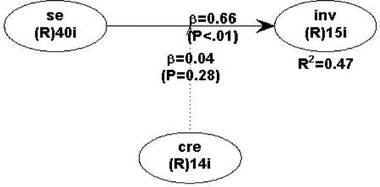
Figure 1. Research model.
Source: WarpPLS 3.0, 2016.
Table 1. Model fit indices and P values.
Average path coefficient (APC)=0.352, Pcan be facilitated. Developing an entrepreneurial culture in an organization will continuously create cultural patterns of member organizations that want to continuously develop and create innovation. The success of cultivators in developing their entrepreneurial culture is due to the form of culinary organization in Bandung city on average on the small and medium scales. On the scale of small and medium organizations, the formation of culture is usually easier and more focused.
Effective entrepreneurial leadership gains information disclosure with organizational members to describe innovations that may be disengaged as a potential advantage (for example, stimulating the development of new competitive advantages). By stimulating the development of new products, it will create a product innovation that is an advantage for the organization. Entrepreneurship leadership in the culinary sub-sector in Bandung influences Innovation. This condition can occur, because most
culinary in Bandung are companies that are in the middle business category, and in this category, owners have full power to manage and develop the company (Mintzberg et al.
1998). In the culinary sub-sector in Bandung city, it is found that the members of the company are very much dependent on the owner or manager (in line with the concept of “design school” put forward by Mintzberg, Ahl- strand & Lampel 1998). Therefore, Product Innovation happens due to the spirit of Leadership Entrepreneurship.References
Abouzeedan, A. 2011. SME Performance and Its Relationship to Innovation. Linkoping, Sweden: Linkoping University.
Alvarez, S. & Barney, J. 2002. Resources-based theory and the entrepreneurial firm. In M. Hitt, R. Ireland, S. Camp, & D. Sexton, Strategic Entrepreneurship: Creating a new mindset (pp. 89-105). Oxford: Blackwell Publishers.
Budhiman, I. 2017, September 29. Bisnis.com. Retrieved from Bisnis.com: http://bandung.bisnis.com/read/ 20170929/13/574517/emil-bersyukur-bandung-ditetap kan-sebagai-destinasi-wisata-kuliner-nasional
Cheng, Y. 2007. An Examination of the Relationship Between Creative Potential and Personality Types Among American and Taiwanese College Student of Teacher Education. Michigan: Eastern Michigan University.
Cook, P. 1998. The Creative advantage- is your organization the leader of the pack? Industrial and Commercial Training, 179-184.
Covin, J. & Slevin, D. 2002. The Entrepreneurial imperatives of Strategic Leadership. In M. Hitt, R. Ireland, S. Camp, & D. Sexton, Strategic Entrepreneurship: Creating a new Mindset (pp. 309-327). Oxford: Blackwell Published.
Drucker, P. 1985. Innovation and Entrepreneurship. London, UK: Heinemann.
Hitt, M., Bierman, L., Shimizu, K. & Kochhar, R. 2001a. Direct and moderating effect of human capital on strategy and performance in profesional service firm: A resource-based perspective. Academy of Management Journal 44, 13-28.
Hitt, M., Ireland, R. & Harrison, J. 2001b. Mergers and aquisitions. In M. Hitt, R. Freeman, & J. Harrison, Handbook of Strategic Management (pp. 384-408). Oxford: Blackwell Publishers.
Ireland, R., Hitt, M. A. & Sirmon, D. G. 2003. A Model of Strategic Entrepreneurship: The Construct and its Dimentions. Journal of Management Vol. 29 No. 6, 963989.
Kusumawardhani, A., McCarthy, G. & Perera, N. 2012. Autonomy and innovativeness: understanding their relationship with the performance of Indonesian SMEs. The Joint ACERE-DIANA International Entrepreneurship Conference (pp. 1-16). Fremantle, Western Australia: ACERE-DIANA.
Mazzarol, T. & Rebound, S. 2008. The Role of Complementary Actors in The Development of Innovation in Small Firm. International Journal of Innovation Management 12(2), 223-253.
Mintzberg, H., Ahlstrand, B. & Lampel, J. 1998. Strategy Safary. United States of America: The Free Press, a Division of Simon & Schuster, Inc.
Pfeffer, J. 1994. Competitive advantage through people. Boston: Harvard Business School Press.
Schumpeter, J. 1934. The theory of economic development. Cambridge, Massachusetts: Harvard University Press.
Tang, H. 1998. An Integrative model of innovation in organization. Technovation, Vol.18, 297-309.