Evaluating entrepreneurship ecosystem at different phases of entrepreneurship activity
G. Pawitan & C.B. Nawangpalupi
Parahyangan Catholic University, Bandung, Indonesia
N.T. Tuan
University of Social Sciences and Humanities, Vietnam National University, Ho Chi Minh City, Vietnam
ABSTRACT: The entrepreneurship ecosystem plays a key role in achieving global competitiveness.
This paper aims to analyze entrepreneurship ecosystem in different phases of entrepreneurial activities in achieving global competitiveness. The GEM model is used to analyze the entrepreneurship ecosystem for Indonesian entrepreneurs in 2015-2017. The entrepreneurs’ activities were classified into three phases, namely nascent, new business, and established business. Meanwhile, the entrepreneurship ecosystem is defined into factors of entrepreneurial framework conditions. The result shows that there are different conditions faced by the entrepreneurs at different phases. All entrepreneurs need firm and definite regulations to support their business. Innovation or research and development (R&D) transfer is not very important for nascent entrepreneurs, but it is one of the most important factors for new and established businesses. The competitiveness and the strategies to win the competition are more important for those who have been operating the business for more than 3 months.1 INTRODUCTION
1.1 Important role of entrepreneurship
Fritsch & Schmude (2007) noted that entrepreneurship has several important factors in regional dimension. Some factors are related to entrepreneurial attitude, aspiration, performance, and also local environment for entrepreneurship, as quoted below:
Differences in startup rates, in entrepreneurial attitudes, and the success of newly founded businesses between regions indicate a distinct importance of space and the local environment for entrepreneurship (Fritsch & Schmude 2007).
Literatures stated the importance of entrepreneurship as a key driver in achieving socio-economic development in the social, cultural, and political context, including new job creation, innovation, and social value creation (Fritsch & Wyrwich 2017, Mueller et al.
2008, Rocha 2012). Individuals, in relation to their environment, perform their activity to gain a better life, either economically or politically. The resulting entrepreneurship activity is motivated by the entrepreneurial spirit, which contains entrepreneurial attitude, aspiration, and activity (Acs et al. 2013, Stough & Nijkamp 2009). This activity requires attitude and aspiration, but then the entrepreneurship activities are supported by entrepreneurship ecosystem (Fuerlinger et al. 2015). Hence, understanding the entrepreneurship ecosystem becomes a necessity to develop a good entrepreneurship.Isenberg (2014) defined entrepreneurship ecosystem as a dynamic community within a geographic region, composed of varied and inter-dependent actors, factors, and processes that evolve over time and whose actors and factors coexist and interact to promote new enterprise creation.
The literatures discussed the importance of entrepreneurship, and also the role of the entrepreneurship ecosystem in promoting the enterprises. However, still there is a lack of discussion on entrepreneurship ecosystem priority in each phase of their entrepreneurship activities. The knowing of priority for each phase will guide policy-maker to design a better intervention program that fits with the entrepreneurs’ needs.
This paper aims to compare the entrepreneurship ecosystem in different phases of entrepreneurship activities. The research question “What is the priority of entrepreneurship ecosystem according to the entrepreneur’s perception at different phases of their activities?”
1.2 Entrepreneurship framework: GEM model
Global Entrepreneurship Monitor (GEM) has developed a conceptual framework that identifies essential elements within the relationship between entrepreneurship and economic growth and how these elements interact with each other (Kelley et al. 2016, Nawangpalupi et al. 2014). The conceptual framework incorporates three main components (Levie & Autio 2008), namely capture aspects
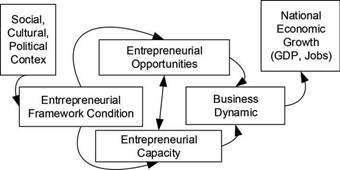
Figure 1.
Entrepreneurship framework based on GEM model.of entrepreneurial ecosystem, entrepreneurial opportunities and capacity, and entrepreneurial activity (see Figure 1).
The entrepreneurship ecosystem in the GEM model is defined by entrepreneurial framework conditions (Nawangpalupi et al. 2014). The entrepreneurship ecosystem measures supporting environmental factors for entrepreneurs in running and developing their ventures.
2 RESEARCH METHOD
2.1 Designofstudyanddata
The GEM defines nine entrepreneurial framework conditions (EFC), namely (A) entrepreneurial finance, (B) government policy, (C) government entrepreneurship programs, (D) education and training, (E) research and development transfer, (F) commercial and professional infrastructure, (G) market openness, (H) physical infrastructure, and (I) cultural and social norms. The entrepreneurship activity’s phase in the GEM model is defined by three phases (Figure 2) which initially involves in setting up a business - nascent, then grew a new business up to
3.5 years ventures, and finally blossoming into an established business. The surviving entrepreneurs (more than 3.5 years) are considered to own and manage an established business.
The data was sourced from the GEM - Adult Population Survey, conducted in 2015-2017, covering 23 major provinces in Indonesia, with 11,702
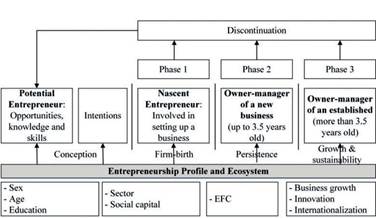
Figure 2. Phases of entrepreneurial activities.
random selected adult of ages 18-64 years. The respondents were collected from 23 provinces in Indonesia covering 80% of the population.
Based on GEM conceptual framework, entrepreneurial ecosystem is called as entrepreneurial framework conditions (EFC). The EFC measures supporting factors for entrepreneurship activity. The entrepreneurs were asked to complete a closed questionnaire consisting of 55 indicators about factors relating to the conditions that make up the country’s entrepreneurial environment (Nawangpalupi et al.
2015). Each response was measured on a 5-point scale, which is designed as 1=completely unsupported condition to 5=completely supported condition. The variables are defined as follows:a. Variable: EE = Entrepreneurship Ecosystem, scale 1 = completely unsupported condition to 5 = completely supported condition, dimension: EEa = Entrepreneurial finance (8 indicators), EEb = government policy (7 indicators), EEc = government entrepreneurship programs (6 indicators), EEd = education and training (6 indicators), EEe = R&D transfer (6 indicators), EEf = commercial and professional infrastructures (6 indicators), EEg = market openness (6 indicators), EEh = physical infrastructures (5 indicators), EEi = cultural and social norms (5 indicators).
b. Variable: PEA = phase of entrepreneurship activities, scale 1 = nascent, 2 = new business, 3 = established business.
2.2 Method
The research question is answered by using Principal Component Analysis (PCA). PCA is a linear statistical approach for analyzing the covariance structure of multidimensional data Xij, where i= 1,...,m, and j= 1,...,n. In this paper, X1j is EEa for j= 1,...,8, X2j is EEb for j= 1,...,7, and so on. Meanwhile, the PEA is a grouping variable.
It is assumed that indicators of entrepreneurship ecosystems were correlated each other, hence it is possible to extract most of the variability present in the (m?n) indicators into k principal components that are retained to capture the majority of variability in Xij. The first principal component is considered as a basis to arrange priority of the entrepreneurship ecosystem to be developed, since it represents the largest Xij’s variance explained (Johnson & Wichern 2014). The priority arrangement is defined by using its components loadings.
2.3 Entrepreneurs profile
There are 3375 entrepreneurs who consist of 17% nascent, 33% new business, and 50% established. Based on gender, 48.1% are male entrepreneurs and 51.9% are female.
The entrepreneurs’ ages were 12.6% of 18-24 years, 28.6% of 25-34 years, 27.6% of 35-44 years, 19.5% of 45-54 years, and 11.7% of 55-64 years. The entrepreneur profiles show that the number of female entrepreneurs was higher, but their ages are mostly within 25-34 years.The types of their business for the early entrepreneurship activities were classified into 3.5% extractive, 11.7% transforming, 6.0% services, and 78.8% consumer-oriented. Meanwhile, the established business activities were classified into 4.6% extractive, 13.3% transforming, 5.3% services, and 76.8% consumer-oriented.
2 RESULTS AND DISCUSSION
2.1 Principal component analysis for each phase
Priority of the entrepreneurship ecosystem for each entrepreneurship phase was determined by applying PCA for each entrepreneurship phase. The results are presented in Tables 1-3.
Table 1 shows the priority arrangement of entrepreneurship ecosystem for the nascent entrepreneurship activities which are mostly dominated by education and training, government policy, bureaucracy, regulation, licensing, government entrepreneurship program, R&D transfer, and entrepreneurial finance. The first and second priorities of entrepreneurship ecosystem indicate a prominent role of education, training, and government in fostering individuals to become entrepreneurs. It is interesting business in terms of funding. R&D transfers are also considered as priority for the nascent entrepreneurs. It’s the reason why majority of youth entrepreneurs are around 25-34 years old.
Table 1. Priorities of nascent’s entrepreneurship ecosystem ordered by component loading.
| D* | Aspect/Indicators | L* |
| EEd | Teaching in primary and secondary education provides adequate attention to entrepreneurship and new firm creation | 0.99 |
| EEd | Teaching in primary and secondary education provides adequate instruction in market economic principles | 0.99 |
| EEc | The people working for government agencies are competent and effective | 0.99 |
| EEb | Government bureaucracy, regulations, and licensing requirements are not excessively difficult for new and growing firms | 0.99 |
| EEb | Government policies consistently favor new firms | 0.99 |
| EEe | New tech, science, and other knowledge are efficiently transferred from universities and public research centers | 0.99 |
| EEa | Professional Business Angels funding available | 0.99 |
Source: first principal component for nascent.
Note: D=dimension, L=component loading.Table 2. Priorities of entrepreneurship ecosystem for new business ordered by component loading.
| D* | Aspect/Indicators | L* |
| EEe | The science and technology base efficiently supports the creation of world-class new technology-based ventures | 0.88 |
| EEd | Colleges and universities provide good and adequate preparation for starting up and growing new firms | 0.84 |
| EEe | New and growing firms can afford the latest technology | 0.82 |
| EEd | The vocational, profession, and continuing education systems provide good and adequate preparation for starting up and growing new firms | 0.77 |
| EEg | New and growing firms can enter markets without being unfairly blocked by established firms | 0.58 |
Source: first principal component for new business.
Note: D=dimension, L=component loading.
Table 3. Priorities of entrepreneurship ecosystem for established business ordered by component loading.
| D* | Aspect/Indicators | L* |
| EEb | Government policies consistently favor new firms | 0.935 |
| EEh | It is not too expensive for a new or growing firm to get good access to communications | 0.910 |
| EEb | The amount of taxes is NOT a burden for new and growing firms | 0.870 |
| EEh | The physical infrastructures provide good support for new and growing firms | 0.868 |
| EEa | Debt funding available for new and growing firms | 0.840 |
Source: first principal component for established business. Note: D=Dimension, L= component loading.
For the new business (see Table 2), the first principal components consist of education and training, R&D transfer, and market openness. It is a typical ecosystem for the new business in encountering the market. They need education and training, technology transfers, and also market openness.
For the established business (see Table 3), the first principal factors are consistency of government policy, taxes, regulations, and financial support. They are followed by physical infrastructures/com- munication and entrepreneurial finance.
2.2 Discussion
These findings reveal that financial support is essential for starting up a business (for nascent entrepreneurs) and also to develop the business (for established businesses), while the new entrepreneurs require sustainable access to the market and a good physical infrastructure. All entrepreneurs need firm and definite regulations to support their business.
Innovation or research and development (R&D) transfer is a priority for nascent entrepreneurs, and new businesses. Innovation that represents the support for creating new products and new technologies, including the use of proprietary technology, is important when a business enters the world of real competition. The competitiveness and the strategies to win the competition are more important for those who have been operating the business for more than 3 months (where nascent ones are those just started their businesses and are under three months). This issue is an alarming message for Indonesia. Based on the Global Entrepreneurship Index of 2017, Indonesia has a very low absorption of technology, commenting to a value of 0.03 and this has been mentioned as the weakest area in Indonesian entrepreneurship. Hence, to improve the entrepreneurial climate and to strengthen the entrepreneurship ecosystem, it is important to prioritize the enforcement of policies and programs in the R&D transfer.
Based on these results, then the policy-makers may focus on suitable programs related with strengthening a particular entrepreneurship ecosystem. Such as, the nascent and new businesses need an innovation program in developing their enterprises. Meanwhile, the established business needs a supporting ecosystem by reforming policy, tax, and regulations, financial support, and physical infrastructures.
3 CONCLUSIONS
Each entrepreneurship activity has different characteristics and conditions, thus revealing that entrepreneurship ecosystem for each phase gives important information for policy-makers or entrepreneurs themselves.
Comparing entrepreneurship ecosystem among activities of their doing business, indicates a different priority between nascent, new business, and established business. The principal factors of entrepreneurship ecosystem for nascent entrepreneurs are mostly dominated by education and training, government policies, bureaucracy, regulation, and licensing.
The new business mostly considers market openness and R&D transfers, and the established business prioritizes physical infrastructures, consistency of government policy, taxes, regulations, and financial support.
ACKNOWLEDGMENTS
This paper was part of research project supported by a grant from the Indonesian government, the Ministry of Research, Technology, and Higher Education 2016-2018 (NES).
REFERENCES
Acs, Z. J., Audretsch, D. B. & Lehmann, E. E. 2013. The knowledge spillover theory of entrepreneurship. Small Business Economics 41(4): 757-774.
Fritsch, M. & Schmude, J. 2007. Entrepreneurship in the Region: Springer.
Fritsch, M. & Wyrwich, M. 2017. The effect of entrepreneurship on economic development—an empirical analysis using regional entrepreneurship culture. Journal of Economic Geography 17(1): 157-189.
Fuerlinger, G., Fandl, U. & Funke, T. 2015. The role of the state in the entrepreneurship ecosystem: insights from Germany. Triple Helix 2(1): 1-26.
Isenberg, D. 2014. What an Entrepreneurship Ecosystem Actually Is. Harvard Business Review.
Johnson, R. & Wichern, D. 2014. Applied Multivariate Statistical Analysis (Sixth Edition ed.): Pearson Education Limited.
Kelley, D., Singer, S. & Herrington, M. 2016. Global Entrepreneurship Monitor 2015/16 Global Report. Boston, USA: Global Entrepreneurship Research Association.
Levie, J. & Autio, E. 2008. A theoretical grounding and test of the GEM model. Small Business Economics 31 (3): 235-263.
Mueller, P., van Stel, A. & Storey, D. J. 2008. The effects of new firm formation on regional development over time: The case of Great Britain. Small Business Economics 30(1): 59-71.
Nawangpalupi, C. B., Pawitan, G., Gunawan, A., Widyar- ini, M., Bisowarno, B. H. & Iskandarsjah, T. 2015.
Global Entrepreneurship Monitor 2014 Indonesia Report. Bandung, Indonesia: UNPAR PRESS.
Nawangpalupi, C. B., Pawitan, G., Gunawan, A., Widyar- ini, M. & Iskandarsjah, T. 2014. Global Entrepreneurship Monitor 2013 Indonesian Report: Universitas Katolik Parahyangan.
Rocha, E. A. G. 2012. The Impact of the Business Environment on the Size of the Micro, Small and Medium Enterprise Sector; Preliminary Findings from a CrossCountry Comparison. Procedia Economics and Finance 4: 335-349.
Stough, R. & Nijkamp, P. 2009. Knowledge spillovers, entrepreneurship and economic development. The Annals of Regional Science 43(4): 835.