Creativity in capital management by young entrepreneurs in West Java SMEs
I. Barlian & E.M. Manurung
Parahyangan Catholic University, Bandung, Indonesia
ABSTRACT: The resilience of small- and medium-scale businesses during the economic crisis is no longer doubted.
While other companies with large capital collapsed due to the crisis, small and medium-scale businesses actually survived and were persistent to run. The research is a continuation of previous research which was conducted in 2014-2015 on several small- and medium enterprises in West Java. The previous research was conducted using mixed-method, while this research was conducted in 2016-2017 with qualitative method using case study. Several in-depth interviews and observations have been carried out on five young entrepreneurs in Bandung who are mostly students. Their major business sectors are fashion and culinary. Bourdieu’s theory of capital was used to analyze the findings. The results showed that financial capital and good bookkeeping were necessary for business development. Each young entrepreneur shows a different way of managing their finance creatively. The same factors which are key to their success are not profit-money- oriented only, but they are more concerned with networking which is social capital. In addition, mastery of smartphone usage and social media to win the competition is an absolute requirement to sustain their businesses.1 INTRODUCTION
Entrepreneurship is becoming an important issue in many countries to support economic development. The same phenomenon happened in Java, one of the regions with most dense population in Indonesia. Young entrepreneurs are classified as young people between age 17 and 39 years. Based on the statement given by Mayor of Bandung city, Mr. Ridwan Kamil, especially in Bandung city, they occupy 60% of the total population.
Some research was conducted to see how young entrepreneurs enhance the regional economic development.
The first research was done by Dash & Kaur (2012) in Orissa, India. They found that entrepreneurship by young people in recent years has managed to boost competition and improve economic development in that area. Dash and Kaur findings showed some reasons behind entrepreneurship increase by young people, on the obstacles and challenges that hinder or motivate young people to start their business, as well as on assessment of their performance.A similar study was also conducted by Baker (2008) in the article “Fostering a Global Youth Spirit of Enterprise”. Baker describes the challenges faced by young unemployed people and how young people deal with these challenges. Baker examined the possibility of collaboration between public and private sectors to achieve social and economic changes. Entrepreneurship among young people is rarely explored; even policies and programs are often made to be applied to all. The emergence of entrepreneurship by young people is caused by, for example, the high unemployment among young people and social gap between them. Bell et al. (2004) also found that traditional firm in the UK can be an internalization firm with knowledge-intensiveness as business strategy. This research looks at creativity of young entrepreneurs in Java in managing the capital, how financial capital matters, and what kind of capital needs for ongoing business.
Small- and medium-scale businesses play important role for economic development, absorb enough numbers of labors, contribute to GDP and development, and increase social welfare. It can be said that small- and medium-scale businesses are the labor organizers. They not only serve in monetary aspect, their contribution serves as innovation driving force in business. In an article entitled “Small Business Administration and Small Business Innovation Research Program”, in 2006, it was stated that small- and medium-scale businesses could be seen in the development of national security, progress and maintenance of healthcare, data improvement, and information management.
Some other research regarding the role of financial capital in small- and medium-scale family business was explained in the following. Rogoff & Heck (2003) defined family as “oxygen” that ignited the “fire” of entrepreneurship in business. Without the time from the family members, talent, and common property, some family businesses will be possibly failed to reach their success.
On the other hand, Hanlon & Saunders (2007) found that the businessmen who joined family business would also rely on friendship as much as they depended on their family. The biggest support is provided by family and closest friends in the form of attentions, emotions, and actions that will encourage them. It is clear that resources owned by business owners are not limited to economic or financial capital, but also human capital, social capital, and cultural capital.
This research is a continuation from that previous research to seek how young and creative entrepreneurs manage their capital to sustain their businesses in the era of digitalization. The previous study in 2014-2016 by Barlian (2013) showed some results as follows: (i) Bandung as cosmopolitan city made by Dutch then developed into a city of students, city of tourism, and now city of creativity of young people, (ii) many communities developing in Bandung ranging from fashion lovers, movie lovers, food lovers, and so forth, (iii) those communities have triggered the creation of some businesses in Bandung initiated by young entrepreneurs, (iv) creative industries grew rapidly in Bandung and its surroundings which started from amateurs toward professionals, some young entrepreneurs are even capable of selling their products abroad, (v) many of those new businesses by young entrepreneurs need huge capital and funding.
This research is different from any other research on young entrepreneur’s topic. The study is not focused on how the role of young entrepreneurs is enhancing regional economic, but it is more focused and emphasized on how they manage their creativity in capital management using Bourdieu’s capital framework.
This research aimed to seek the answers of two questions, namely, Will small- and mediumscale businesses in West Java continue to sustain in digital era? Does financial capital still play an important role in business sustainability?2 Theoritical framework
2.1 Creativity
In a research article entitled “Perspectives in Business Anthropology: Cultural Production, Creativity and Constraints” in 2011, Brian Moeran argued that the words “creative” and “creativity” have other different meanings when they attached to the boundaries that work in the creativity. Being creative does not merely mean being innovative, talented, and occurring in an empty space without process. Moeran emphasized that creativity in cultural products is limited by a number of factors and the agreements and has to do with the social system in which the creative process (lasting cultural products) happens.
Creativity is unique, but the impact can be devastating not only to the way-habit-patterns of human life socially, culturally, and politically, but also on the economic growth of the nation. The term creative appeared around 2001 when John Howkins argued that new economy has emerged around creative industries controlled by the law of intellectual property such as patent, copyright, trademark, royalties, and design.
The creative era focuses on the creation and exploitation of intellectual property such as works of art, movie and TV programs, software, games, or fashion design. It also includes creative services such as advertising, publishing, and design companies. Creative era arrived in the third millennium wave which was characterized by increased prosperity and by emerging new needs to find meaning in experiencing and consuming goods/services. Design workers are now replacing the knowledge workers to produce goods and services with full meaning and uniqueness (Simatupang 2007).
Gartner (2001) and Low (2001) explained entrepreneurship process which includes all functions, activities, and actions related to the opportunity and creating organization to reach the opportunity.
Zim- merer (1997) also defined entrepreneurship as one who creates a new business in the face of risk and uncertainty for the purpose of achieving profit and growth by identifying opportunities and assembling the necessary resources to capitalize on them.2.2 Capital
Pierre Bourdieu, a French sociologist, offered ideas of capital which were not only limited to financial habitus, and so on. Capital, in Bourdieu‘s theory, was a broad definition. Capital in Bourdieu‘s theory was not limited to material objects, but also intangible ownership. Capital became a meaning of a field. Capital acted as social relation in exchange system. Capital also meant as domination basis for Bourdieu, even though it was not always known by the participants. Some types of capital could not be exchanged with other types of capital (inconvertible). Capitals with the highest level of conversion, or powerful, were types of capital that could be converted into symbolic capital. Symbolic capital provided legitimation (legitimate authority) to someone regarding their class and status.
There were four types of capital influencing the society in determining the power related to social relationships and social gaps; they were (i) material capital, (ii) social capital, (iii) cultural capital, and (iv) symbolic capital. The structure of this capital formed a structure of social environment based on differentiation and distribution. The actors and groups of people were defined by their position based on the size of owned capital and the composition weight of the whole capital.
Material capital showed the ownership of economic sources, while social capital was the network of social relation owned by someone that could be beneficial in determining the reproduction of its social stance (used in mobilizing his/her interest). Cultural capital had several dimensions; they were: objective knowledge, taste and preference, formal qualification (such as degree), cultural skills such as writing skills, language skills, politeness, communication skills, and practical skills (such as playing music).
Symbolic capital showed the owner’s high status, authority, and prestige. For example, the inherited good reputation, luxurious car with its chauffer, ways of making guest to wait, and so on. Another example is the position in a career (Director, Minister, Lecturer) that referred and explained the activity and group name.
Out of the four types of capital, material capital and cultural capital were the determining types of capital in the most relevant differentiation criteria in advanced society. Material capital was the easiest type of capital to be converted into other types of capital. In every kind of struggle condition or social condition, the existence of material capital would be highly needed and impossible to deny. However, if it’s compared to other capitals, the conversion of capital with the highest authoritative level was the symbolic capital. Among various kinds of capital forms, symbolic capital was perceived and recognized as the legitimate one that received recognition and was accepted by the public.
Someone’s condition on that day, either in business or other conditions, was determined by habitus. Habitus was the formed disposition and they were continually formed through someone’s background and experience from time to time. The center of attitude was the idea of habitus. Some experts defined habitus as:
“Habitus refers to a set of dispositions, created and reformulated through the conjuncture of objective structures and personal history. Dispositions are acquired in social positions within a field and imply a subjective adjustment to that position ” (Harker et al. 2016).
“A system of durable, transposable disposition, structured structure predisposed to function as structuring structure which is the principle which generates and organizes practice and representation that can be objectively adapted to its outcomes without presupposing a conscious aim at the end or an express mastery of the necessary operation in order to attain it” (Swartz, 1994).
Habitus is a system that can last long, change dispositions, and act as structured structures that function as structuring structures (principles of generalization and practice of creation). For example, attitudes and patterns of one’s mind and adjustments to these attitudes are sometimes included in views, thought patterns, and even reflected through his posture. This affects one’s position and habitus which is formed through friendship, professional experience, love, and other personal relationships.
In the process of a person acquiring abilities in their life, skills are trained and structures are shifted into forming new structures. Artists, pianists, writers or thinkers, or other professionals can only create brilliant and creative works after experiencing the process of reflecting on the standard skills of their profession. A person can begin to develop his/her abilities and potential only after being processed in his professional experience.
3 RESEARCH METHOD: CASE STUDIES
The research was conducted in qualitative method, using case studies combined with some interviews with young entrepreneurs in West Java.
From previous research, it was found that the two largest sectors were engaged by young entrepreneurs, namely fashion and culinary. From a total of 388 respondents of previous research, 50 young entrepreneurs were invited to focus on group discussion in 2016-2017. The result of discussion shows that every entrepreneur has his uniqueness to manage his creativity.
During 2016-2017, five young student entrepreneurs came in to ask for help. They needed some training in financial recording. While providing training in finance, the research continued to observe how these young entrepreneurs manage their capital in line with the development and expansion of their businesses. Their business field varies, such as fashion accessories, design in event organizer, and culinary. During the training, some reports of financial transactions were summarized and explained in Tables 1-7.
3.1 “B-Meatball”: Culinary business in Jakarta
B-Meatball was a family business established by a university student. Previously, the owner and his family had tried to engage in fashion field by producing bags, but the business failed. As the business only ran for nine months, the owner served as the owner and manager. By employing simple financial record, the business which had been recently established started to show its profit. Even though there was still no financial report such as cash flow, they knew the exact number of money they had and the cost they made for each month. On August 2015, the owner planned to buy a storehouse to open a new branch, as an expansion of the business they had. The owner did not need huge capital to run the business due to the workshop located in his own house. B-Meatball Loss and Profit Report during 2015-2016 is presented in Figure 1.
3.2 “YY”: Ricebox in Bandung
YY was a boxed meal culinary business established by a student and her husband with their siblings. The business started from her hobby in cooking and having culinary travel to various regions in Indonesia and overseas. The owner wanted to serve complete meal for employees in office who did not have much time to have lunch. Her strategy was to pack
Table 1. Revenue and expense of —B-Meatball.
| 2015 | 2016 | |||||||
| Nov (Rp) | Dec (Rp) | Jan (Rp) | Feb (Rp) | Mar (Rp) | Apr (Rp) | May (Rp) | Jun (Rp) | |
| Income Raw Material Costs | 85,800,000 | 117,000,000 | 128,700,000 | 168,750,000 | 168,750,000 | 128,700,000 | 172,500,000.00 | 89,700,000.00 |
| Bakso Urat | 1,200,000 | 1,600,000 | 1,760,000 | 1,760,000 | 1,600,000 | 1,760,000 | 2,000,000 | 1,040,000 |
| Bakso Daging | 1,500,000 | 2,000,000 | 2,200,000 | 2,200,000 | 2,000,000 | 2,200,000 | 2,500,000 | 1,300,000 |
| Bakso Urat Besar | 300,000 | 420,000 | 360,000 | 450,000 | 480,000 | 540,000 | 750,000 | 264,000 |
| Mie Telor | 300,000 | 400,000 | 440,000 | 440,000 | 400,000 | 440,000 | 500,000 | 260,000 |
| Mie Tepung | 187,500 | 250,000 | 275,000 | 275,000 | 250,000 | 275,000 | 312,500 | 162,500 |
| Bihun | 112,500 | 150,000 | 165,000 | 165,000 | 150,000 | 165,000 | 187,500 | 97,500 |
| Garam | 150,000 | 200,000 | 220,000 | 220,000 | 200,000 | 220,000 | 250,000 | 130,000 |
| Merica | 277,500 | 370,000 | 407,000 | 407,000 | 370,000 | 407,000 | 462,000 | 240,500 |
| Sawi | 240,000 | 320,000 | 352,000 | 352,000 | 320,000 | 253,000 | 400,000 | 208,000 |
| Seledri | 150,000 | 200,000 | 220,000 | 220,000 | 200,000 | 220,000 | 250,000 | 130,000 |
| Tulang Sapi | 300,000 | 400,000 | 440,000 | 440,000 | 400,000 | 440,000 | 500,000 | 260,000 |
| Bumbu Kuah | 225,000 | 300,000 | 330,000 | 330,000 | 300,000 | 330,000 | 375,000 | 195,000 |
| Cabai | 330,000 | 440,000 | 484,000 | 484,000 | 440,000 | 484,000 | 550,000 | 286,000 |
| Saos Sambal | 15,000 | 20,000 | 22,000 | 22,000 | 20,000 | 22,000 | 25,000 | 13,000 |
| Bawang Goreng | 150,000 | 200,000 | 220,000 | 220,000 | 200,000 | 220,000 | 250,000 | 130,000 |
| Ayam | 1,140,000 | 1,520,000 | 1,672,000 | 1,672,000 | 1,520,000 | 1,672,000 | 1,900,000 | 988,000 |
| Minyak | 114,000 | 152,000 | 167,200 | 167,200 | 152,000 | 167,200 | 190,000 | 98,800 |
| Profit | 79,108,500 | 108,058,000 | 118,965,800 | 127,455,800 | 159,748,000 | 118,785,800 | 161,097,500 | 83,895,700 |
| Biaya Gaji | 9,500,000 | 9,500,000 | 9,500,000 | 10,400,000 | 10,400,000 | 10,400,000 | 10,400,000 | 10,400,000 |
| Biaya Listrik | 750,000 | 750,000 | 750,000 | 750,000 | 750,000 | 750,000 | 750,000 | 750,000 |
| Biaya Gas | 1,500,000 | 1,500,000 | 1,500,000 | 1,650,000 | 1,650,000 | 1,650,000 | 1,650,000 | 1,300,000 |
| Biaya Marketing | 255,000 | 1,250,000 | 1,000,000 | 2,500,000 | 1,000,000 | 875,000 | 1,500,000 | 450,000 |
| Total Biaya | 12,005,000 | 12,000,000 | 15,200,000 | 15,300,000 | 13,800,000 | 13,675,000 | 14,300,000 | 12,900,000 |
| Net Profit | 67,103,500 | 106,215,800 | 106,215,800 | 112,155,800 | 145,948,000 | 105,110,800 | 146,797,500 | 70,996,700 |
Source: B-Meatballll, 2016.
the lunch in a box. Table 2 shows the financial and sales record of YY in 2015-2016.
The product sale was carried out by two means, namely store (restaurant) and exhibition (event).
Table 2. Sales target and achievement of —YY (20152016).
| No | Month & Year | Target | Achieved (✓),or, Not (X) |
| 1 | October 2014 | Sales target 5 box per day | ✓ |
| 2 | November | Sales target 5 box per day | ✓ |
| 2014 | Event 50 box per day | ✓ | |
| 3 | December | Sales target 10 box per day; | X |
| 2014 | Event 50 box per day; and | ✓ | |
| New Store | ✓ | ||
| 4 | January | Sales target 15 box per day in | X |
| 2015 | store 1; 5 box per day in store 2 | ||
| Event 75 box per day | ✓ | ||
| 5 | February | Sales target 15 box per day in | ✓ |
| 2015 | store 1 and 5 box per day store 2 | ✓ | |
| 6 | March | Sales target 20 box per day in | X |
| 2015 | store 1 and 10 box per day in store 2 | X | |
| 7 | April 2015 | Sales target 30 box per day in | ✓ |
| store 1 and Event 100 box/ day | ✓ | ||
| 8 | Mei 2015 | Sales target 30 box per day in | X |
| store 1 and Event 125 box/ day | ✓ | ||
| 9 | June 2015 | Sales target 30 box per day in store 1 | ✓ |
| 10 | July 2015 | Sales target 30 box per day in store 1 and | X |
| Event 130 box per day | ✓ | ||
| 11 | August | Sales target 35 box per day in | ✓ |
| 2015 | store 1 and Event 140 box/ day | ✓ | |
| 12 | September | Sales target 35 box per day in | ✓ |
| 2015 | store 1 and Event 140 box/ day | ✓ | |
| 13 | October | Sales target 35 box per day in | ✓ |
| 2015 | store 1 and New Work Shop | ✓ | |
| 14 | November | Sales target 35 box per day | X |
| 2015 | and Event 150 box per day | ✓ | |
| 15 | December | Sales target 35 box per day | X |
| 2015 | and Event 150 box per day | ✓ | |
| 16 | January 2016 | Sales target 35 box per day | X |
| 17 | February | Sales target 35 box per day | X |
| 2016 | and Event 150 box per day | ✓ | |
| 18 | March | Sales target 40 box per day | X |
| 2016 | and New Store | ✓ |
Source: YY, 2016.
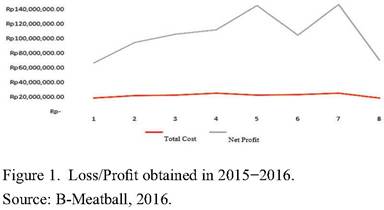
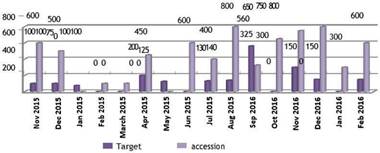
Figure 2. Graphic of —YY sales through store and events. (Source: —YY, 2016).
Sometimes, sales from event were more obtained than sales from store, as shown in Figure 2.
It could be seen that the sale achievement of YY was proven to be more maximum and exceeded its sales target if an event or exhibition was held than in-store (restaurant) sales. The owner admitted that her business required quite huge amount of capital and financing at the beginning, due to material and equipment purchases and employee training. However, she also believed that the business would not run without her brilliant idea of how to put rice, vegetables, and meat in a simple box to eat and good promotion through exhibition.
3.3 “SP”: Event organizer in Bandung
SP was a creative service in organizing surprise events (birthday, wedding anniversary, etc.), which was established by some university students, S and friends. For approximately eight months organizing the business, the income of SP is as presented in Table 3.
The income for the end of 2015-2016 was still not significantly huge. The owner only did simple recording of his business. This business was considered as a quite interesting one because as the owner and manager, S almost did not need a starting capital since all of the incurred fees were covered by the customers who usually gave downpayment (approximately half of the price) prior to ordering the service.
3.4 “CC accessories”: Fashion business in
Cirebon and Bandung
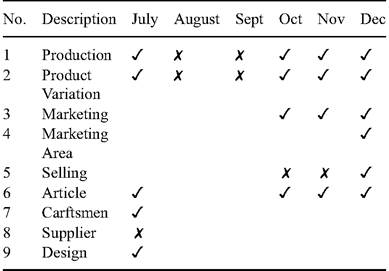
CC Accessories was a business on manufactured handmade cellphone case, tablet phone case, and so on by D and his sister. The sale record for the last six months in 2015 is presented in Table 4.
Table 3. —SP Income.
| No. | Date | Event | Total Cost |
| 1 | Nov 25, | Birthday Dinner | IDR 1.250.000 |
| 2015 | Couple | ||
| 2 | Dec 15, | Surprise Birthday | 900.000 |
| 3 | Jan 14, 2016 | Wedding Anniversary | 1.250.000 |
| 4 | Jan 29, | Birthday | 1.250.000 |
| 5 | Feb 2, | Birthday | 1.250.000 |
| 6 | Feb 16, | Birthday | 1.250.000 |
| 7 | March 15, | Birthday | 1.250.000 |
| 8 | March 27, | Birthday | 1.250.000 |
| 9 | April 26, | Birthday Dinner Couple | 1.500.000 |
Source: SP, 2016.
Table 4. CC evaluation of sales achievement (2015).
Source: CC, 2015.
Table 5. Merchandise inventory of product 2015
| Month | Beginning balance | Sold | Ending balance |
| October, 2015 | 30 | 10 | 20 |
| November, 2015 | 50 | 4 | 46 |
| December, 2015 | 76 | 38 | 38 |
Source: CC, 2015.
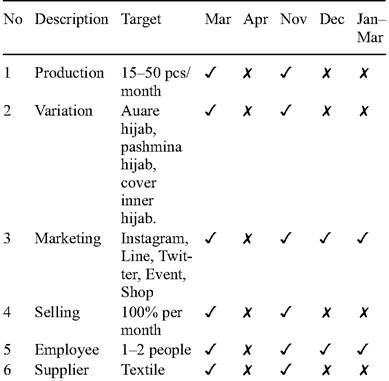
Table 6. PS Veil Selling Achievement (2015-2016).
shop
Source: PS Veill, 2016.
The data of product sold in units could be seen in Table 5.
The table of inventory shows that there are still plenty of inventories to make the products. CC products seem to take time to increase awareness and need more branding strengthening. In the first three months, this business requires quite large financing for material inventory. Since the production was still conducted by the owner, it seemed that CC did not add more financial capital in the near future. If there are more orders in the future, the owner will ask for for 50% downpayment at the beginning of production process to prevent liquidity difficulties.
3.5 “PS Veil”: Hijab store in Subang andSerang
PS Veil was a hijab store business established by P and S with their family.
In the early stages of production, the owner plans to produce a minimum of 15 products with the consideration that they still need to make some adjustments to market conditions, consumer preferences, models, and so on. Production continued in March 2015 until November 2016. Based on the inventory
Table 7. Inventory 2015
| Month | Stock, beginning | Production | Selling | Stock, ending |
| March | 0 | 25 | 5 | 20 |
| 2015 | ||||
| April- | 20 | 0 | 0 | 20 |
| October | ||||
| November | 20 | 15 | 29 | 6 |
Source: —PS Veill, 2016.
tables, the sales have not reached the expected target so there will be more promotions to increase awareness and branding.
Because there are still some stocks left in November 2015, the remaining stock is sent to HD Cloth in Serang, Banten for sale.
There seems to be no sales during April-October 2015. PS Veil products have a simple model. The veil design is suitable for modern children. The choice of material does not feel hot when used and is comfortable to do many activities. The veil design with limited stocks make PS Veil products unique.
The weakness of the PS Veil business was the fact that the company had no network with other business partners. This was a lack of social capital because products were handled by only one person. The owner targetted products for Muslim women because basically Muslim women are advised to wear a veil. Furthermore, because the product offered was simple, the targeted segment was young people. In the future, market segments need to be expanded to get more customers. One business threat was the number of competitors who have released similar products and they also have creative marketing strategies. The new strategy through several promotional events was a threat because the sales of PS Veil were still done online.
4 CONCLUSION
Five young entrepreneurs in West Java as participants in this study were advised to explore their creativity in managing their capital, especially in this digital era. Most of them only use their smartphones to communicate with the work team but have not used it for marketing. Only “B-Meatball” and “YY Ricebox” have started using smartphones to promote their products via Line and Instagram. Three other businesses only use telephone and text messages to buy materials or production processes. Only “YY Ricebox” serves shipping orders.
Nowadays, young entrepreneurs are not only looking for profit as a result of their investment and financing at the beginning of the business. They want more than profit. They are now looking for more benefits to explore their creativity that will enhance the sustainability of their business and a good reputation for the future.
REFERENCES
Baker, K. 2008. Fostering a Global Spirit of Youth Enterprise Preparatory Briefing of the Global Forum on Youth Entrepreneurship.
Barlian, I. 2013. The Role of Creative Young Entrepreneur for Entrepreneurship Expansion in Bandung. LPPM Report: UNPAR.
Bell, J., Crick, D. & Young, S. 2004. Small firm internationalization and business strategy: an exploratory study of ‘knowledge-intensive'and ‘traditional'manufac- turing firms in the UK. International Small business journal 22(1): 23-56.
Dash, M. & Kaur, K. 2012. Youth entrepreneurship as a way of boosting Indian economic competitiveness: A study of Orissa. International Review of Management and Marketing 2(1): 10-21.
Gartner, W.B. 2001. Is there an elephant in entrepreneurship? Blind assumptions in theory development. Entrepreneurship Theory and practice 25(4): 27-39.
Hanlon, D. & Saunders, C. 2007. Marshaling resources to form small new ventures: Toward a more holistic understanding of entrepreneurial support. Entrepreneurship Theory and Practice 31(4): 619-641.
Harker, R., Mahar, C. & Wilkes, C. (eds) 2016. An introduction to the work of Pierre Bourdieu: The practice of theory. Springer.
Low, M.B. 2001. The adolescence of entrepreneurship research: specification of purpose. Entrepreneurship theory and practice 25(4): 17-26.
Rogoff, R. & Heck, H. 2003. Evolving Research in Entrepreneurship and Family Business: Recognising Family as The Oxygen that Feeds the Fire of Entrepreneurship. Journal of Business Venturing, Elsevier.
Simatupang, T.M. 2007. Industri Kreatif Jawa Barat. Bahan Masukan Kepada Dinas Perindustrian dan Per- dagangan Provinsi Jawa Barat.
Schwartz, H. 1994. Small states in big trouble: State reorganization in Australia, Denmark, New Zealand, and Sweden in the 1980s. World Politics 46(4): 527555.
Zimmerer, K.S. 1997. Changing fortunes: Biodiversity and peasant livelihood in the Peruvian Andes (Vol. 1). Univ of California Press.
More on the topic Creativity in capital management by young entrepreneurs in West Java SMEs:
- Abdullah A.G., Widiaty I., Abdullah G.U. (eds.). Global Competitiveness: Business Transformation in the Digital Era. Routledge,2019. — 325 p., 2019
- Table of contents
- MUSIK ISLAMI IN THE CONTEXT OF WEST JAVA
- Capital adequacy management
- A Harder Non-Case: The West
- The Eastern Empire and the Reconquest of the West