Croatia
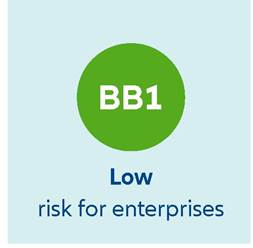
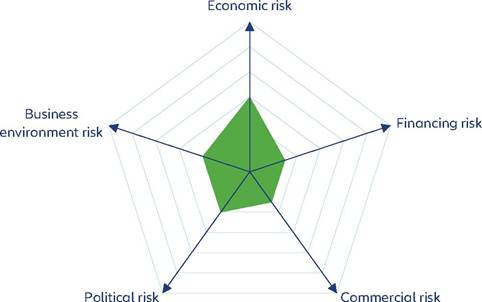
Joining the Eurozone reduced country risk
| GDP | USD71.0bn (World ranking 80) |
| Population | 3.9mn (World ranking 129) |
| Form of state | Parliamentary Republic |
| Head of government | Andrej Plenkovic (PM) |
| Next elections | 2024, Presidential and legislative |
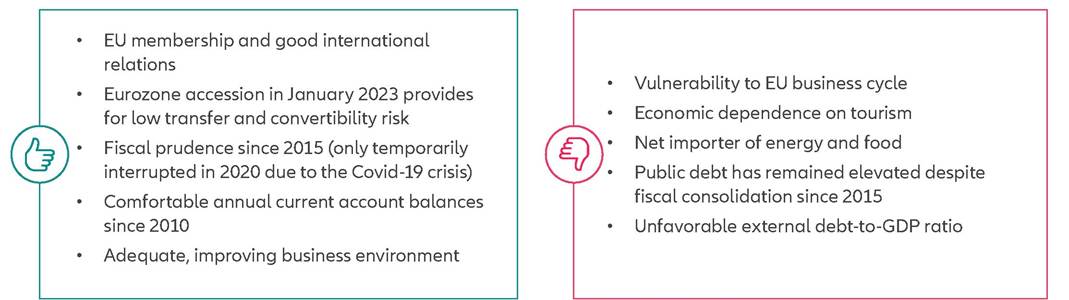
Strengths & weaknesses
Economic overview
Moderate growth slowdown while inflation is easing
The economic outlook for Croatia has markedly deteriorated as a result of the war in Ukraine.
The economy is highly dependent on exports, especially the export of services (tourism), which makes it vulnerable to external shocks. Croatia is also a large net importer of energy and food and thus has been hit by the surge in global prices for these goods in 2022. However, the country's direct trade relations with Russia have been small so it has been less impacted by the European energy-supply crisis and EU trade sanctions against Russia than other countries in the Emerging Europe region. Following a strong post-Covid-19 recovery, with real GDP growth of around +13% in 2021 and over +8% y/y in the first half of 2022, economic activity began to cool in the second half of that year amid higher inflation, rising interest rates, softening external demand and declining business confidence. Growth came in at +6.3% in 2022 as a whole and decelerated further to an average +2.3% y/y in the first three quarters of 2023, as the economic slowdown in Western Europe, Croatia's main export destination, weighed on trade and tourism in the country. Domestic fiscal stimulus has been moderate due to rising financing costs. Going forward, EU funding inflows should somewhat mitigate the impact on growth. We forecast annual real GDP to expand between +2.5% and +3% in 2024-2025.Croatia joined the Eurozone at the start of 2023, marking an important milestone in the process of integration with the EU a decade after it joined the bloc. While monetary policy is now conducted by the European Central Bank (ECB), membership of the Eurozone provides for low transfer and convertibility risk and has substantially decreased external vulnerabilities related to exchange-rate risk. The backing of the ECB should strengthen the banking and financial system in Croatia and increase the economy's resilience to external economic shocks. Investor confidence should rise as well and overall Eurozone membership should provide a medium-term boost to the economy.
Inflation has moderated to 4.5% y/y at end-2023, after it had risen to a peak of 13.5% y/y in November 2022, driven by interrupted supply chains and surging energy and food costs. We project it to remain somewhat elevated in 2024 owing to strong wage growth, persistent, though slowing, price increases in services and the likely phase out of measures to mitigate the impact of high energy prices. We forecast annual average inflation of around 3.5% in 2024 and 2.5% in 2025.
Fiscal and current accounts under control but debt ratios remain elevated
Croatia's public finances are improving again after the Covid-19 crisis temporarily reversed five years of fiscal consolidation. Public finances had improved in 2015-2019, thanks to the growth rebound after the extended 2009-2014 recession as well as fiscal restraint. The budget was close to balance in those years and public debt declined from 84% of GDP in 2014 to 71% in 2019. However, owing to large stimulus measures in response to the Covid-19 crisis, combined with a substantial decline in nominal GDP, a fiscal shortfall of -7.3% of GDP was recorded in 2020, pushing public debt again up to 87% of GDP.
The annual fiscal deficit narrowed markedly to around -2.5% of GDP in 2021 and returned to a narrow surplus in 2022 thanks to strong fiscal revenue growth. It likely moved back to a small deficit in 2023 owing to large increases in public wages and social benefits. Further such increases and higher public investment are forecast to widen the annual fiscal shortfalls to still moderate ratios of around -1.5% of GDP in 2024-2025. Meanwhile, the public debt-to- GDP ratio is projected to retreat gradually towards 60% of GDP by 2025.Croatia's external finances should remain manageable. After six years of current account surpluses from 2014 to 2019 (on average +2.3% of GDP), reflecting a continued solid export performance, Croatia posted a small external deficit of -1% of GDP in 2020, mainly as a result of sharply lower exports of services (as Covid-19 hit tourism). After the annual current account moved back to a surplus of +1% of GDP in 2021, it posted another deficit of -2.8% of GDP in 2022, this time owing to sharply increased import costs for energy and food. As these costs have moderated in 2023, a small external surplus was recorded in the first three quarters of last year and we forecast continued small annual surpluses in 20242025. Meanwhile, Croatia's gross external debt will remain elevated at close to 90% of GDP. On a positive note, the annual external debt-service ratio has declined from a hefty 35% in 2020-2021 to a more manageable 20% or so in 20232024. Moreover, by joining the Eurozone in 2023, Croatia now has access to the pooled FX reserves of the ECB so that FX coverage of imports as well as of short-term external debt payments falling due is not an issue anymore.
Improving business environment
The business environment in Croatia is generally adequate though spots of weaknesses remain. The World Bank Institute's annual Worldwide Governance Indicators surveys suggest that the regulatory framework is generally business-friendly while weaknesses remain with regard to perceived corruption and the legal framework. The Heritage Foundation's Index of Economic Freedom survey 2023 ranks Croatia 46 out of more than 180 economies, a significant improvement from rank 79 in the 2021 survey. The country gets strong scores with regard to the tax burden, trade freedom, investment freedom, property rights and judicial effectiveness (with the latter two items reflecting the improvement since 2021) while weaknesses remain in the areas of government integrity, labor freedom and financial freedom. Our proprietary Environmental Sustainability Index assigns Croatia is a strong rank of 13 out of 210 economies, reflecting high scores for energy use and CO2 emissions per GDP, renewable electricity output, water stress and general vulnerability to climate change. However, the recycling rate is the one weakness.