Effects of good corporate governance, ownership structure, political connections on tax aggressiveness of manufacturing companies listed in Indonesia Stock Exchange
M.S. Kurniawan, B.P. Sutjiatmo & R. Wikansari
Politeknik APP Jakarta, Jakarta, Indonesia
K. Haryono
Edinburgh Napier University, Edinburgh, Scotland, UK
ABSTRACT: This research aims to provide empirical evidence of the effects of good corporate governance, ownership structure, and political connection on tax aggressiveness.
This research used linier regression as analysis tool. 64 sample manufacturing companies listed in Indonesia Stocks Exchange were selected purposively. The finding indicates that board of commissioners significantly and positively affected tax aggressiveness, that board of directors did not significantly affect tax aggressiveness, that audit committee did not significantly affect tax aggressiveness, that family ownership significantly and positively affected tax aggressiveness, and that political connection did not significantly affect tax aggressiveness.1 INTRODUCTION
Companies’ main purpose is to make profit. In doing so, good corporate governance is one of the most important aspects (Desai & Darmapala 2007).
National committee on governance policy (KNKG) is an organization that publishes guidelines for implementation of good corporate governance in Indonesia. KNKG states there are three important elements in the application of good corporate governance, there are board of committee, board of commissioners, board of directors, and audit committee (KNKG 2006).
In agency theory, one of the most frequently occurring agency conflicts was a conflict between company an owner and management. This conflict occurs because of differences in the interests; the company owner wants the addition of wealth from company profits, while management wants to gain benefit from the facilities provided by the company that sometimes can reduce company profit (Watt & Zimmerman 1986, Godfrey et al.
2010). This conflict can be reduced with good corporate governance that consists of board of commissioner helped by audit committee to oversee board of director in company’s operations.Another type of agency conflict is a conflict between controlling shareholders and non-controlling shareholders. This conflict occurs because of differences in interest between controlling and non-controlling parties. The controlling parties want to maximize their wealth using company assets which sometimes harms non-controlling parties. In companies with family ownership, commonly the family own the control of company, despite the fact that family ownership is more effective organizational structure compared with other type of structure to overcome agency conflicts between company owners and management. This is because company owner is likely to place people on the board of directors or board of commissioners as representative of company owner, who are usually parts of the family (Randoy & Goel 2003, Gaaya et al. 2017).
Political connections are important resources for companies in developing countries. Political connections provide an option for companies to resolve issues related to law and taxes (Rajan & Zingales 1998, Leuz & Gee 2006). Commonly in Indonesia, retired soldiers, retired policemen, retired senate members, members of political parties become directors or commissioners in a company.
2 LITERATURE
2.1 Agency theory
In agency theory, there are two types of agency conflicts, conflict between company owners and the management and conflict between controlling shareholders and non-controlling shareholders. These conflicts can be resolved by the establishment of a board of commissioners and audit committee that can represent shareholders in overseeing operations of the company. Conflicts between controlling shareholder and non-controlling shareholder occurs because of the interest of controlling shareholders to transfer company assets into their assets, so it may harm the
non-controlling shareholders (Watts & Zimmerman 1986, Godfreyetal.
2010).2.2 Good corporate governance
Good corporate governance will help companies maintain sustainability, business efficiency, reduce the possibility of companies violating legislation, laws, and related regulations (IICG 2012).
Good corporate governance can be implemented properly if supported by the company’s organs that perform their duties and functions as they must do. According to KNKG, there are 3 important organs in the company including:
a. General meeting of shareholders
This meeting is one of the most important agendas for the company and the owners of the company because the ultimate decision making in the company is taken during this meeting (KNKG 2006).
b. Boardofcommissioners
The board of commissioners is the organ of the company responsible for ensuring the proper implementation of corporate governance in the company, overseeing and advising management with the help of audit committee, and audit committee themselves help board of commissioners oversee and advise on management (KNKG 2006).
The relations between board of commissioners and tax aggressiveness is the board of commissioners responsible for overseeing the operation of the company by management in accordance with rules and laws, including rules and laws in tax. Thus, the existence of board of commissioners can reduce agency conflicts between company owners and management. In Indonesia the board of commissioners of a company usually serves as the board of director or commissioners in other companies; that can cause difficulty in coordination between each member board of commissioners, so it can be assumed that the larger size of the board of commissioners will inhibit the function of the board of commissioners to conduct supervision. The larger size of the board of commissioners can lead to a greater tax aggressive action by company (Annisa & Kurniasih 2013).
c. Audit committee
The audit committee is tasked with assisting the commissioners in overseeing the operations of the company whether it is in compliance with applicable laws and regulations.
Financial Services Authority (OJK in Indonesia) rules state that minimum number of audit committee for companies listed on Indonesia Stock Exchange are at least 3 people. Relationship between audit committee and tax aggressiveness is audit committee in charge of ensuring the operational implementation of company in accordance with applicable tax regulation so that the lager audit committee made the chances of management taking tax aggressive action can be reduced (Annisa & Kurniasih 2013).d. Board of Directors (BoD)
Board of Directors is the organ of the company responsible for company operations. Board of directors are appointed in general meeting of shareholder. Board of directors are responsible to shareholders. The bonus plan hypothesis stated that one of objectives of management with the bonus plan is to maximize the bonus she/he earns, one way to maximize management bonus with increased company profit and minimize amount of tax using tax aggressive policy (Watt & Zimmerman 1986, Godfrey et al. 2010).
2.3 Family ownership
Company with family ownership is one of the most effective types of corporate organizations because family firms have clear long-term goals, have almost absolute and clear policies, tend to maintain family name reputation, and with some of family members becoming directors or commissioners make firm management more likely effective (Chen et al. 2010). In Indonesia, majority of companies are owned by family or government (Dyanti et al. 2012).
There are two opinions concerning relationship between family ownership and tax aggressive action. The first opinion states that companies with family ownership will tend to reduce agency conflicts between controlling shareholders and non-controlling shareholders (Shleifer & Vishny 1986). Companies with family ownership will tend to have views for the future and minimize actions that will harm the company and damage family name such as tax avoidance action (Chen et al. 2010).
The second opinion states that in a company with family ownership, agency conflicts will likely to happen between the family members serving as controlling shareholders and those of the non-controlling shareholders. The family members serving as controlling shareholders will tend to take advantage of the company, resulting in loss for noncontrolling shareholding family members (Shleifer & Vishny 1986; Desai & Dharmapala 2007).2.4 Political connections
Businesses in Asia are characterized with a connection system consisting of bankers, politicians, and members of government (Rajan & Zingales 1998). Company with political connections will generally find it easier to get credit from bank and leniency in law and taxation (Bliss & Gull 2012). In Indonesia, politics and business have been inseparable since the early Indonesian independence era. For example, many former military and police officers, former members of parliament, or politicians were appointed to the board of directors or commissioners (Leuz & Gee 2003).
Kim and Zhang (2015) state that there are 5 reasons why companies with political connections are more likely to engage in tax aggressive action than companies with no political connections: First, companies with political connections tend to have less control than companies with no political connections. This is due to the fact that companies with political connections tend to rely on assistance from their political connections. Second, companies with political connections tend to have wider access than those without political connections to changes in tax rules, so they can anticipate the rules earlier than others. Third, companies with political connections will tend not to be financially transparent as they have protections from their political connections. Fourth, companies with political connections will be more tax aggressive than those with non-political connections. Fifth, companies with political connections tend to be associated with the possibility of tax aggressive action due to consequences of their risk averse decision making.
3 RESEARCH DESIGN
3.1 Sample and data collection
The samples were chosen by using a purposive sampling technique based on the following criteria: being a manufacturing company listed on Indonesia Stock Exchange, publishing a complete annual report in the 2016 period, using rupiah (IDR) currency in reporting, and having a positive profit value. The number of samples was 64 companies.
3.2 Variable measured
3.2.1 Boardofcommissioners
This variable is measured using number of commissioners in a company.
3.2.2 Board of Directors
This variable is measured using number of directors in a company.
3.2.3 Audit committee
This variable is measured using number of audit committee in a company.
3.2.4 Family ownership
This variable is measured using the presence of the shareholding family members serving as board of commissioners or board of directors. If any family members become board of commissioner or board of directors, it is measured with value of 1, whereas if none it is measured with value of 0.
3.2.5 Political connection
This variable is measured by the presence of retired military officers, retired police officers, former members of the parliament, members of political parties in the board of commissioners and board of directors. Any presence of these figures in the board of commissioners and board of directors is valued 1, and no presence is valued 0.
3.2.6 Tax aggressiveness
This variable is measured by using effective tax rate (ETR), which is obtained by the following formula:
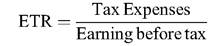
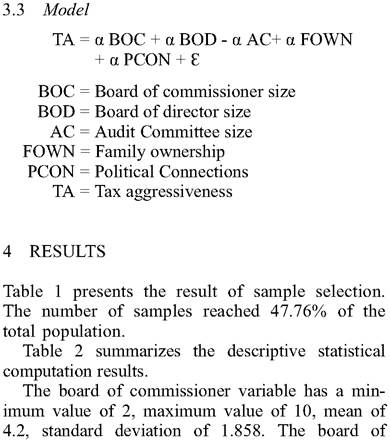
Table 1. Sample Selection.
| NO | Sample Critera | Companies |
| 1. | Manufacturing companies listed on IDX and publishes a complete annual report for the reporting period 2016 | 134 |
| 2. | Companies not using rupiah (IDR) currency in reporting | (29) |
| 3. | Companias with negative profit value | (41) |
| TOTAL SAMPLE | 64 | |
Table 2. Descriptive Statistics.
| Variable | Data | Max. Value | Min. Value | Mean | Standard deviation |
| BOC | 64 | 10 | 2 | 4.42 | 1.858 |
| BOD | 64 | 16 | 2 | 5.54 | 2.850 |
| AC | 64 | 6 | 3 | 3.4 | 0.812 |
| FOWN | 64 | 1 | 0 | 0.51 | 0.503 |
| PCON | 64 | 1 | 0 | 0.29 | 0.460 |
| TA | 64 | 4.96 | 0.02 | 0.30 | 0.614 |
Table 3. Regression test results.
| Model | B | Sig. |
| Constant | 0.323 | 0.409 |
| BOC | 0.128 | 0.013 |
| BOD | 0.020 | 0.505 |
| AC | -0.161 | 0.170 |
| FOWN | 0.273 | 0.042 |
| PCON | -0.165 | 0.407 |
director variable has a minimum value of 2, maksi- mum value of 16, mean of 5.54, and standard deviation of 2.85. The audit committee variable has a minimum value of 3, maximum value of 6, mean of 3.4, and standard deviation 0.812. In Indonesian Stock Exchange rules, each company must have an audit committee with a minimum of 3. Table 1 show that the audit comittee variable has a mean of 3.4 and hence indicates that manufacturing companies in Indonesia tend to appoint audit committees in minimal account, or just to meet requirements set by the regulator. The family ownership variable has a minimum value of 0, maximum value of 1, mean of
0. 51, standard deviation of 0.503. This implies that the majority of manufacturing companies in Indonesia are owned by family. The political connection variable has a maximum value of 1, minimum value of 0, mean of 0.29, and standard deviation of 0.460, indicating that most of sample companies do not have BOD/BOC with political affiliation. The tax aggressiveness variable has a maximum value of 4.96, minimum value of 0.02, mean of 0.3, and standard deviation of 0.614.
Table 3 shows that the board of commissioners positively and significantly affected tax aggressiveness, indicating that larger size of the board of commisioners will inhibit the function of the board of commissioners to conduct supervision. The board of directors did not significantly affect tax aggressiveness. The audit committee did not significantly affect tax aggressiveness. This is due to the fact that most sample companies appoint an audit committee in minimum size as shown in Table 2, only to meet aplicable regulations. The family ownership positively and significantly affected tax aggressiveness. Political connections did not significantly affect tax aggressiveness because in the context of this study politicians who served as directors or commissioners in companies tend to conduct good business practices for the future of their political carreers.
3 CONCLUSIONS
This study investigates the effect of board of commissioners, board of directors, audit committee, family ownership, and political connections on tax aggressiveness. This study used 64 sample of manufacturing companies listed in Indonesia Stock Exchange. Using linear regression, we found an evidence that board of commissioners positively and significantly affected tax aggressiveness, that board of directors did not significantly affect tax aggressiveness, that audit committee did not significantly affect tax aggressiveness, family ownership significantly and positively affected tax aggressiveness, and political connections did not significantly affect tax aggressiveness.
REFERENCES
Annisa, A., Ayu, N. & Kurniasih, L. 2012. Pengaruh Corporate Governance Terhadap Tax Avoidance. Surakarta: UNS.
Bliss, M.A, & Gull F.A. 2012. Political connection and cost of debt: Some Malaysian evidence. Journal of Banking & Finance 36(5): 1520-1527.
Chen, S, Chen, X, Chen, Q, & Shevlin, T. 2010. Are family firms more tax aggressive than non family firms. Nan kai Business Review International. 5(1): 25-42.
Desai, A., Mihir, M. & Dharmapala, D. 2007. Taxation and corporate governce: an economic approach. Harvard University, Working paper.
Komite Nasional Kebijakan Governance (KNKG). 2006. Pedoman umum good corporate governance. Jakarta. KNKG.
Dyanty, V., Utama, S., Rossieta, H. & Veronica, S. 2012. Pengaruh Kepemilikan pengendali akhir terhadap trans- aksi pihak berelasi. SNA XV Banjarmasin.
Gaaya, S., Lakhal, N. & Lakhal, F. 2017. Does family ownership reduce corporate tax avoidance? The moderating effect of audit quality. Managerial Auditing Journal. 32(7): 731-744.
Godfrey, J., Hodgson, A., Tarca, A., Hamilton, J. & Holmes, S. 2010. Accounting Theory 7th edition. New York: John Wiley & Sons.
Indonesian Institute Corporate Governance (IICG). 2012. Laporan Corporate Governance Perception Index: Good Corporate Governance dalam Perspektif Risiko. Jakarta. IICG.
Kim, C. & Zhang, L. 2015. Corporate political connections and tax aggressiveness. Contemporary Accounting Research. 3(1): 78-114.
Leuz, C & Gee O.F. 2006. Political Relationship, Global Financing, and corporate transparency: Evidence from Indonesia. Journal of Financial Economics. 81(2): 411439.
Rajan, R, & Zingales, L. 1998. Which capitalism? Lesson from the East Asian Crisis. Journal of applied corporate finance. 11(3): 40-48.
Randoy, T, & Goel, S. 2003. Ownership structure, founder leadership, and performance in Norwegian SME's: implication for financing entrepreneurial opportunities. Journal of bussiness Venturing. 18: 619-637.
Shleifer, A. & Vishny, R. 1986. Large shareholders and corporate control. Journal of Political Economy. 94(3): 461-488.
Watts, R., & Zimmerman, J. 1986. Positive accounting theory.