Entrepreneurship and small medium enterprises in ASEAN
L. Danil & N. Septina
Parahyangan Catholic University, Bandung, Indonesia
ABSTRACT: Entrepreneurship and small and medium-sized enterprises (SMEs) have grown positively all over the world, especially in ASEAN countries.
This phenomenon has received attention from many scholars from various disciplines. In this research, we conducted in-depth in interviews with entrepreneurs from Indonesia, Cambodia, Brunei Darussalam, Lao Peoples Democratic Republic, Myanmar, Vietnam and Thailand. SMEs in ASEAN could be improved by the provision of marketing training and supports from the government. The results of this study are expected to be provide relevant information particularly useful for SMEs in ASEAN countries.1 INTRODUCTION
Minister of Cooperatives and SMEs Anak Agung Gede Ngurah Puspayoga say the National Entrepreneurship Movement (GKN) makes the entrepreneurial ratio of Indonesia go up to 3.1 percent from 1.67 percent in 2013/2014. Based on data from Statistics Indonesia (BPS) in 2016, out of a population of 252 million, the number of non-agricultural fulltime entrepreneurs has reached 7.8 million people or 3.1 percent. Thus, the level of entrepreneurship Indonesia has reached 2 percent of the population, meeting a minimum criterion of a welfare of society. The Entrepreneur ratio of 3.1 percent is still lower than those of other countries such as Malaysia 5%, China 10%, Singapore 7%, Japan 11% and the US 12%.
The development of entrepreneurship and SMEs in Indonesia itself is an integral part of the economic unification among ASEAN member countries. The Blueprint for SME Development in ASEAN, the ASEAN SME Blueprint for 2004-2014 and the ASEAN Strategic Action Plan for SME Development 2010-2015 constitute a framework of cooperation and action plans to develop competitive, dynamic and innovative ASEAN SMEs. This study was conducted in order to examine the competitiveness of Indonesian SMEs compared to other ASEAN countries and to develop strategies to improve the competitiveness of Indonesian SMEs anticipating the ASEAN Economic Community (MEA).
As an important contributor to economic growth, employment creation and gender empowerment in ASEAN, SMEs are increasingly becoming important forces in ASEAN economic integration. Their expansion and progress are important for ASEAN. SMEs play an important role in helping ASEAN achieve its fair economic development goals because of its wide range and diversity. ASEAN SMEs have been facing a number of challenges in terms of access to finance, technology and competitive markets. ASEAN countries are increasingly paying attention to these challenges and helping them to deal with these issues.
The ASEAN Strategic Action Plan for SME Development (SAPSMED) in 2016-2025 serves to strengthen the involvement of SMEs in an increasingly competitive economic environment and to support their growth and development through the vision of “Global and Innovative Partnership SME” and by 2025 ASEAN will have created more competitive and globally resilient SMEs. The overall achievement of SMEs will be traced through a series of 10 key policy indicators and other operational indicators to be developed. The plan was launched on the sidelines of the 27th ASEAN Summit on 21 November 2015. The plan was developed by the ASEAN SME Working Group. This study aims to examine the factors affecting entrepreneurship so as to increase the number of SMEs in ASEAN Countries.
Over the past few decades many scholars have conducted research on entrepreneurship and micro, small and medium-sized enterprises (MSMEs) in relation to poverty alleviation and state revenues. This study focuses on various aspects of entrepreneurship and SMEs.
Entrepreneurship is one aspect that can increase employment and economic growth in Indonesia. However, the number of entrepreneurs in Indonesia is unfortunately rather limited. The difference between business and entrepreneurship, according to Shane and Venkataraman in Campbell and Mitchell (2012), is that entrepreneurship is greater than starting new businesses or managing a small business: entrepreneurship does not require, but can include, the creation of new organizations.
Morrison et al. (1998) also argue the process of entrepreneurship initiation has its foundations in person and intuition, and society and culture. It is much more holistic than simply an economic
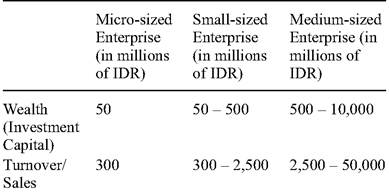
Table 1. Criteria for Indonesian MSMEs Source: Law of the Republic of Indonesia Number 20 of 2008 on Micro, Small and Medium Enterprises, 2018.
function, and represents a composite of material and immaterial, pragmatism and idealism.
It can be concluded that entrepreneurship is not just a matter of running a new business or managing a small business, but it can also create an organization. The difference between these can be observed in the Table 1.
The total number of micro enterprises in Indonesia from 2006 to 2013 is described in Figure 1.
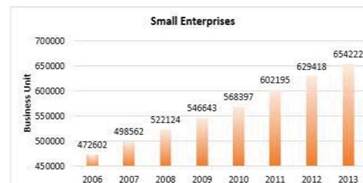
The total number of small enterprises in Indonesia from 2006 to 2013 is described in Figure 2.
The total number of medium enterprises in Indonesia from 2006 to 2013 is described in Figure 3.
Storey (1994) states that SMEs has been the majority of businesses around the world. For studying entrepreneurship, the authors usually use start-up rates as a dependent variable (Van Stel et al. 2005). But there are some limitations in using this proxy:
1) The decision to become an entrepreneur could be affected more by social capital than by existing institutions. This assumption is confirmed by Engle et al. (2011) who empirically defined that parental experience and social norms have a significant positive effect on entrepreneurial intent.
2) Start-up rate does not cover the decision of entrepreneurs to act productively, i.e. it is impossible
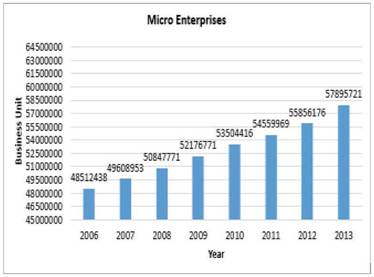
Figure 1. Indonesian Micro Enterprises 2006 until 2013.
Source: www.aseansme.org, 2018.
tear
Figure 2.
Indonesian Small Enterprises 2006 until 2013.Source: www.aseansme.org, 2018.
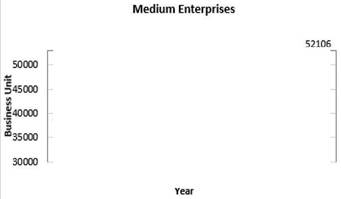
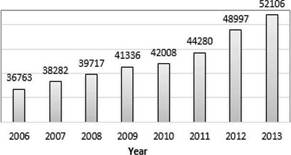
Figure 3. Indonesian Medium Enterprises 2006 until 2013.
Source: www.aseansme.org, 2018.
to make an assumption that all business will behave in a productive way (properly pays taxes to the state budget and so on).
The results of Nataliia’s (2015) research also uphold the contradictive results of previous research that revealed the influence of national culture on business development/entrepreneurship. The outcome also shows that power distance has an impact on entrepreneurship development (Kreiser et al. 2010). The results of research conducted by Roland & Gorodnichenko (2010) show the causal effect of the personal income of individuals. The research done by Zhao et al. (2012) also shows that the modernistic culture creates high-growth and high-innovation entrepreneurship.
ASEAN SME sector is characterized by heterogeneity (Tambunan 2011). SMEs are keen to improve productivity and innovative capabilities to meet the increased competition in the global market. While the development gap between the ASEAN countries is often seen as a major defect. The gap could be turned into a source of dynamism, as indicated by classic models of the flying geese and product cycles. Some ASEAN countries have had experience with SME policies since the 1970s (Sato 2015).
This implies that it is necessary for Indonesia to increase the number of entrepreneurs to improve the performance of SMEs.
Quantitative indicators refer to the economic, financial and operational results of the business. They are also called extrinsic indicators (Weber 2014) of business performance (Zolin et al. 2013, Robb & Watson 2012), or organisational variables (Baron & Henry 2011). Qualitative indicators refer to subjective aspects also known as intrinsic indicators (Weber 2014), such as effects on the entrepreneur (Baron & Henry 2011), success perception of positive consequences (Fisher et al.
2014) or development platform ascent (Dalborg 2012). With regard to qualitative indicators, Dej (2010) proposes a measurement in two dimensions: perception of the entrepreneur’s financial success (and of the success of the business) and perception of the entrepreneur’s personal success. The latter encompasses social recognition, establishment of loyalty relationships with customers also indicated by Lewis (2013), the accomplishment of personal goals and personal development. Dijkhuizen et al. (2014) establish an association between what they call demand factors: working hours, uncertainty and risk and responsibility, and factors that operate like resources: autonomy, variety of work, feedback, learning opportunities, organization and independence and perception of success as measured by Dej’s (2010) proposed instrument.However, some studies reveal that business results’ indicators should be combined for a better explanation of business venturing success. In this regard, Fried and Tauer (2009) proposed an index combining total business resource cost, the entrepreneur’s hours of dedication, total earnings and profit growth.
The literature on entrepreneurial tendencies focuses on recognizing individuals with the inclination to behave entrepreneurially by considering personal characteristics of entrepreneurs (e.g., Cromie 2000). Both academics and practitioners appear to believe that, relative to any other factor, the success of a venture is more dependent on the individual entrepreneur (Lee & Tsang 2001). Studies such as Collins et al. (2004), Rauch & Frese (2007a, 2007b), Stewart & Roth (2007), Zhao et al. (2012), Gurel et al. (2010) and Brandstatter (2011) have revealed various findings, arguments and meta-analytical evidence in support of the validity of personality traits as predictors of entrepreneurial behavior, as well as established differences between entrepreneurs and other occupational groups such as managers.
This study is focused on five key personality traits: need for achievement (nAch), need for autonomy, internal locus of control, calculated risk-taking and creative tendency (Dada et al, 2015).
It is believed that the “need to achieve” motivates individuals to prevail over obstacles and difficult situations and also motivates individuals to make every effort to attain their goals and excellence quickly (Tajeddini & Mueller 2009). Most studies have found achievement to be a robust characteristic of successful entrepreneurs (Sebora et al. 2009).
Particular emphasis has been on differentiating entrepreneurs and professional managers on their risk-taking propensity, and a notable premise is that entrepreneurs personally take the risk of profit and loss (Gurol & Atsan 2006).
Locus of control refers to the extent to which individuals believe that they are able to influence events encountered in their lives (Lee & Tsang 2001, Shane et al. 2003).
Need for autonomy is associated with entrepreneurs’ avoidance of restrictive environments. They prefer to make decisions independent of supervisors to set their own goals and develop their own plans of actions, and to control goal achievement themselves (Rauch & Frese 2007b).
2 RESEARCH METHOD
Given the varied dimensions of entrepreneurship and small medium enterprises as gauged in some previous studies, it will be identified in advance what particular dimensions are most appropriate for the context of this research. The method of this research is In-depth interviews with entrepreneurs in Indonesia, Cambodia, Brunei Darussalam, Lao Peoples Democratic Republic, Myanmar, Vietnam and Thailand.
3 RESULTS
The main motivation of entrepreneurship is to earn money with the desired passion, in contrast to merely being an employee who goes through the motions of performing tasks that may not suit the heart. Other motivations may range from improving the economy and contributing to society to sustaining ourselves and taking care of those around us.
Indonesia has the opportunity to become a more powerful country of entrepreneurs with a population of 250 million people (but only about 3% of whom become entrepreneurs) and with its increasing middle market resulting in higher purchasing power.
Prices are becoming more and more efficient in terms of production cost, whether it is derived from raw materials or access to information, which creates the right time and conditions for becoming a businessman.
Products of Indonesian MSMEs are unique and cannot be found in other countries such as Jepara carving/furniture, Cirebon rattan, and batik. Unfortunately, these MSMEs still haven’t got a firm grasp of sufficient network marketing. There must be awareness on the part of entrepreneurs of their own MSMEs to be able to improve their own marketing tools enabling them sell their products. One of these could be digital marketing, where the cost incurred is not too high while it can make a considerable impact.
But the obstacles frequently encountered by MSMEs, among others, include investment capital and the difficulty of finding other craftsmen. The position of Indonesian SMEs in ASEAN countries can be classified as a leading one because there is a strong domestic demand for products as many Indonesian people purchase domestic products. Another contributing factor is that the Indonesian middle market is expanding so the products are well absorbed by the consumers. Indonesia even shows the potential of becoming the third leading market in Southeast Asia and according to McKenzie, in 2030 Indonesia will be the seventh largest economy in the world due to its considerable market purchasing power, greater investment, enhanced by more flexible regulation and a more efficient infrastructure.
Table 2. ASEAN'S Export in January 2017.
| Country | Value (US$) | Weight (kg) |
| BRUNEI | 4.678.950,31 | 6.366.347,02 |
| DARUS SALAM CAMBODIA | 39.837.006,74 | 244.085.497,94 |
| INDONESIA | 13.401.704.047,89 | 43.595.887.615,63 |
| LAO PEO- | 674.489,70 | 252.862,54 |
| PLES DEMOCRATIC REPUBLIC MALAYSIA | 738.684.360,45 | 2.831.184.510,43 |
| MYANMAR | 51.572.817,59 | 59.811.490,97 |
| (FORM. BURMA) PHILIPPINES | 489.115.510,62 | 1.779.676.889,32 |
| SINGAPORE | 844.702.525,41 | 1.761.239.152,28 |
| THAILAND | 479.951.566,03 | 1.375.526.326,90 |
| VIETNAM | 234.363.132,31 | 451.897.951,22 |
Source: www.asean.org, 2017.
The distribution of SMEs by sector shows that the majority of Indonesian SMEs are involved in agriculture. The second largest sector is trade, hotel, and restaurant while the third largest is manufacturing as seen in Table 3.
Tambunan's (2011) research result show that SMEs are indeed very important not only as a source of employment, but, potentially, as a growth engine for the economy.
3.1 TheIndonesian Government’s involvement in the process of raising the standard of MSMEs in ASEAN
The Government of the Republic of Indonesia has been heavily involved in improving MSMEs in
Table 3. SMEs in ASEAN countries.
| Member Country | Number | Year | As a percentage of all firms (for last year of data available) |
| Brunei Dar- | 30,000 | 2004 | 98 |
| ussalam | |||
| Cambodiaa | 369 | mid-1950s | 99 |
| 1,000 | 1958 | ||
| 24,097 | 1998 | ||
| 25,406 | 2000 | ||
| 25,985 | 2003 | ||
| 28,747 | 2005 | ||
| Indonesia | 377,652,000 | 1997 | 99,9 |
| 378,563,000 | 1999 | ||
| 434,659,220 | 2003 | ||
| 488,229,005 | 2006 | ||
| Lao PDR | 22,000 | 1998 | 99,4 |
| 25,993 | 2004 | ||
| Malaysia | 516,855 | 2003 | 99,2 |
| 518,996 | 2005 | ||
| Myanmar | 34,000 | 1998/ | 96 |
| 1999 | |||
| Philippines | 68,000 | 2001 | 99,5 |
| 72,696 | 2003 | ||
| Singapore | 72,000 | 2002 | 97,8 |
| Thailand | 779,033 | 1997 | 99,8 |
| 1,639,427 | 2001 | ||
| 1,995,929 | 2003 | ||
| 2,274,525 | 2006 | ||
| Vietnam | 59,831 | 2002 | 96,8 |
| 98,233 | 2005 |
Note: aIn manufacturing industry only
Source: Asia-Pacific Economic Cooperation (APEC) (2003a, 2003b, 2003c, 2003d), RAM Consultancy Services (2005), UNCTAD (2003), Myint (2000), Regnier (2000), Ministry of Industry, Mines and Energy of the Kingdom of Cambodia, Indonesian National Agency of Statistics, SMIDEC, Dhungana (2003), Rasiah (2001), Jajri & Ismail (2007), OSMEP; National SME Development Agenda 2000/2001, Kyophilavong et al. (2007a, 2007b), Sang (2007), Aldaba (2007), Cuong et al. (2007), and Bailey (2007), Tambunan (2011).
ASEAN as over the past two years there have been several meetings with ASEAN countries and those cooperating with ASEAN. In a session entitled ‘Promoting an Innovative, Entrepreneurial ASEAN Economic Community', the President of Indonesia emphasized two priorities that deserved to receive the attention of ASEAN and the US. The two main priorities are MSME cooperation as well as technology and the digital economy.
President Joko Widodo (popularly known as “Jokowi”) went on to suggest this particular cooperation should take precedence because MSMEs are the backbone of the economy of Indonesia and ASEAN. Approximately 88.8 percent to 99.9 percent of business establishments in ASEAN are MSMEs, taking up 51.7 percent to 97.2 percent of the workforce in ASEAN.
“High-end SMEs are able to support the country’s economy, even in times of global crisis”, Jokowi explained. But MSMEs often face challenges, especially in terms of capacity building, access to capital and alternative funding, access to technology, global market access, and regional and global link integration.
Therefore, technology and the digital economy are absolute necessities in the era of digitalization. Every government, according to the President, must ensure that this era brings benefits to the people, especially MSMEs. As a consequence, these MSMEs must have access to technology and the digital economy.
In the ASEAN-Korea Free Trade Area (AKFTA) meeting, the Indonesian government stated that ASEAN and Korea should be able to maintain their ideals based on the notion of mutual economic openness. This statement was made by President Joko Widodo at the 19th ASEAN-South Korea Summit held at Philippine International Convention Center (PICC) in Manila, the Philippines on Monday, 13 November 2017.
SMEs play a very important role for the ASEAN economy. As a matter of fact, 96 percent of ASEAN consists of MSMEs. As stated by the President of the Republic of Indonesia “When we talk about ASEAN economic integration then it is our duty incorporate SMEs into our integration.”
President Jokowi expressed his appreciation to the ASEAN Business Advisory Board for seeing the importance of ASEAN’s partisanship towards MSMEs. In addition, attention should also be paid to empowering women in MSMEs. Indonesia will promote efforts to increase cooperation, both between ASEAN Members and between ASEAN and its partner countries. AKTFA will provide tangible benefits that can be felt by all Indonesian people as well as people in ASEAN and the Asia Pacific region.
Another meeting at the 28th ASEAN Summit was held at the National Convention Center (NCC), Vientienne, Laos, on September 6, 2016. The President asked ASEAN to ensure the involvement and progress of MSMEs through technological development and innovation as well as expansion of financial access and markets.
“If the people of ASEAN do not feel the benefits of ASEAN’s existence, it will be difficult for ASEAN to grow in a sustainable manner,” or so the President predicted.
Indonesia’s ranking on the Global Competitive Index went up by five from 41st rank out of 138 countries in 2016/2017 to 36th rank from 137 countries in 2017/2018. Out of 10 ASEAN countries, only 9 countries made the top 138 countries in the 2016 and 2017 CGI.
Table 4. GCI Index.
| Country of ASEAN | 2011 | 2012 | 2013 | 2014 | 2015 | 2016 | 2017 |
| Singapore | 2 | 2 | 2 | 2 | 2 | 2 | 3 |
| Malaysia | 21 | 25 | 24 | 20 | 18 | 25 | 23 |
| Thailand | 39 | 38 | 37 | 31 | 32 | 34 | 32 |
| Indonesia | 46 | 50 | 38 | 34 | 37 | 41 | 36 |
| Brunei Dar- | 28 | 28 | 26 | - | - | 58 | 46 |
| ussalam | |||||||
| Vietnam | 65 | 75 | 70 | 68 | 56 | 60 | 55 |
| Philippines | 75 | 65 | 59 | 52 | 47 | 57 | 56 |
| Cambodia | 97 | 85 | 88 | 95 | 90 | 89 | 94 |
| Laos | - | - | 81 | 93 | 83 | 93 | 98 |
Source: presidenri.go.id, 2018.
The development of entrepreneurship has been very rapid under two periods of government when there was a strong focus on MSMEs and these enterprises took up 98% of the workforce. Many university and college students are under the impression that a businessman is not an employee. The Government of Indonesia has helped the development of MSMEs by providing working space in the shape of business centers.
Indonesia has the opportunity to become a more powerful entrepreneur with a population of 250 million people (only about 3% of whom become entrepreneurs) and aided by its increasing middle market resulting in higher purchasing power. Prices are becoming more and more efficient in terms of production costs, whether it is derived from raw materials or access to information, creating the right time and conditions for becoming a businessman.
There is something unique about products of Indonesian MSMEs not available in other countries, such as Jepara carving/furniture, Cirebon rattan, and batik. Unfortunately, these MSMEs still haven’t got a firm grasp of sufficient network marketing. There must be awareness on the part of entrepreneurs of their own MSMEs to be able to improve their own marketing tools enabling them sell their products. One of these could be digital marketing, where the cost incurred is not too high while it can make a considerable impact.
SMESCO helps MSMEs by holding national and international exhibitions in various parts of the world, such as Europe and Middle East.
4 CONCLUSIONS
Based on the available data, it can be summarized as follows:
1) The main motivation of entrepreneurship is to earn money with the desired passion, in contrast to merely being an employee who goes through the motions of performing tasks that may not suit
the heart. Other motivations may range from improving the economy and contributing to society to sustaining ourselves and taking care of those around us.
2) But the obstacles encountered by MSMEs, among others, include investment capital and the difficulty of finding other craftsmen capable of making handmade products.
3) Although MSMEs include micro-sized businesses, 96% of all enterprises in ASEAN countries still show limited contribution to the formation of added value, even though MSMEs contribute 42% of the total GDP of ASEAN countries.
4) In general, the performance of Indonesian SMEs is still relatively low compared to ASEAN countries with relatively similar levels of development, especially in terms of productivity, export contribution, participation in global and regional production and contribution to added value.
5) The position of Indonesian SMEs in ASEAN countries can be classified as a leading one because there is a strong domestic demand for products as many Indonesian people purchase domestic products. Another contributing factor is that the Indonesian middle market is expanding so the products are well absorbed by the consumers. Indonesia even shows the potential of becoming the third leading market in Southeast Asia, and according to Mc Kenzie, in 2030 Indonesia will be the seventh largest economy in the world due to its considerable market purchasing power, greater investment, enhanced by more flexible regulation and a more efficient infrastructure.
6) Two ways of improving SMEs in ASEAN would be providing training for SMEs (especially in the field of marketing), and creating policies that support SMEs to run smoothly and make progress such as ease of business licensing as well as providing facilities such as work space for SMEs.
REFERENCES
Aldaba, R.M. 2007. SMEs in the Philippines manufacturing industry and globalisation. Paper presented at the Third Workshop, the ERIA Related Joint research of SME project, IDE-JETRO, Bangkok, 1314 November.
APEC. 2003a. APEC informatization survey for small and medium enterprises. APEC Small and Medium Enterprises Working Group, APEC Secretariat, Singapore.
APEC. 2003b. From income generation to patent creation - mapping out APEC best practices guidelines for industrial clustering. Chung-Hua Institution for Economic Research and the APEC Secretariat, Singapore, December.
APEC. 2003c. Profile of SMEs and SMEs issues in APEC 1990-2000. APEC Small and Medium Enterprises Working Group, APEC Secretariat, Singapore.
APEC. 2003d. Providing financial support for micro-enterprise development. Paper presented at the SMEs Ministerial Meeting, Chiang Mai, Thailand, 7-8 August.
Bailey, P. 2007. Cambodian Small and Medium sized Enterprises Constraints, Policies and Proposals for their Development. In third workshop for the ERIA Related Joint Research of SME Project, IDE-JETRO, Bangkok, November.
Baron, R.A. & Henry, R.A., 2011. Entrepreneurship: The genesis of organizations. American Psychological Association.
Brandstatter, H. 2011. Personality aspects of entrepreneurship: a look at five meta-analyses. Personality and Individual Differences 51(3): 222-230.
Campbell, N. & Mitchell, D. T. 2012. A (partial) review of entrepreneurship literature across disciplines. Journal of Entrepreneurship and Public Policy 1(2): 183-199.
Collins, C.J., Hanges, PJ. & Locke, E.E. 2004. The relationship of achievementmotivation to entrepreneurial behavior: a meta-analysis. Human Performance 17(1): 95-117.
Cromie, S. 2000. Assessing entrepreneurial inclinations: some approaches and empirical evidence. European Journal of Work and Organisational Psychology 9(1): 7-30.
Cuong, T.T., Sang, L.X. & Anh, N.K. 2007. Small and medium enterprises development in Vietnam: the case of electronics and motorcycle. Draft Report for the ERIA Related Joint Research of SME Project, IDE- JETRO, Central Institute for Economic Management, Vietnam, Hanoi.
Dada, O., Watson, A., & Kirby, D. 2015. Entrepreneurial tendencies in franchising: evidence from the UK. Journal of Small Business and Enterprise Development 22(1): 82-98.
Dalborg, C.A. 2012. Beyond the numbers: qualitative growth in womens business. International Journal of Gender and Entrepreneurship 4(3): 289-331.
Dej, D. 2010. Defining and measuring entrepreneurial success”, in Lagun, M.L. (Ed.), Entrepreneurship: A Psychological Approach, Oeconomica Publishers, Prague: 89-102.
Dhungana, B.P. 2003. Strengthening the competitiveness of small and medium enterprises in the globalization process: prospects and challenges. Investment Promotion and Enterprises Development Bulletin for Asia and the Pacific, No.1, Economic and Social Commission for Asia and the Pacific, United Nations, New York, NY, ESCAP works towards reducing poverty and managing globalization.
Dijkhuizen, J.G., Gorgievski, M., van Veldhoven, M. & Schalk, R. 2014. Feeling successful as an entrepreneur: a job demands - resources approach. International Entrepreneurship and Management Journal 12(2): 555-573.
Engle, R.L., Schlaegel, C. & Dimitriadi, N. 2011. Institutions and entrepreneurial intent: a cross-country study. Journal of developmental entrepreneurship 16(2): 227-250.
Fisher, R., Maritz, A. & Lobo, A. 2014. Evaluating entrepreneurs’ perception of success: Development of a measurement scale. International Journal of Entrepreneurial Behavior & Research 20(5): 478-492.
Fried, H.O. & Tauer, L.W. 2009. Understanding the entrepreneur: an index of Entrepreneurial success. Frontiers of Entrepreneurship Research 29(5): 7.
Gurel, E., Altinay, L. & Daniele, R. 2010. Tourism students’ entrepreneurial intentions. Annals of Tourism Research 37(3): 646-669.
Gurol, Y. & Atsan, N. 2006. Entrepreneurial characteristics amongst university students: some insights for entrepreneurship education and training in Turkey. Education and Training 48(1): 25-38.
Jajri, I. & Ismail, R. 2007. Source of output growth in small and medium scale enterprises in Malaysia. MPRA Paper No 2779, January, University of Malaya, Kuala Lumpur.
Kreiser, P., Marino, L., Dickson, P. & Mark, K. 2010. Cultural influences on entrepreneurial orientation: the impact of national culture on risk taking and proactiveness in SMEs. Entrepreneurship Theory and Practice 34(5): 959-983.
Kyophilavong, P., Sanesouphap, C., Suvannaphakdy, S. & Nakiengchan, A. 2007a. Determine the performance of SME in Vientiane and other provinces. Lao journal of Economic and Business Management 2: 31-61.
Kyophilavong, P., Wongpit, P. & Inthakesone, B. 2007b. SMEs development in Lao PDR. In Third Workshop, the ERIA Related Joint Research of SME Project, IDE- JETRO, Bangkok, 13-14 November.
Law of the Republic of Indonesia Number 20 of 2008 concerning Micro, Small and Medium Enterprises, 2017.
Lee, D.Y. & Tsang, E.W.K. 2001. The effects of entrepreneurial personality, background and network activities on venture growth. Journal of Management Studies 38(4): 583-602.
Lewis, P. 2013. The search of authentic entrepreneurial identity: difference and professionalism among women business owners. Gender, Work and Organization 20(3): 252-266.
Morrison, A., Rimmington, M. & Williamson, C. 1998. Entrepreneurship in the Hospitality, Tourism and Leisure Industry. Butterworth-Heinemann: Oxford.
Myint, S. 2000. The SMEs and skill development in Myanmar. In the Leadership Forum 2000, Bangkok, 15-17 January.
Nataliia, O. 2015. National culture, institutions and economic growth: The way of influence on productivity of entrepreneurship. Journal of Entrepreneurship and Public Policy. 4(3): 331-351
RAM Consultancy Services. 2005. SME access to financing: addressing the supply side of SME financing. REPSF Project No. 04/003, Final Main Report, Ram Consultancy Services, Bangkok.
Rasiah, R. 2001. Government-business coordination and small business performance in the machine tools sector in Malaysia. Research Report, World Bank Institute/The World Bank, Washington, DC.
Rauch, A. & Frese, M. 2007a. Born to be an entrepreneur? Revisiting the personality approach to entrepreneurship. In Baum, R.J., Frese, M. and Baron, R. (Eds), The Psychology of Entrepreneurship, Lawrence Erlbaum Associates, Mahwah, NJ, pp. 41-66.
Rauch, A. & Frese, M. 2007b. Let’s put the person back into entrepreneurship research: a meta-analysis on the relationship between business owners personality traits, business creation, and success. European Journal of Work and Organisational Psychology 16(4): 353-385.
Regnier, P. 2000. Small and Medium Enterprises in Distress - Thailand. The East Asian Crisis and Beyond, Gower, Aldershot.
Robb, A.M. & Watson, J. 2012. Gender differences in firm performance: Evidence from new ventures in the United States. Journal of Business Venturing 27(5): 544-558.
Roland, G. & Gorodnichenko, Y. 2010. Culture, Institutions and the wealth of nations. IZA Discussion Paper No. 5187, available at: http://ftp.iza.org/dp5187.pdf (accessed 20 October 2014).
Sang, L.X. 2007. Vietnam’s small and medium-sized enterprises development: the cases of motorcycle and electronic industries. In the Third Workshop, the ERIA Related Joint Research of SME Project, IDE-JETRO, Bangkok, 13-14 November.
Sato, Y. 2015. Development of Small and Medium Enterprises in the ASEAN Economies: 154-181.
Sebora, T.C., Lee, S.M. & Sukasame, N. 2009. Critical success factors for e-commerce entrepreneurship: an empirical study of Thailand. Small Business Economics 32(3): 303-316.
Shane, S., Locke, E.A. & Collins, C.J. 2003. Entrepreneurial motivation. Human Resource Management Review 13(2): 257-279.
Stewart Jr, W.H. & Roth, P.L., 2007. A meta-analysis of achievement motivation differences between entrepreneurs and managers. Journal of Small Business Management 45(4): 401-421.
Storey, D. 1994. Understanding the Small Business Sector. Routledge: London.
Tajeddini, K. & Mueller, S.L. 2009. Entrepreneurial characteristics in Switzerlandand the UK: a comparative study of techno-entrepreneurs. Journal of International Entrepreneurship 7: 1-25.
Tambunan, T. 2011. Development of small and medium enterprises in a developing country: The Indonesian case. Journal of Enterprising Communities: People and Places in the Global Economy 5(1): 68-82.
UNCTAD. 2003. Improving the Competitiveness of SMEs through Enhancing Productive Capacity, TD/B/Com.3/ 51/Add. 1, United Nations, Geneva.
Van Stel, A., Carree, M. & Thurik, R. 2005. The effect of entrepreneurial activity on national economic growth. Discussion papers on Entrepreneurship, Growth and Public Policy, Max Planck Institute for Research into Economic Systems Group Entrepreneurship, Growth and Public Policy Kahlaische Str. 10 07745 Jena.
Weber, P.G. 2014. Gender related perceptions of SME success. International Journal of Gender and Entrepreneurship 6(1): 15-27.
Zhao, X., Li, H. & Rauch, A. 2012. Cross-country differences in entrepreneurial activity: the role of cultural practice and national wealth. Frontiers of Business Research in China 6(4): 447-474.
Zolin, R., Stuetzer, M. & Watson, J. 2013. Challenging the female underperformance hypothesis. International Journal of Gender and Entrepreneurship 5(2): 116-129.