The effect of endorser’s perceived credibilities in brand image establishment
H. Liem
Sekolah Tinggi Ilmu Ekonomi Harapan Bangsa, Indonesia
ABSTRACT: Television has become the primary means of promotion. However, advertising expenditure in print media like newspapers, magazines, and tabloids actually showed a decrease.
In creating effective advertising, there are various important factors, including the selection of celebrities as supporters. The attributes that can be used to say if the endorser is effective or not include attractiveness, trust, and expertise. The purpose of this research is to examine the effect of attractiveness, expertise, and trustworthiness using the celebrity endorser Maudy Ayunda either simultaneously or partially on the brand image of Teh Javana and to measure which of these three attributes has a dominant influence on the brand image. The samples of this research were 25 students of Sekolah Tinggi Ilmu Ekonomi Harapan Bangsa. This research was tested by using multiple linear regression analysis method. The results of the analysis show that attractiveness, trust, and expertise of the endorser simultaneously have a significant influence on the brand image. Partially, only trust and expertise affected the brand image significantly. Attractiveness partially has no significant effect on the brand image.1 INTRODUCTION
Nielsen Advertising Services data show that television advertising spending in 2016 grew 22 percent to Rp 103.8 trillion. Meanwhile, newspaper ad spending in 2016 dropped by 4.6 to Rp 29.4 trillion from the previous year. Similarly, magazine and tabloid ad spending also fell 15.8 percent to Rp 1.6 trillion from a year earlier. Total spending on television, newspaper, magazine, and tabloid advertisements in 2016 grew 14 percent to Rp 134.8 trillion. About 77 percent of this is television advertising expenditure (The Nielsen Company 2017a). One factor in creating effective advertising is the selection of endorsers.
Teh Javana is a brand-new player in the packaged tea beverage industry. Teh Javana is in perfect competition market so that it has to face various brands of competitors such as Teh Pucuk Harum, Teh Gelas, Frestea, Ichi Ocha, Mytea, The Kotak, Teh Sosro, Nu Green Tea, Fiesta Black Tea, and others (The Nielsen Company 2017b).
According to Nielsen Advertising Information Services, Teh Pucuk Harum is the largest shopping and advertising manufacturer in print and television media in 2016. Its value reached IDR 381.7 billion, a 26 percent increase from the previous year (The Nielsen Company 2017b). Figure 1 shows that Teh Javana advertising spending is very big, reaching IDR 138.7 billion.
Teh Javana television advertisement using celebrity endorser Maudy Ayunda is expected to be one solution for brand image and positioning addressed by Wings Food that can be well received by consumers and can stick in the minds of consumers. However, there are attributes that become a reference that can state if the use of such endorser can effectively improve the company’s brand image or not. Attributes that can be used to say an endorser is effective or not are attractiveness, trust, and expertise (Ohanian 1990). Therefore, it is necessary to research on how effective the influence of endorser used in the formation of Teh Javana brand image.
2 LITERATURE REVIEW
2.1 Endorserinadvertising
In order for products offered by marketers through advertising media have an appeal to potential consumers, it requires the support of the figure (endorser) to deliver messages in advertising. Shimp (2000a) divides the role of endorsers in advertising into two types, namely typical person endorsers and celebrity endorsers.
1. Typical Person Endorser
Very often the advertising use ordinary people instead of the celebrities to support the product. Some advertisers play with the common people often in large quantities rather than one individual because a lot of resources shall be more effective than a single source.
Actions that describe more than one person will increase the likelihood of advertising and will lead to the involvement of the message and its relationship to a higher level.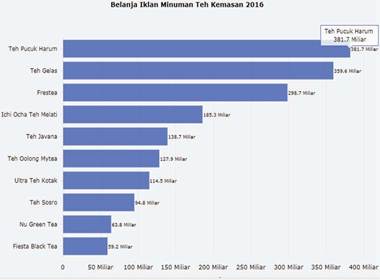
Figure 1. Advertising expenditures of tea beverage package year 2016. Source: The Nielsen Company (2017a).
2. Celebrity Endorser
Friedman and Friedman (1979) stated that celebrities can be interpreted as someone who is known by the public (actors, athletes, etc.) for their achievements in other fields. There are factors that companies pay attention to when making their celebrity selection decisions. McCracken (1989) defines celebrity endorser as everyone who is popular or known to the public and uses its popularity for a product with an appearance in an advertisement. Celebrity endorsers become one of the alternatives in marketing communication to build images that are appropriate to the brand and target audience (Byrne et al. 2003).
Shimp (2000b) states that today many consumers easily identify with these stars, often by looking upon them as heroes for their personal achievements, personalities, and attractiveness. Advertisers are proud to use celebrities in their ads because their popularity attributes, including beauty, courage, talent, athleticism, elegance, power and sexual attraction are often the desired enthusiasts for the brands they support. Repeated association of a brand with a celebrity ultimately leads consumers to think that the brand has interesting properties similar to those of a celebrity.
2.2 Attribute of the endorser
In choosing endorsers, companies need to pay attention to attributes that can affect the success of the campaign or in other words the endorser can represent what is desired by the company. Perceptions of endorsers will be measured using instruments developed by Ohanian (1990). In his research, Ohanian developed and validated the scale to measure the credibility of the endorser through perceived attractiveness, trustworthiness, and perceived expertise of the endorser.
The following is Ohanian’s developed scale, called the Source Credibility Scale.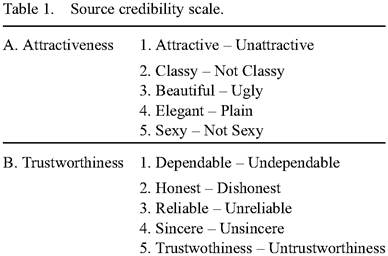
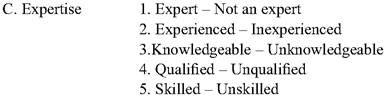
Source: Ohanian (1990).
2.3 Brand image
Identity consists of various ways that the company directs to identify itself or promote themselves or their products, while the image is a public perception of the company or its products (Kotler & Keller 2009). Identity is the introduction of the image. An effective image does three things: establishing product character and value proposals; conveying the character in different ways so as not to be confused by the competitor; and providing an emotional power that is just a mental image. In order to function, the image must be conveyed through available communication means and brand contacts. According to Kamins (1994), matching star ads with starred ads requires that celebrities have to be attractive because these conditions are more effective to support products that can ultimately improve consumer appeal to the item.
Brand image is a series of interrelated brand associations. The brand association is all the impression that comes to the mind of a person associated with his memory of a brand. Brand-related impressions will increase with the increasing number of consumer experiences in consuming a brand or with the more frequent appearance of the brand in its communications strategy, plus if it is supported by a network of other links. An established brand will have a prominent position in the competition when supported by a strong association. The more interconnected the associations, the stronger the brand image of the brand. Generally, brand associations (especially those that form the brand image) have become the basis of consumers in their purchasing decisions and loyalty to the brand (Durianto et al. 2003).
Goldsmith in Seno and Lukas (2007) states that the basic factors that influence brand image are
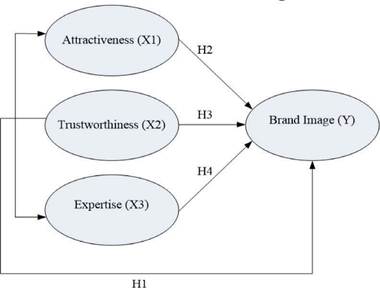
Figure 2.
Proposed conceptual framework of the research.celebrity credibility. Celebrity credibility is the perception of expertise related to messages communicated and can be trusted opinions or objective opinions of the message source. Perception, attractiveness, expertise, and trustworthiness regarding source credibility have a positive impact in persuading consumers and influencing consumers’ attitudes to the products associated.
2.4 Conceptual framework and hypotheses development
A research conducted by Ramadhani (2014) suggests that celebrity credibility, attractiveness, and charisma simultaneously have significant influence on the brand image, and partially credibility had the most significant influence.
Using Principal Component Analysis, Multidimensional Scaling, and Importance Performance Analysis, Anggraesti (2010) conducted a study on the use of celebrity endorsers in shampoo ads. She concluded the the attractiveness, trustworthiness, and expertise of the endorsers will affect the creation of a positive brand image. The relationship between the four variables can be seen in Figure 2.
3 METHODOLOGY
3.1 Samplingandpopulation
The sample of the study includes prospective buyers of Teh Javana product at Sekolah Tinggi Ilmu Eko- nomi Harapan Bangsa, and selected purposively using the following criteria: respondents had seen on TV Maudy Ayunda’s Teh Javana ad. In this study, the sample size was determined using Slovin formula with 90% confidence level so that the error value (e) was 10% (0.10). The total number of population members was 438 students. The minimum required sample (n) is:
438
1 + (438 + 0.12)
¼ 81,41 ¼ 125
4 DATA ANALYSIS
4.1 Demographic characteristics of respondents
The number of questionnaires collected was 125. The profile of the respondents involved in this study shows that:
• 54.4% respondents were male;
• 124 of the respondents were between 15 and 25 years old, while 1 respondent was between 26 and 35 years old.;
• 59 respondents had monthly expenses of less than 1 million rupiahs, 59 respondents had monthly expenses between 1 million to 3 million rupiahs, 3 respondents had monthly expenses between 3 to 5 million rupiahs, 2 respondents had monthly expenses between 5 to 10 million rupiahs, and 2 respondents had monthly expenses of more than 10 million rupiahs.
4.2 Validity and reliability of the instrument
Validity test is used to measure the validity of the questionnaire. A questionnaire is said to be valid if the question on the questionnaire is able to reveal something to be measured by the questionnaire. In this study, the validity measurement was done by doing bivariate correlation between each indicator score with the value of construct score. The result of validity test shows that all items were valid. The research instrument was reliable because it had a value of Cronbach’s Alpha > 0.60. The result of reliability test is presented in Table 2.
Table 2. Reliability coefficients for attractiveness, trustworthiness, expertise, and brand image.
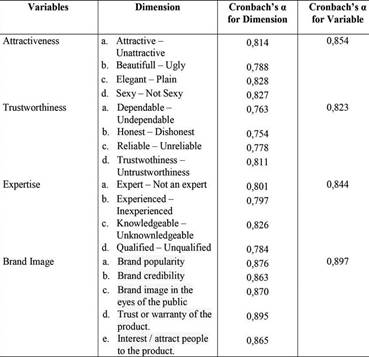
Table 3. Anovatestresults(F).
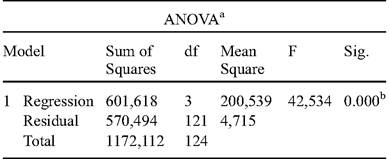
a. Dependent Variable: BRANDIMAGE
b. Predictors: (Constant), ATTRACT, TRUST, EXPERTISE
4.3 Anova test (F)
The Anova test (F-test) was performed using IBM SPSS 24. The results show that at least one variable X had a significant effect on the variable Y. This result was obtained because the value of F arithmetic > F table using level 95% confidence, α = 5% by specifying degrees of freedom or df l (number of variables free - 1) i.e. 3-1 = 2 and dfl 2 (the number of samples - the number of independent variables), i.e., 100 - 3 = 97. The F value = 42.534 > F table = 3.07 with probability value (0,000) < α = 5%. H0 was then rejected and H1 accepted. The result of Anova test results are presented in Table 3.
H2: The Influence of Attractiveness of Endorser Attention on Brand Image.
The result of T test (partial) indicates that attractiveness has no significant influence on the brand image. The result of this test indicates that the stage action, beauty, dressing, and sex appeal of Maudy Ayunda do not affect the psychological process where the recipient of the message can receive and understand the position of the endorser inside the ad. The results can be seen in Table 4.
H3: Effect of Endorser Trustworthiness Attribute on Brand image.
Table 4. T-Test results.
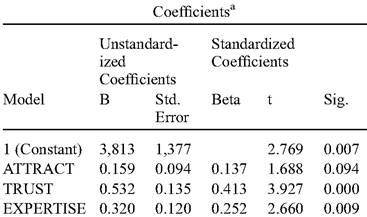
a. Dependent Variable: BRANDIMAGE
Trusthworthiness means how much the level of consumer trust in the endorser can affect the image of Teh Javana. Such trustworhiness can be seen on the basis of how to deliver advertising messages by endorsers.
This research resulted in the regression coefficient of trustworthiness of 0.532. This result means if trustworthiness is increased by one unit, then the brand image Teh Javana will increase by 0.532 assuming that other attributes have fixed value. This regression coefficient was the greatest compared with other attributes.
The result of T test (partial) indicates that trustworthiness had the most significant influence on the brand image. Thus, trust to Maudy Ayunda is very influential in Teh Javana brand image creation.
H4: Effect of Endorser Attribute Attitude on Brand image.
The regression coefficient of expertise was 0.320, meaning that if expertise is increased by one unit, then the brand image Teh Javana will experience an increase of 0.320 assuming that other attributes have fixed values. The indicators of expertise include knowledge, experience, and expertise in delivering advertising messages.
The result of T test (partial) indicates that expertise had significant influence on the brand image. Thus, the expertise of Maudy Ayunda has a significant effect on image the Teh Javana brand.
Each independent variable positively affected the brand image. This can be seen from the beta value which indicates a positive value. Based on the value of the coefficient, the regression equation can be stated as follows:
Brand image = 3.813 + 0.532 trustworthiness + 0.320 expertise.
• The constant of 3.813 means if the variable of trustwothiness and expertise is worth 0, then the brand image will be worth as much as 3.813
• The regression coefficient of trustworthiness variable of 0.532 means that if variable confidence increases by one unit, then the brand image Teh Javana will experience an increase of 0.532 units assuming the other variables have fixed values.
• The regression coefficient of expertise variable of
0. 320 means that if the variable expertise increases by one unit, then the brand image Teh Javana will experience an increase of 0.2576 units with assuming the other variables have fixed values.
The determination analysis was performed to find out the contribution of variable X to variable Y. The result is presented in Table 5.
The adjusted R square number was 50.1%. This indicates that the independent variables had influence on the dependent variable as much as 50.1%; the rest is influenced by factors other than the studied variables.
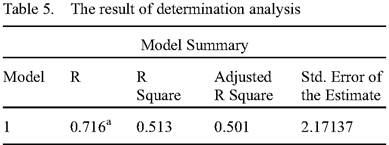
a. Predictors: (Constant), EXPERTISE, ATTRACT, TRUST
5 DISCUSSION
5.1 Managerial Implications
The management of Wings Food needs to make efforts to be able to maintain and enhance its positive image in the eyes of consumers. This can be done by hiring a celebrity to be a brand ambassador. People’s admiration towards the celebrity will affect the product image.
5.2 Suggestion
Based on the results of the overall research, it is suggested that company promotion pays more attention to trust factor of the endorser because this variable is the highest variable to affect the brand image.
REFERENCES
Anggraesti H.P. 2010. Analisis Efektivitas Penggunaan Celebrity Endorser Dalam Meningkatkan Brand Image Sampo Menurut Pandangan Mahasiswa Strata 1 IPB [skripsi]. Bogor: Institut Pertanian Bogor.
Byrne, A., Whitehead, M. & Breen, S. 2003. The Naked Truth of Celebrity Endorsement. British Food Journal 4(5): 288.
Durianto, D., Sugiarto, S., Widjaja, A.W. & Hendrawan, S. 2003. Invasi Pasar Dengan Iklan Yang Efektif. Jakarta: PT. Gramedia Pustaka Utama.
Friedman, H.H. & Friedman, L. 1979. Endorser affectiveness by product type. Journal of Advertising Research 19(5): 63-71.
The Nielsen Company. 2017a. Perang Iklan Minuman Teh Kemasan. [Online]. Retrieved from: https://databoks. katadata.co.id/datapublish/2017/02/06/televisi-masih- menjadi-pilihan-utama-produsen-beriklan. Accessed on 1 December 2019.
The Nielsen Company. 2017b. Televisi Masih Menjadi Pili- han Utama Produsen Beriklan. [Online]. Retrieved from: https://databoks.katadata.co.id/datapublish/2017/ 02/04/perang-iklan-minuman-teh-kemasan. Accessed on 1 December 2019.
Kamins, M.A. & Gupta, A. 1994. Congruence between Spokesperson and Product Type: A Matchup Hypothesis Perspective. Psychology and Marketing 11(6): 569-586.
Kotler, P. & Keller, K.L. 2009. Manajemen Pemasaran. Jilid 1. Ed ke-13. Jakarta: Penerbit Erlangga.
McCracken, G. 1989. Who is the celebrity endorser? Cultural foundations of the endorsement process. Journal of consumer research 16(3): 310-321.
Ohanian, R. 1990. Construction and Validation of a Scale to Measure Celebrity Endorser’s Perceived Expertise, Trustworthiness, and Attractiveness. Journal of Advertising, 19(3): 39-52.
Ramadhani, R. 2014. Pengaruh Penggunaan Endorser Ter- hadap Brand Image Pada PT Nike Indonesia [skripsi]. Bogor: Institut Pertanian Bogor.
Seno, D. & Lukas, B.A. 2007. The Equity Effect of Product Endorsement by celebrities. European Journal of Marketing. Emerald Group Publishing.
Shimp, S. & Terence, A. 2000a. Periklanan Promosi: Komunikasi Pemasaran Terpadu. Jilid 1. cetakan V. Jakarta: Penerbit Erlangga.
Shimp, S. & Terence, A. 2000b. Periklanan Promosi: Komunikasi Pemasaran Terpadu. Jilid 2. cetakan V. Jakarta: Penerbit Erlangga.