Influences of social support on job satisfaction and organizational commitment
R. Setiawan, R.G. Munthe & A. Aprillia
Maranatha Christian University, Bandung, West Java, Indonesia
ABSTRACT: Employees’ work attitudes determine their performances at company.
Situation at the company and social support enable employees to feel happy at work and be loyal to the company. Social support refers to any active attention and care showed by peers and managers to employees in accomplishing the tasks assigned. Job satisfaction is a positive feeling experienced by employees in doing their job while organizational commitment refers to a tendency of employees to do at their best for the success of the company and at the same time keep staying in the company for long. The objectives of this study were to test the influence of social support on job satisfaction as well as its influence on organizational commitment. The respondents of this study were 43 first-line and middle managers working in several private banks in Bandung, Indonesia. Using simple linear regression analysis, the study found that there is a positive influence of social support on both employees’ job satisfaction and employees’ organizational commitment.1 INTRODUCTION
Employees are the only active resources that contribute their aspirations and creativities to the performance of their company. The success of a company’s performance is determined by the performance quality of its employees. Employees’ performance is a function of ability, motivation, and opportunity (Appelbaum et al. 2000). According to Maslow’s motivation theory, employees can be motivated by five levels of needs, which one of them is social needs (Onah, 2015). Specifically, social needs refer to needs of affection, belongingness, acceptance, and friendship. Employees’ social needs can be fulfilled through social support that is given by people around them at their workplace.
Social support has positive psychological impact time after time (Hola- han & Moos 1981, George et al. 1989, Lee & Robbins 1998, Kendler et al. 2006, Hill et al. 2011, Hyde et al. 2011). Social support from co-workers and supervisor becomes employees’ motivation in showing positive work attitudes in a company. Job satisfaction and organizational commitment are two important work attitudes in most research (Moynihan & Pandey 2007).Many studies, which have been conducted all over the world across some different industries, have proven that job satisfaction and organizational commitment are the result of social support. The respondents of those studies were workers at information technology companies in the United States (Liu 2004), workers at fashion companies in New Zealand (Bateman 2009), workers at five-star hotels in Bodrum, Turkey (Colakoglu et al. 2010), workers at services sector companies in Catalonia, Spain (Garcia et al. 2011), workers at education and healthcare companies in Turki (Emhan 2012), workers at a company engaged in postal services in Indonesia (Pradesa et al. 2013), elementary school teachers in Turkey (Gunduz 2014), workers at non-profit public sector companies in Malaysia (Zumrah & Boyle
2015), workers at manufacturing companies in Taiwan (Chou 2016), workers at higher education institutions in South Africa (Donald et al. 2016), workers at large companies in Nairobi (Miring’u
2016), workers at private libraries in South-West, Nigeria (Olaojo et al. 2016), and security guards in Singapore (Nalla et al. 2017). In order to confirm the results of those previous studies, there is a need to conduct another research on the same topic with specific respondents in different industry, in this case bank managers. Bank is a company that offers services to the consumers. Satisfied and loyal bank customers are resulted from satisfied and loyal frontline bank employees; conversely, those competent staffs derived from satisfied and loyal managers, including first-line manager and middle manager.
Those managers play major roles in managing relationship between front liner and top management (Robbins & Coulter 2016). This research was intended to investigate the influence of social support on both job satisfaction and organizational commitment of first-line and middle bank managers at several private banks.2 LITERATURE REVIEW AND RESEARCH DEVELOPMENT
Job satisfaction is a pleasurable emotional state coming from the appraisal of one’s job as achieving or facilitating the achievement of one’s job values (Locke 1969). Organizational commitment is the relative strength of an individual’s identification with and involvement in a particular organization (Porter et al. 1974). Ifjob satisfaction involves the employees’ positive feelings toward their work, then organizational commitment has a broader context; organizational commitment relates to positive feelings of employees to the company where they work that can be demonstrated through employees’ loyalty, including acceptance of organizational values, devotion, and loyalty to the company. Social support is an interpersonal transaction containing affection (love, liking, respect, admiration), affirmation (agreement, acknowledgement of appropriateness or rightness of other’s behavior), and aid (direct service or giving of material supplies) (Turner 1983). Employees who work in the company have the role of human beings in their daily lives, namely as individual beings and social beings. To become a full employee, employees must demonstrate individual achievements that support the company’s progress. In addition, they also need interaction, communication, and information flow from colleagues and their managers in the form of psychological and moral support to feel comfortable in their workplace and feel at home in the company where they work.
Employees who get support from colleagues or supervisors tend to have a high level of satisfaction with their work (Robbins & Judge 2016). The existence of co-workers and supervisors who provide support, both in terms of work and personal or family issues, will make employees feel appreciated and this will encourage the emergence of positive emotions that manifest in the work employees do.
Employees who have fun friends will motivate themselves to be always excited and enthusiastic in completing each of their jobs. Employees who meet their social needs will feel comfortable in their work environment. They do not feel alone if they face some problems because both colleagues and supervisors are always willing to help. Employees who are satisfied with their work and social environment in the workplace tend to feel reluctant to leave the company where they work. They are convinced by the familiar atmosphere of the family at work, their work will be well resolved, and can even encourage them to improve their work performance. Employees who get support from colleagues and supervisors tend to have a high level of commitment to the organization (Tansky & Cohen 2001). Employees who feel their social needs are being fulfilled as a sense of respect as a fellow employee of the company in which they work, whether by their co-workers or supervisors, will be motivated to retain their membership within the organization; in particular, they will have willingness to perform more for the organization progress and agree with the values and goals of the organization. The existence of social support from colleagues and supervisors towards fellow employees will create stronger cohesiveness and ties to jointly commit to the organization. Even if employees do not have a high organizational commitment, but with the support and transmission of organizational commitment through social support from colleagues and supervisors, they tend to think twice in leaving the company where they work because of strong bonds of brotherhood as their biggest consideration. The emergence of a sense of reluctance to leave a friendly and welcoming family and laziness to adapt to the new environment leave employees committed to the company where they work.Thus, the study tried to investigate the influence of social supports on both employees’ job performance and on their organizational commitment by testing two research hypotheses as follows:
H1: Social support positively affects employees’ job satisfaction
H2: Social support positively affects employees’ organizational commitment
3 RESEARCH METHOD
The study involved 43 employees who work at first-line and middle managerial level in several banks (branch regional offices) in Bandung, Indonesia as respondents.
As a matter of privacy, the investigated banks’ names are hidden and protected from any kinds of publications. Some of these banks are among the top ten largest banks in Indonesia based on the amount of assets at the time of this study being conducted. The data of the study were collected by survey (questionnaire) and literature study. This is a causal explanatory research that measures linkages among three variables namely social support, job satisfaction, and organizational commitment. Job satisfaction was measured using eighteen items of questions adapted from the questionnaire developed by Brayfiel & Rothe (1951). Organizational commitment was measured using nine item questions developed by Mowday et al. (1979). Meanwhile, social support (from supervisors and co-workers) was measured using twelve item statements developed by Caplan et al. (1975). Because the objectives of the study were to examine influences, hypotheses tests used is simple linear regression. The first simple linear regression analysis was conducted to test the influence of social support on job satisfaction and the second hypothesis is to test influence of social support on organizational commitment. To ensure eligibility of regression analysis tests, this study also conducted validity and reliability as well as normality and heteroskedasticity test. All instrument, data, and hypotheses test were analyzed by using SPSS version 20.4 RESULTS AND DISCUSSION
The statistical calculation revealed some results. First, the Cronbach’s alpha coefficient value of job satisfaction is.885 with item-total correlation values ranging from.266 to.81 and significant value equals to.000. Second, the Cronbach’s alpha coefficient value of organizational commitment is.902 with the item-total correlation values ranging from.581 to.880 and significant value equals to.000. Finally, the Cronbach’s alpha coefficient value of social support variable is.905 with item-total correlation values ranging from.622 to.796 and significant value equals to.000.
The data collected were proven normal through Kolomogorov-Smirnov’s test with significant values, respectively, being.788 and.735. The research data were also free from heteroskedasticity proven by Glejser’s test with significant values, respectively, at.892 and.599. The results of hypotheses test in this study are presented in Tables 1 and 2.
JS: Job Satisfaction, SS: Social Support.
Table 1 shows that social support significantly and positively affects job satisfaction, as indicated by significant value of.003 and beta value of.451. This result indicates that more the social support perceived by the employees, the more satisfied they feel towards their job. Social support brings excitement to employees at workplace. Therefore, the first hypothesis was not rejected.
OC: Organizational Commitment, SS: Social Support
Showing the same result, Table 2 reveals that social support have also significant and positive influence on employees’ organizational commitment, as indicated by significant value of.006 and beta value of.414. The result implies that the more the social support perceived by the employees, the more the committed employees to their organization. Social support brings engagement for employees to their organization. The second hypothesis was not rejected either.
5 CONCLUSION
This study has shown that both research hypotheses proved that social support has a positive and significant impact both on job satisfaction and organizational commitment. Furthermore, these results confirmed the alignment of the previous researches on the similar topic on social support and its impacts towards employees’ job satisfaction and organizational commitment. Employees, who feel that they have support from their co-workers and their direct supervisors tend to have job satisfaction and show organizational commitment at a better level. Companies need to create and develop a more familyfriendly culture and policies, to look after the conditions of their employees, to understand the conditions and situations they face, to better understand their fellow employees, to help those who are in trouble both physically and psychologically, to look for solutions to personal and collective problems, and to encourage their co-workers and supervisors to be more proactive sympathetically and empathetic- ally towards their social environment in the workplace (Mondy & Martocchio 2016). Any managerial employees should feel that employees’ problems will be a problem for them as well, even the company as a whole. Thus, there will be a sense of brotherhood among fellow employees. Social support that is perceived by employees, whether in work or personal matters, will motivate them to be more courageous in facing all these problems because they feel that they are linked each other as united members of the company making them realize that they will be able to strengthen each other even with organizational problems. Social support sourced from a sincere heart and a wise mind will create a cohesive, strong, dynamic, growing, evolving, and positive organizational environment. By sowing well begins with small things, done from now, and begins with personal initiative; then in time, it will inevitably reap great happiness, on an ongoing basis, and affect many people. Positive treatment will be a chain that will be passed from one generation to the next in the company’s sustainability.
Table 1. Test on first research hypothesis.
Coefficients’
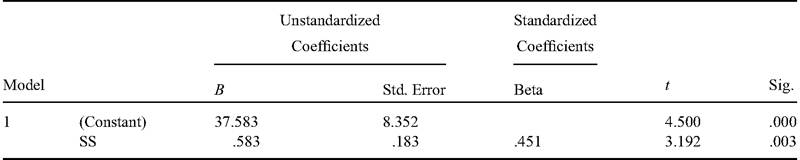
a. Dependent Variable: JS.
Table 2. Test on second research hypothesis.
Coefficients’
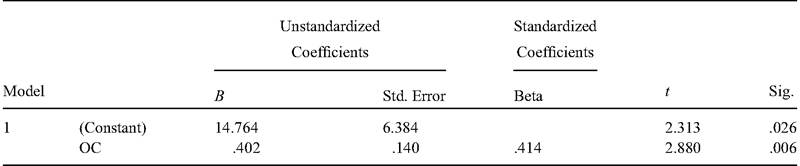
a. Dependent Variable: OC.
Research means re and search, a continuous searching process through better methods and process. Therefore, the study proposes some suggestions for the future research. First, there are many consequences of social support in terms of work behaviors, such as organizational citizenship behavior and pro-social behavior. The study about the aforementioned results of social support will be conducted as the future research. Second, this study only tested managers from banking industry. Studies with the same topic at different industries (non-profit organization, community, public company) can be conducted as the future research. Third, this study only used a simple linear regression. With the complexity of variables and relationships, the future research can be conducted with model test, such as structural equation modeling. Fourth, social support in this context is attention and help that people give at workplace. For the future research, social support can be expanded as interactions and interrelationship among people through social media, thus broadening the scope of social support and comparing the difference between influence from direct and indirect social support.
REFERENCES
Appelbaum, E., Bailey, T., Berg, P. & Kalleberg, A.L. 2000. Manufacturing advantage: Why high-performance work systems pay off London: Economic Policy Institute: Cornell University Press.
Bateman, G. 2009. Employee perceptions of co-worker support and its effect on job satisfaction, work stress and intention to quit. Dissertation in Master of Science in Applied Psychology at the Department of Psychology, University of Canterbury
Brayfield, A.H. & Rothe, H.F. 1951. An index of job satisfaction. Journal of Applied Psychology 35: 307-311.
Caplan, G., Cobb, S., French, J., Van Harrison, R. & Pin- neau, S. 1975. Job demands and work health: main effects and occupational differences. Washington, D.C.: U.S. Government Printing Office.
Chou, P. 2016. The effects of social support on employee’s behavioural support for organizational change: an empirical study in Taiwan. International Journal of Economics, Commerce and Management IV(2): 22-41.
Colakoglu, U., Culha, O. & Atay, H. 2010. The effects of perceived organisational support on employees’ affective outcomes: evidence from the hotel industry. Tourism and Hospitality Management 16(2): 125-150.
Donald, M.F., Hlanganipai, N. & Richard, S. 2016. The relationship between perceived organizational support and organizational commitment among academics: the mediating effect of job satisfaction. Investment Management and Financial Innovations 13(3): 267-273.
Emhan, A.E. 2012. Relationship among managerial support, job satisfaction and organizational commitment: a comparative study of non-profit, for-profit and public sectors in turkey. International Journal of Business, Humanities and Technology 2(5): 179-190.
Garcia, J.A.M., Bonavia, T. & Losilla, J.M. 2011. Exploring working conditions as determinants of job satisfaction: an empirical test among Catalonia service workers. The Service Industries Journal 31(12): 2051-2066.
George, L.K., Blazer, D.G., Hughes, D.C. & Fowler, N. 1989. Social support and the outcome of major depression. British Journal of Psychiatry 154: 478-485
Gunduz, Y. 2014. The effect of organizational support on organizational commitment. Anthropologist 18(3): 1041-1057.
Hill, J., Holcombe, C., Clark, L., Boothby, M.R.K., Hincks, A. & Fisher, J. 2011. Predictors of onset of depression and anxiety in the year after diagnosis of breast cancer. Psychological Medicine 41: 1429-1436.
Holahan, C.J. & Moos, R.H. 1981. Social support and psychological distress: a longitudinal analysis. Journal of Abnormal Psychology 90: 365-370.
Hyde, L.W., Gorka, A., Manuck, S.B. & Hariri, A.R. 2011. Perceived social support moderates the link between threat-related amygdala reactivity and trait anxiety. Neuropsychological 49: 651-656.
Kendler, K.S., Gatz, M., Gardner, C.O. & Pedersen, N.L. 2006. A Swedish national twin study of lifetime major depression. American Journal of Psychiatry 163: 109-114.
Lee, R.M. & Robbins, S.B. 1998. The relationship between social connectedness and anxiety, self-esteem, and social identity. Journal of Counselling Psychology 45: 338-345.
Liu, W. 2004. Perceived organizational support: linking human resource management practices with important work outcomes. Dissertation in Doctor of Philosophy at Faculty of the Graduate School of the University of Maryland.
Locke, E.A. 1969. What is job satisfaction? Organizational Behaviour and Human Performance 4: 309-336.
Miring’u, W. 2016. Perceived influence of organisational support on organisational commitment in githunguri dairy co-operative society limited. A Research Project Submitted in Partial Fulfilment of the Requirement for the Degree of Master of Business Administration (MBA) School OfBusiness, University OfNairobi.
Mondy, R.W. & Martocchio, J.J. 2016. Human Resource Management. 14th Edition. New Jersey: Pearson Education
Mowday R., Steers R. & Porter L. 1979. The measure of organizational commitment. Journal of Vocational Behaviour 14(2): 224-227.
Moynihan, D.P. & Pandey, S.K. 2007. Finding workable levers over work motivation: comparing job satisfaction, job involvement, and organizational commitment. Administration & Society 39(7): 803-832.
Nalla, M.K., Paek, S.Y. & Lim, S.S. 2017. The influence of organizational and environmental factors on job satisfaction among security guards in Singapore. Australian & New Zealand Journal of Criminology 50(4): 548-565.
Olaojo, P.O., Oyeboade, J.A. & Gbotosho, A.S. 2016. Social support, work motivation and work commitment of library personnel in selected private university libraries in south-west, Nigeria. Qualitative and Quantitative Methods in Libraries (QQML) 5: 11-22.
Onah, F.O. 2015. Human Resource Management. 4th Edition, Enugu: John Jacob’s Classic Publisher, Ltd.
Porter L.W., Steers R.M., Mowday R.T. & Boulian P.V. 1974. Organizational commitment, job satisfaction, and turnover among psychiatric technicians. Journal of Applied Psychology 59(5): 603-609.
Pradesa, H.A., Setiawan, M. & Rahayu, D.M. 2013. The relationships of perceived organizational support (pos) with positive work behaviour: mediating role of job satisfaction, affective commitment, and felt obligation. IOSR Journal of Business and Management (IOSR- JBM) 13(3): 23-34.
Robbins, S.P. & Coulter, M. 2016. Management. 13th Edition. New Jersey: Pearson Education
Robbins, S.P. & Judge, T.A. 2016. Organisational behaviour. 17th Edition. New Jersey: Pearson Education
Tansky, J.W. & Cohen, D.J. 2001. The relationship between organizational support, employee development, and organization commitment: an empirical study. Human Resource Development Quarterly 12: 285-300.
Turner, R.J. 1983. Direct, indirect, and moderating effects of social support on psychological distress and associated conditions. In H.P. Kaplan (ed.) Psychosocial Stress, Trends in Theory and Research. New York: Academic Press
Zumrah, A.R. & Boyle, S. 2015. The effects of perceived organizational support and job satisfaction on transfer of training. Personnel Review 44(2): 236-254.