The role of inclusive leadership on job performance through mediators in interior design and construction companies in Vietnam
H. T.N. Le
Van Hien University, Ho Chi Minh City, Vietnam
P.V. Nguyen, T.V.A. Trinh & H.T.S. Do
International University-Vietnam National University, Ho Chi Minh City, Vietnam
ABSTRACT: This study was intended to develop a conceptual model to investigate the indirect effects of inclusive leadership on job performance throughout the mediating factors, including person-job fit, employee well-being and innovative behaviour.
The paper conducted a structural equation model approach to test the research hypotheses through questionnaire survey of 387 employees who were working at twelve interior design and construction companies. The results revealed that person-job fit and employee well-being had a significant direct impact on job performance with estimated results supported all hypotheses. Interestingly, employee well-being, person-job fit, innovative behaviour are considerable mediators that statistically support indirect effect of employee well-being on job performance. The findings highlighted a theoretical and empirical contribution to further understanding the impact existence of leader-member exchange policies on job performance. In other words, the results proposed some managerial implications to enhance job performance by strengthening self-worth through innovative behaviour in the workplace and reinforcing inclusive leadership practices.1 INTRODUCTION
Recently, researchers have focused on employee well-being and innovative behaviour (Mumford et al. 2002, Scott & Bruce 1994) as major predictors of organizational performance (Huhtala & Parzefall 2007).
In general, leadership has significant impacts on employee well-being and innovative behaviour (Arnold et al. 2007, Gong et al. 2009). However, the linkages among these factors in a specific setting have rarely been studied. Several scholars encouraged further studies to examine relational leadership since an increasing emphasis is based on building a relationship between supervisors and subordinators, which calls for leaders’ contribution to create an inspiring workplace (Uhl-Bien 2006, Carmeli et al.
2010). Accordingly, deeper investigations have been conducted into one key facet of the relational leadership, inclusive leadership, because of its distinguished features from those of other leadership styles (Hollander 2012) to build up a positive working ambiance (Carmeli et al. 2010).Although some studies demonstrated a strong relationship between person-job fit and specific styles of leadership (Mulki et al. 2006), employee well-being (Singh & Greenhaus 2004), and innovative behaviour (Afsar et al. 2015), few studies have identified the mediating effect of person-job fit.
In the Asian context, Vietnam highly represents collectivism and high uncertainty avoidance (Wang & Yi 2011). In such society, employees are more comfortable and intrinsically motivated by sharing an intimate relationship with their colleagues and leaders. Therefore, this study stresses the importance of leadership practices, specifically inclusive leadership, and its effectiveness in shaping a supportive working climate. In a creativity-intensive field like architectural and engineering design sector, employees should acquire particular abilities to match with the job requirements. These factors, which can be fostered under the encouraging working environment, ultimately stimulate high performance. To fully understand job performance and its predictors, we propose the conceptual model to test the relation between inclusive leadership, person-job fit and innovative behaviour, and in turn, the findings enable us to suggest some practical implications to enhance job performance.
2 LITERATURE REVIEW
2.1 Inclusive leadership and employee well-being
The inclusive leadership is identified by three facets consisting of “openness, accessibility, and availability to pay attention to employee ideas” (Carmeli et al. 2010). It enhances the beliefs that members’ voices are genuinely appreciated which proposes the positive emotional leader-member ties (Choi et al. 2017). Hence, it has a significant effect on employee wellbeing.
Thus, hypothesis 1 was proposed as follows:H1: the inclusive leadership has a positive impact on employee well-being.
2.2 Inclusive leadership and personal job-fit
According to Shin (2004), person-job fit has been recognized as the perception of harmonizing between employees’ qualities and job demand. Three potential ways illustrate that the inclusive leadership is significantly associated with person-job fit. Firstly, according to (Choi et al. 2015), the inclusive leadership’s openness may help reduce followers’ uncertainty and ambiguity of their roles. Next, the inclusive leadership creates a supportive work climate that strengthens the belief of person-job fit (Tims et al. 2011). Finally, mastery experience through managers’ constant support is able to foster employees’ self-evaluation in their capacities through positive feedback about their performance (Tims et al. 2011).
Therefore, the following hypothesis is suggested:
H2: the inclusive leadership has a positive impact on person-job fit.
2.3 Inclusive leadership and innovative behaviour
Innovative behaviour is described as “the intentional introduction within one’s work role of new and useful ideas, processes, products, or procedures” by West (1990). Previous studies demonstrated that specific leadership styles motivate employee innovation (Shalley & Gilson 2004) such as transformational leadership (Afsar et al. 2015, Sharifirad 2013) and ethical leadership (Yidong & Xinxin 2013).
The prior studies found the relationship between the inclusive leadership and innovative behaviour in three different ways. Firstly, the leaders with supportive behaviour motivate their employee’s engagement in innovative work because they receive emotional and cognitive resources (Vinarski-Peretz & Carmeli 2011). Secondly, employees’ novel ideas are stimulated in the supportive working climate. They contribute to the foundation of perception of support for employees’ creativity and innovation (Cerne et al.
2013). Lastly, availability and accessibility of the inclusive leader result in clarity of employees’ work, thereby implementing innovative ideas (Carmeli et al. 2010). Therefore, we propose hypothesis 3:H3: the inclusive leadership has a positive impact on employee innovative behaviour.
2.4 Person-job fit and employee well-being and performance
Person-job fit is associated with employee wellbeing and job performance in several ways. First, employees who well perceive that the requirements of the job are within their capabilities often feel more fulfilled in their work (Quinn 2005). Second, the positive perception of person-job fit results in less pressure and burnout (Singh & Greenhaus 2004) and less worry (Quinn 2005). As a result, it enhances their well-being at work. Finally, combination of employees’ capabilities and job demands help them to manage the tasks more effectively (Brkich et al. 2002, Hamid & Yahya 2011). Hence, we suggest two hypotheses (H4) and (H5):
H4: Person-job fit has a positive impact on employee well-being.
H5: Person-job fit has a positive impact on job performance.
2.5 Employee well-being and job performance
Previous studies have found the positive linkage between employee well-being and job performance (Lyubomirsky et al. 2005). Wright (2014) suggests that “Emotion-based employee well-being is attained by an employee when s/he experiences psychological wellbeing in the form of lack of stress and emotional burnout, and positive affectivity.” It was also pointed out that emotion-based employee well-being is more likely to have a positive relation to job performance (Wright & Hobfoll 2004). Additionally, the state of enthusiasm, activeness, and consciousness play a predicting role in several job outcomes (Choi & Lee 2014). Therefore, the following hypothesis (H6) is suggested:
H6: Work well-being has a positive impact on employee job performance.
2.6 Person-job fit and innovative behaviour
When employees self-evaluate themselves for being qualified for the job, they form a sense of contentment, achievement, and confidence (Xie & Johns 1995).
These positive emotions encourage them to be strongly committed to the job, foster supportive ideas for innovative development and repress fear for potential mistakes (Cerne et al. 2013). Positive expectations, consequently, triggers motivation for idea generating process (Cerne et al. 2013). Moreover, employees’ positive self-evaluation of their qualities to fit job characteristics stimulates flexibility and creativity in thinking, which is one essential feature of innovative behaviour (Avolio et al. 2004). Therefore, we propose the following hypothesis (H7):H7: Person-job fit has a positive impact on innovative behaviour.
2.7 Innovative behaviour and job performance
The innovative behaviour includes discovering new technologies, introducing new techniques to meet objectives, applying new task methods, and investigating resources for generating new ideas (Janssen 2000). Employees’ willingness to learn, explore and initiate ideas results in resolution of pressing problems; consequently, triggering higher job performance (Amabile et al. 2005). Thus, hypothesis 8 is suggested:
H8: Innovative behaviour has a positive impact on job performance.
3 RESEARCH METHODOLOGY
3.1 Measurement
All measurements items were rated on the five-point Likert scale, ranging from 1 (strongly disagree) to 5 (strongly agree). Particularly, Appendix 1 shows the measures of variables with the relative sources.
3.2 Methodology
3.2.1 Questionnaire design
The questionnaire covers two main parts: (1) respondents’ profile including age, gender, education level and working position and (2) 36 questions relating to the hypothetical model. It was translated into the Vietnamese language with some adjustments to be more compatible within the Vietnamese context.
3.2.2 Data collection
The data were collected through two phases: a pilot test and official survey, which was conducted in Ho Chi Minh City, Vietnam. Pilot test with the sample size of 37 was carried out to check the measurement scale.
After the minor revision, the questionnaires were then distributed to 409 respondents that include employees working in twelve interior design and construction companies. Eventually, 387 valid samples were used to test the hypothetical model.4 RESULTS
4.1 Demographic characteristics
By gender, the percentage of the male is dominant, at 52.7%, while respondents whose age ranging from 21 - 40 takes the proportion of round 95%. Last demographic information revealed that the number of employees who have the academic level of
Table 1. Reliability analysis.
| Var | Items | Mean | SD | Cronbach’s Alpha | Factor Loadings |
| IL | IL5 | 4.06 | .747 | .854 | .747 |
| IL4 | 4.19 | .759 | .742 | ||
| IL6 | 4.21 | .786 | .722 | ||
| IL3 | 3.90 | .797 | .645 | ||
| IL2 | 3.99 | .821 | .642 | ||
| IL1 | 4.08 | .722 | .628 | ||
| PJF | PJF2 | 3.87 | .853 | .808 | .854 |
| PJF3 | 3.72 | .778 | .749 | ||
| PJF1 | 3.61 | .876 | .731 | ||
| EWB | EWB1 | 3.87 | .834 | .902 | .813 |
| EWB3 | 3.72 | bgcolor=white>.788.803 | |||
| EWB2 | 3.91 | .803 | .792 | ||
| EWB4 | 3.79 | .812 | .755 | ||
| EWB5 | 3.79 | .767 | .731 | ||
| IB | IB5 | 3.96 | .756 | .851 | .778 |
| IB4 | 3.73 | .779 | .766 | ||
| IB6 | 4.24 | .697 | .707 | ||
| IB3 | 4.24 | .699 | .643 | ||
| JP | JP3 | 4.22 | .663 | .857 | .761 |
| JP4 | 4.17 | .644 | .754 | ||
| JP6 | 4.06 | .655 | .716 | ||
| JP2 | 4.09 | .673 | .686 | ||
| JP5 | 4.19 | .681 | .654 | ||
| JP1 | 4.07 | .720 | .484 |
undergraduate and above was nearly ¾ of the total samples.
4.2 Reliability analysis
To analyze the reliability, a calculation of Cron- bach’s alpha coefficients was made by implementing exploratory factor analysis (EFA) by using the software SPSS 20.0. According to (Kline 1998), all of the Cronbach’s alpha coefficients and factor loadings of all items reach the required standard (above 0.5), excluding that the factor loading of JP1 equals 0.484 which is close to the requirement (See in Table 1).
4.3 Confirmation factor analysis
Based on the Table 2 below, the analysis of fitness of structural model through conducting confirmation
Table 2. Composite reliability and average variance extracted.
| Variables | CR | AVE |
| IL | .854 | .494 |
| PJF | .816 | .598 |
| EWB | .902 | .650 |
| IB | .851 | .588 |
| JP | .859 | .505 |
factor analysis (CFA) including Composite Reliability (CR) and Average Variance Extracted (AVE) indicated the statistical significance of proposed hypotheses according to Hair et al. (1998).
4.4 Structural equation modelling & Hypothesis testing
Structural equation modelling (SEM) was conducted with the software AMOS 20.0. It was observed that all values of model fit indices are acceptable (see Table 3).
Figure 1 shows the testing results.
Table 3. Model fit indices in CFA and SEM.
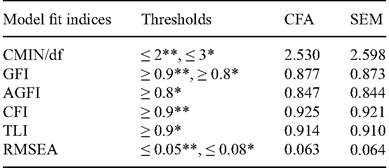
** good, * moderate. CMIN/df = Chi-square/df, GFI = Goodness-of-Fit Index, AGFI = adjusted GFI, CFI = Comparative Fit Index, TLI = Tucker Lewis Index, RMSEA = Root Mean Squared Error of Approximation.
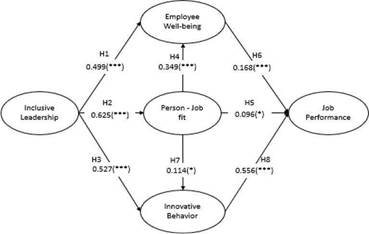
Figure 1. Testing results.
Table 4. Reliability analysis.
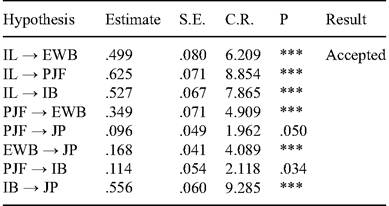
Table 4 illustrates that all hypotheses are statistically significant.
5 DISCUSSION
It was proposed that employee well-being and innovative behaviour could be fostered through inspirational leadership style (Sharifirad 2013). The findings demonstrated that the inclusive leadership has a positive influence on employee well-being and innovative behaviour. These results are consistent with prior studies (Arnold et al. 2007, Choi et al. 2017, Gong et al. 2009, Carmeli et al. 2010, Cerne et al. 2013).
Leadership is considered essential to trigger employees’ engagement in generating innovative ideas in a knowledge-intensive, complicated and creative environment like the interior design industry in Vietnam (Mumford et al. 2002, Carmeli et al. 2010). Leaders’ supportive behaviour may strengthen the relationship with their employees, which in turn results in fuelling employees’ motivation and organizational commitment to the innovating process.
Next, the current study investigated the inclusive leadership which is distinctive from general leadership style (Carmeli et al. 2010) by centering and prioritizing employees’ needs over collective interests to enhance their well-being (Hollander 2012). It is in line with a previous finding (Shuck & Herd 2012). Specifically, leaders’ attentive behaviour to employees’ needs can create a motivational workplace.
The results also show that the correlation between the inclusive leadership and innovative behaviour and employee well-being becomes stronger through person-job fit. By studies of Brkich et al. (2002) and Singh & Greenhaus (2004), our result discovers the suitability between employees and job characteristics enhance their well-being. Similarly, person-job fit also has a positive influence on employees’ engagement in innovative activities (Afsar et al. 2015).
Other findings of the study also suggested a promising path for future research on the mediating role of person-job fit in the linkages between different styles of leadership and employee well-being and innovative behaviour with distinct characteristics in Vietnam. In addition to prior research that discovers the impact of person-job fit on several job-related outcomes (Cable
6 DeRue 2002), the correlation between person-job fit and job performance is statistically supported. This study calls for further research on person-job fit as determinant of job performance.
Finally, the innovative behaviour is clarified to be the most significant predictor of job performance. It warrants further investigation into this promising factor on job performance.
5.1 Managerial implications
Results of the study have confirmed the role of employee well-being, person job-fit and innovative behaviour as mediators in relation to the inclusive leadership and job performance. The inclusive leadership takes a decisive role in shaping the working climate, thereby fostering managers to be more attentive to their leadership practices (Vinarski-Peretz & Car- meli 2011). Providing sufficient training, performance evaluation, and rewarding policies are feasible approaches to advance employee well-being, person job-fit, and innovative behaviour (Choi et al. 2015).
First, to maintain a good performance, employees’ well-being should be enhanced by making them feel valued. Proper feedbacks and praise would strengthen employees’ process of self-development. Adequate resources (tools, budget, information) and immediate training (coaching and mentoring) on improving employee knowledge and skills would be helpful as guidelines for them to well accomplish the assigned tasks (Hamid & Yahya 2011).
Second, as an important mediator, person-job fit should be managed effectively. Managers must carefully identify employees’ strengths that are compatible with the required qualities of the job and company’s core value, which in turn unleashes their potential to generate better performance. During working processes, “managers’ constructive feedbacks and appropriate mentoring” make a substantial contribution to enhancing employees’ perspective on person-job fit (Choi et al. 2017).
Last, innovative behaviour’s role in heightening job performance must be centralized. Managerial practices would shape a supportive working environment where employees can actualize innovative ideas (Carmeli et al. 2010) such as being receptive to employees’ creative approaches and willing to take any risk that is entailed in. This cultivates independence and confidence in employees to commit themselves to high performance.
6 CONCLUSION
The findings have emphasized the influence of the inclusive leadership on job performance through the mediating role of employee well-being, person-job fit, and innovative behaviour. The study added to the literature suggesting that in order to enhance these factors, the inclusive leadership practices plays a crucial role. In addition, the results also highlighted the potential mechanism of these effects on forming a motivating working climate for employees to achieve better performance. Investigating innovative behaviour as a significant driver of job performance opens a promising path for future research of inclusive leadership and job performance.
REFERENCES
Afsar, B., Badir, Y. & Khan, M.M. 2015. Person-job fit, person-organization fit and innovative work behavior: The mediating role of innovation trust. Journal of High Technology Management Research 26(2): 105-116.
Amabile, T.M., Barsade, S.G., Mueller, J.S. & Staw, B.M. 2005. Affect and Creativity at Work. Administrative Science Quarterly 50(3): 367-403.
Arnold, K.A., Turner, N., Barling, J., Kelloway, E.K. & McKee, M.C. 2007. Transformational Leadership and Psychological Well-Being: The Mediating Role of Meaningful Work. Journal of Occupational Health Psychology 12(3): 193.
Avolio, B.J., Gardner, W.L., Walumbwa, F.O., Luthans, F. & May, D.R. 2004. Unlocking the mask: A look at the process by which authentic leaders impact follower attitudes and behaviors. The Leadership Quarterly 15(6): 801-823.
Brkich, M., Jeffs, D. & Carless, S.A. 2002. A global selfreport measure of person-job fit. European Journal of Psychological Assessment 18(1): 43.
Cable, D.M. & DeRue, D.S. 2002. The convergent and discriminant validity of subjective fit perceptions. Journal of Applied Psychology 87(5): 875.
Carmeli, A., Reiter-Palmon, R. & Ziv, E. 2010. Inclusive leadership and employee involvement in creative tasks in the workplace: The mediating role of psychological safety. Creativity Research Journal 22(3): 250-260.
Cerne, M., Jaklic, M. & Skerlavaj, M. 2013. Authentic leadership, creativity, and innovation: A multilevel perspective. Leadership 9(1): 63-85.
Choi, S.B., Tran, T.B.H. & Kang, S.W. 2017. Inclusive Leadership and Employee Well-Being: The Mediating Role of Person-Job Fit. Journal of Happiness Studies 18 (6): 1877-1901.
Choi, S.B., Tran, T.B.H. & Park, B.I. 2015. Inclusive leadership and work engagement: Mediating roles of affective organizational commitment and creativity. Social Behavior and Personality: An International Journal 43 (6): 931-943.
Choi, Y. & Lee, D. 2014. Psychological capital, big five traits, and employee outcomes. Journal of Managerial Psychology 29(2): 122-140.
Gong, Y., Huang, J.C. & Farh, J.L. 2009. Employee learning orientation, transformational leadership, and employee creativity: The mediating role of employee creative self-efficacy. Academy of Management Jour- nal52 (4): 765-778.
Hamid, S.N.A. & Yahya, K.K. 2011. Relationship between person-job fit and person-organization fit on employees’ work engagement: A study among engineers in semiconductor companies in Malaysia. In Annual Conference on Innovations in Business and Management London (Vol.6, pp. 1-30). Citeseer.
Hair, J.F., Anderson, R.E., Tatham, R.L. & Black, W.C. 1998. Multivariate data analysis. New Jersey: Upper Saddle River.
Hollander, E. 2012. Inclusive leadership: The essential leader-follower relationship. London: Routledge.
Huhtala, H. & Parzefall, M.R. 2007. A review of employee well-being and innovativeness: An opportunity for a mutual benefit. Creativity and innovation management 16(3): 299-306.
Janssen, O. 2000. Job demands, perceptions of effort-reward fairness and innovative work behavior. Journal of Occupational and Organizational Psychology 73(3): 287-302.
Kline, R.B. 1998. Software Review: Software Programs for Structural Equation Modeling: Amos, EQS, and LISREL. Journal of Psychoeducational Assessment 16 (4): 343-364.
Lyubomirsky, S., King, L. & Diener, E. 2005. The benefits of frequent positive affect: Does happiness lead to success? Psychological Bulletin 131(6): 803.
Mulki, J.P., Jaramillo, F. & Locander, W.B. 2006. Emotional exhaustion and organizational deviance: Can the right job and a leader’s style make a difference? Journal of Business Research 59(12): 1222-1230.
Mumford, M.D., Scott, G.M., Gaddis, B. & Strange, J.M. 2002. Leading creative people: Orchestrating expertise and relationships. The Leadership Quarterly 13(6): 705-750.
Quinn, R.W. 2005. Flow in Knowledge Work: High Performance Experience in the Design of National Security Technology. Administrative Science Quarterly 50(4): 610-641.
Scott, S. & Bruce, R. 1994. Determinants of innovative behavior: A path model of individual innovation in the workplace. Academy of Management Journal 37(3): 580-607.
Shalley, C.E. & Gilson, L.L. 2004. What leaders need to know: A review of social and contextual factors that can foster or hinder creativity. The Leadership Quarterly 15 (1): 33-53.
Sharifirad, M.S. 2013. Transformational leadership, innovative work behavior, and employee well-being. Global Business Perspectives 1(3): 198-225.
Shin, Y. 2004. A person-environment fit model for virtual organizations. Journal of Management 30(5): 725-743.
Shuck, B. & Herd, A.M. 2012. Employee engagement and leadership: Exploring the convergence of two frameworks and implications for leadership development in HRD. Human Resource Development Review 11(2): 156-181.
Singh, R. & Greenhaus, J.H. 2004. The relation between career decision-making strategies and person-job fit: A study of job changers. Journal of Vocational Behavior 64(1): 198-221.
Tims, M., Bakker, A.B. & Xanthopoulou, D. 2011. Do transformational leaders enhance their followers’ daily work engagement? The Leadership Quarterly 22(1): 121-131.
Uhl-Bien, M. 2006. Relational Leadership Theory: Exploring the social processes of leadership and organizing. In Leadership, gender, and organization (pp. 75-108). Springer, Dordrecht.
Vinarski-Peretz, H. & Carmeli, A. 2011. Linking Care Felt to Engagement in Innovative Behaviors in the Workplace: The Mediating Role of Psychological Conditions. Psychology of Aesthetics, Creativity, and the Arts 5(1): 43.
Wang, S. & Yi, X. 2011. It’s happiness that counts: Full mediating effect of job satisfaction on the linkage from LMX to turnover intention in Chinese companies. International Journal of Leadership Studies 6(3): 337-356.
West, M.A. 1990. The social psychology of innovation in groups. In M.A. West & J.L. Farr (eds.) Innovation and creativity in work: Psychological and Organizational Strategies (pp. 309-333). London: Wiley.
Williams, L.J. & Anderson, S.E. 1991. Job Satisfaction and Organizational Commitment as Predictors of Organizational Citizenship and In-Role Behaviors. Journal of Management 17(3): 601-617.
Wright, T.A. 2014. Putting your best “face” forward: The role of emotion-based well-being in organizational research. Journal of Organizational Behavior 35(8): 1153-1168.
Wright, T.A. & Hobfoll, S.E. 2004. Commitment, psychological well-being, and job performance: An examination of conservation of resources (COR) theory and job burnout. Journal of Business & Management 9(4): 389406.
Xie, J.L. & Johns, G. 1995. Job scope and stress: Can job scope be too high? Academy of management journal 38 (5): 1288-1309.
Yidong, T. & Xinxin, L. 2013. How ethical leadership influence employees’ innovative work behavior: A perspective of intrinsic motivation. Journal of Business Ethics 116(2): 441-455.
APPENDIX1 MEASURES
| Variables (sources) Code | Measures | |
| Inclusive leader- IL1 ship (Carmeli IL2 et al. 2010) IL2 e a. IL3 | My manager is attentive to new opportunities to improve work processes (openness) My manager is open to discuss the desired goals and new ways to achieve them (openness) My manager is available for professional questions I would like to consult with him/her (availability) | |
| IL4 IL5 IL6 | My manager is ready to listen to my requests (availability) My manager encourages me to access him/her on emerging issues (accessibility) My manager is accessible for discussing emerging problems (accessibility) | |
| Person-Job Fit PJF1 (Mulki et al. PJF2 2006) PJF3 | My skills and abilities perfectly match with my job demands My personal likes and dislikes match perfectly with my job demands There is a good fit between my job and me | |
| Employee Well- EWB1 being (Arnold EWB2 et al. 2007) EWB3 EWB4 | In the past 6 months, I have felt motivated In the past 6 months, I have felt energetic In the past 6 months, I have felt enthusiastic In the past 6 months, I have felt lively |
(Continued)
APPENDIX 1. (Cont.)
| Variables (sources) | Code Measures |
| Innovative Behaviour (Janssen 2000) | EWB5 In the past 6 months, I have felt joyful IB1 I search out new working methods, techniques, or instruments IB2 I generate original solutions for problems IB3 I make important organizational members enthusiastic for innovative ideas IB4 I transform innovative ideas into useful applications IB5 I introduce innovative ideas into the work environment in a systematic way IB6 I evaluate the utility of innovative ideas |
| Job Performance (Williams & Anderson 1991) | JP1 Perform tasks that are expected of him/her JP2 Engages in activities that will directly affect his/her performance evaluation JP3 Goes out of way to help new employees JP4 Takes time to listen to co-workers’ problems and worries JP5 Passes along information to co-workers. JP6 Attendance at work is above the norm. |
More on the topic The role of inclusive leadership on job performance through mediators in interior design and construction companies in Vietnam:
- THE ROLE OF LEADERSHIP IN DRIVING EMERGENT STRATEGY
- Participatory Design and Training
- Table of contents
- Abdullah A.G., Widiaty I., Abdullah G.U. (eds.). Global Competitiveness: Business Transformation in the Digital Era. Routledge,2019. — 325 p., 2019
- OUTSIDE INFLUENCES OR AN INSIDE JOB—THE EXTRINSIC AND INTRINSIC PATHWAYS
- Vietnam
- Foucault: The Construction of the Subject
- The New Leadership
- Rhetorical Design of the Protagonists in Greek Novels
- From Status Performance to Gender Performance