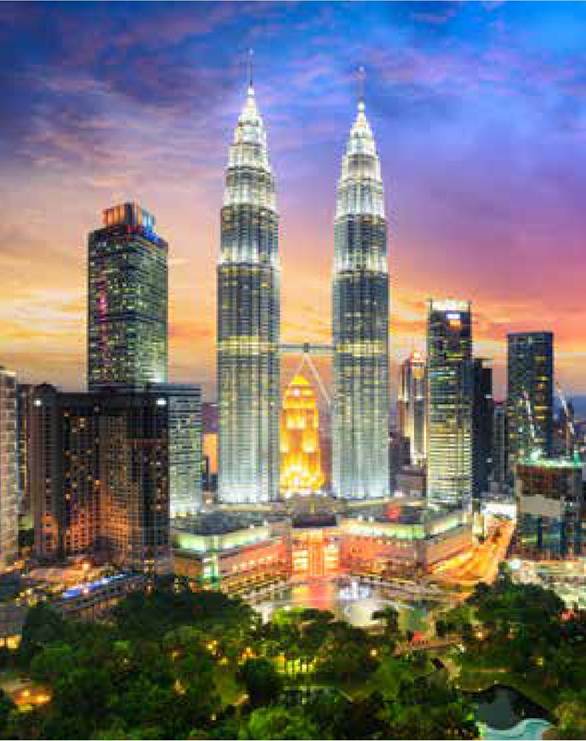
Malaysia
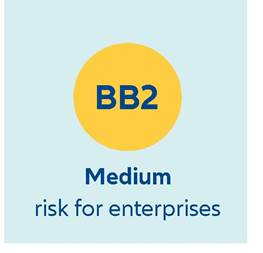
Weak spots remain amid broadly strong macro-fundamentals
| GDP | USD406.3bn (World ranking 37) |
| Population | 33.9mn (World ranking 45) |
| Form of state | Federal parliamentary constitutional monarchy |
| Head of government | Anwar Ibrahim (PM) |
| Next elections | 2028, legislative |
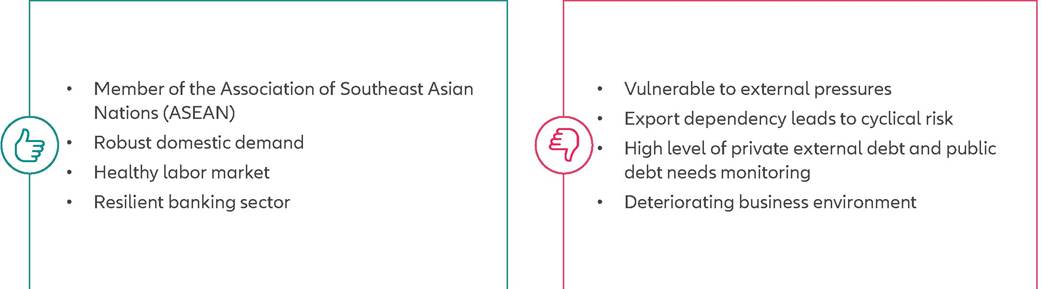
Strengths & weaknesses
Economic overview
Growth to moderate below pre-pandemic levels in the near term
After having experienced a robust growth trajectory, growing by +4.7% y/y on average in the 2000s and +5.4% y/y between 2010 and 2019, Malaysia was severely hit by the Covid-19 pandemic and the ensuing Movement Control Orders put in place by the government.
Consequently, the economy experienced a -5.5% y/y contraction in 2020 which was followed by a modest recovery of +3.3% in 2021. On the back of tailwinds, notably a buoyant global environment, global commodities boom and a recovery in domestic demand, the economy saw a strong rebound in 2022, growing by +8.7%. In 2023, the economy remained resilient to the challenging external environment, high inflation and tight monetary policy and we estimate that the economy grew by +4.4% primarily driven by private consumption. Going forward, supported by a recovery in external demand, an easing of monetary policy and a pick-up in the services sector, we expect growth to remain stable at +4.4% in 2024 and to average around +4% per year in the medium term until 2030.The fiscal policy in Malaysia has been broadly expansive after the onset of the pandemic, with the fiscal deficit increasing from 4.9% to 5.9% of GDP during the 20202022 period.
However, we expect the fiscal deficit to have narrowed to 4.5% in 2023 and to remain at this level in the near term going forward as fiscal consolidation will remain an area of focus for Malaysian policymakers, especially on the back of clear targets set in the Public Finance and Fiscal Responsibility Act passed in October 2023.With the aim of finding an equilibrium between supporting economic growth and keeping inflation under control, the Bank Negara Malaysia - the central bank of Malaysia - is likely to maintain a neutral policy stance after having implemented a cumulative 125bps hike in the policy rate in 2022-2023. We forecast inflation to moderate to 2.3% and 2.4% in 2024 and 2025 respectively, declining from 2.6% in 2023. Still, inflationary pressures from domestic policies including the subsidy reform, price caps and higher services tax will prevent the central bank from a premature monetary policy easing in the near term.
Keep an eye on public and external debt
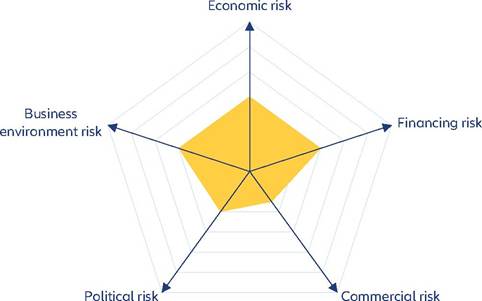
Broadly, the short-term financing risk for the economy is deemed medium. While structural macroeconomic vulnerabilities are manageable, it is worth monitoring public finances and external debt, reflected by a high and rising fiscal deficit, public debt, and external debt relative to GDP.
The large round of fiscal stimulus since the pandemic widened the fiscal deficit and elevated public debt to 70% of GDP in 2021 and 2022 (compared with 55% on average in the 2010s). The fiscal deficit widened to 6% of GDP during this period - a significant deviation from 2.9% on average in the 2010s. However, in 2023 the fiscal deficit narrowed to 4.5% of GDP and will stabilize at 4.6% in 2024 and 2025 as policymakers focus on a path of fiscal consolidation through a combination of spending cuts, new taxes and subsidy reforms. We expect public debt to remain above 60% in the next two years. On the brighter side, most of the public debt is expected to be funded onshore. On the current account front, we expect Malaysia to register a surplus of 2.7% of GDP in 2023, followed by 2.8% and 2.9% primarily driven by a goods trade surplus, as external demand recovers and the slump in the electronics cycle experiences a recovery.
That said, Malaysia's reliance on external trade and its structure also makes it vulnerable to cyclical swings in some specific sectors including electrical machinery and equipment, commodities and electronics.Challenges remain in the business environment despite easing political instability
Malaysia exhibits an above-average business environment but is facing a downward trend. The Heritage Foundation's Index of Economic Freedom survey 2022 assigns the economy rank 42 out of 185 economies, down from rank 22 in 2021 - thereby pushing it down to the “Moderately Free” category from “Mostly Free” previously. The drop reflects weaknesses in terms of financial freedom, government integrity, labor freedom and judicial effectiveness to name a few. However, monetary freedom and trade freedom remain bright spots. Meanwhile, the World Bank Institute's annual Worldwide Governance Indicators 2022 survey indicates that Malaysia performed well in terms of regulatory quality, although the rule of law and control of corruption remain weak spots. Lastly, our proprietary Environmental Sustainability Index ranks Malaysia 147 out of 210 economies, due to challenges in terms of climate change vulnerability, recycling rate and renewable electricity output.
Malaysia's predominant political party, United Malays National Organization (UMNO), has long held power in the ruling coalition. The situation changed in 2018 amid a corruption scandal, launching an era of political instability, with four different governments over a period of five years. In the November 2022 election, none of the contestants won a parliamentary majority, which was the first time that Malaysia has seen a hung parliament since its independence. After intense negotiations, the leader of the multicultural Pakatan Harapan (PH) coalition, Anwar Ibrahim, became the 10th prime minister of Malaysia and heads a unity government. Stability and continuity have been key features of Anwar's speeches in addition to the signing of a memorandum of understanding between the component parties in the PH coalition. In addition, he has pledged to work with the pro-Malay factions in the coalition and focus on areas such as economic growth and anti-corruption rather than on reforms on sensitive issues including race-related reforms. These factors should ensure broad political stability although the weak standing of the UMNO due to corruption charges poses some risk to political stability in the near term.