Netherlands
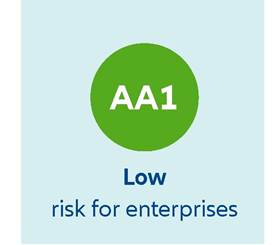
Return to positive growth, but activity will remain below trend
| GDP | USD991.1bn (World ranking 18) |
| Population | 17.7mn (World ranking 68) |
| Form of state | Constitutional Monarchy |
| Head of government | Mark Rutte (PM, outgoing) |
| Next elections | 2028, General |
Strengths & weaknesses
Economic overview
Recovery from technical recession will be only gradual
The Netherlands recorded three consecutive quarters of contraction in 2023 and the economy is likely to remain subdued in the coming quarters.
We expect activity to gradually recover from Q2 2024, with overall GDP growth at +0.6% in 2024, after a timid +0.2% in 2023. Despite GDP growth staying at +5.8% compared to end-2019 (EZ average +3.0%), the Netherlands' faster post-Covid-19 rebound is now narrowing compared to Eurozone peers. Private consumption suffered due to elevated uncertainty and surging prices eroding households and corporates' consumption behavior. Net trade and investment remained volatile over the recent quarters.Inflation pressures in the Netherlands have been decelerating strongly, after reaching one of the highest rates in the Eurozone in October 2022. The price development of energy (gas, electricity and district heating) has long had a major impact on the course of inflation -due to soaring prices in late 2022. Easing prices and strong wage growth should provide some breathing room for private consumption which will gradually resume in 2024-25.
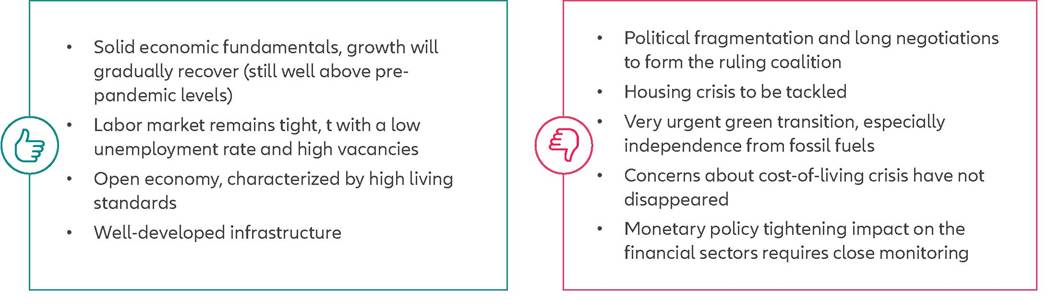
The Netherlands has a strong and tight labor market. This means many companies are looking for workers while few people are looking for a job; vacancies are at record highs. There is a huge shortage of staff in various sectors such as ICT, construction, healthcare and education. The high inflation environment and labor market tightness led to a sharp rise in wages. Also, the government has taken a step for the lowest income earners by increasing the minimum wage by 10.15% on 1 January 2023. Looking forward, the disinflationary pressures should ease any fears of a wageprice spiral in the Netherlands.
On the confidence side, consumer sentiment is gradually recovering from historic lows, while business confidence remains weak.
According to the Draft Budgetary Plan, the government deficit is seen at 2.4% of GDP in 2024 (from 1.5% in 2023). This increase is driven by growing expenditure on social benefits and defense as well as an increase in public investments. However, with the government formation talks still ongoing and a probable right-wing ruling party, we cannot exclude a deterioration in the government deficit over the next years.
Dutch election results surprised with far-right party in the lead
Political fragmentation means forming the next government will take months of negotiations. Indeed, the Netherlands went to the polls in November 2023 after the former government led by long-serving Prime Minister Mark Rutte collapsed in early July when the four parties of the ruling coalition clashed over an immigration bill to reduce asylum seekers. In a surprise result, Wilders' Party for Freedom PVV won the election and obtained 37 seats (out of 150 seats), but to govern it would need to seek coalition with at least two other parties.
Migration and housing were the key themes of the 2023 electoral campaign. The centrist and right-wing parties are confident in reducing or capping the number of migrants allowed in the country per year - including asylum seekers, labor migrants and students.
Strictly connected to new arrivals, the structural lack of housing has also re-emerged as a hot topic, given the further push to demand. To address the issue of availability and affordability of both rental and owner-occupied homes, the previous government implemented the Housing Construction policy program. One of its objectives is to build at least 981 000 dwellings up to 2030, despite increasing challenges stemming from higher construction costs and rising interest rates.In addition, the new government will have to tackle climate policy and the issue of nitrogen emissions. The Netherlands is an extensive agricultural exporter (second only to the US). This coupled with a dense population and heavy traffic leads to large nitrogen emissions. All major parties have promised to halve (or cut significantly) emissions by 2030. But the new ruling coalition will have to reach an agreement on which sectors to prioritize in the coming years.
Declining inflation has also not really reduced concerns over the cost-of-living crisis. Price growth entered negative territory in October 2023 and reached its lowest level since September 2016 on the back of sturdy base effects from the peak reached last year (>14% in September and October 2022) and declining energy prices. But this has only partially alleviated households' loss of purchasing power since prices of food and alcohol were still high. In response to high inflation, negotiated wages are lagging behind but are expected to grow by more than +5% both in 2023 and 2024. Wage-price-setting dynamics should also remain in focus for the next government.
The Netherlands will receive EUR4.7bn in grants (0.8% of GDP) from the NGEU funds. The Netherlands did not apply for EU loans as its cost of borrowing remains low. The Dutch plan is structured around six pillars: promoting the green transition; accelerating the digital transformation; improving the housing market with a focus on building renovation; strengthening the labor market, pensions and future-oriented education; strengthening the public health sector and pandemic preparedness; tackling aggressive tax planning and money laundering.
Amid a reduction in Russian gas exports to Europe, the Netherlands benefits from LNG import capacity as well as a low dependence on Russian gas, but as a major transit and storage hub remains under pressures to help out with supply for elsewhere, including Germany.