New Zealand
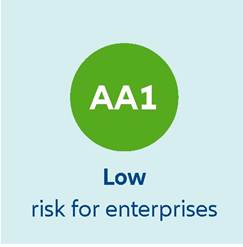
Slow and modest recovery from difficult past years
GDP
USD247.2bn (World ranking 51)
| Population | 5.1mn (World ranking 122) |
| Form of state | Parliamentary democracy under a constitutional monarchy |
| Head of government | Christopher Luxon (PM) |
| Next elections | 2026, Legislative |
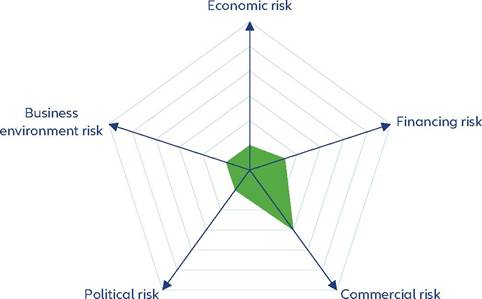
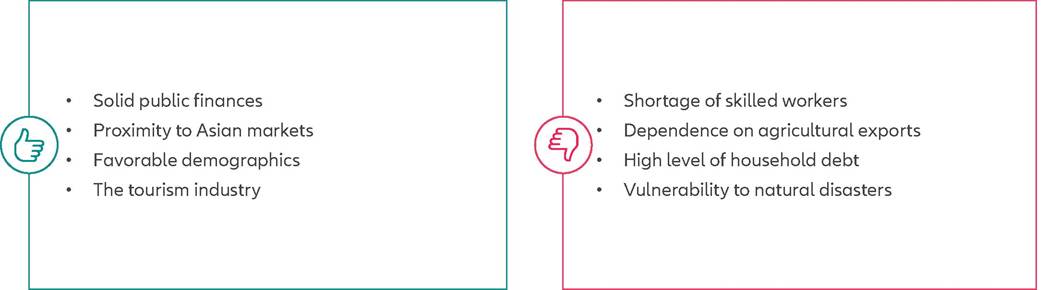
Strengths & weaknesses
Economic overview
Modest recovery and gradual retreat of inflation
New Zealand recorded robust GDP growth in the 2000s and 2010s by OECD standards, with +3% and +3.2% on average, respectively.
Thanks to a swift policy reaction, which consisted of stringent rules that contained the pandemic, the economy experienced a comparatively moderate Covid-19 slump in 2020, with GDP contracting by -1.1%. The country experienced a strong recovery in 2021 (+6% growth), but a central bank tightening cycle from end-2021 onwards undermined consumption and investment growth which, combined with a deteriorating global trade environment and rising energy prices, resulted in a slowdown of economic growth to +2.3% in 2022. New Zealand even experienced a technical recession in Q4 2022-Q1 2023 and another one is likely to be recorded for Q3-Q4 2023. For the full year 2023, growth is expected to come in below +1.5%, jeopardized by persistent high inflation, weak consumption and investment and floods. However, in 2024-2025, we expect annual average growth to be lifted to the range of +1.5% to +2%, thanks to the economic reopening of China, New Zealand's main trading partner, the gradual recoveries of other export markets (supported by free-trade agreements), increased investments in infrastructure and a consumption rebound.The Reserve Bank of New Zealand tightened its monetary policy from October 2021 on, trying to tackle rising inflation prompted by disturbances in supply chains and furthered by the global hike in energy prices in 2022. Consumer price inflation increased to an average of 7.2% in 2022 and remained elevated through 2023 (likely averaging in the 5.5-6% range over the year). Notably, food prices are set to remain elevated for some time after the damages to agriculture caused by natural events, though goods prices should decline due to a moderation of oil prices and lower domestic demand. Overall, inflation is forecast to decelerate gradually and to fall below 3% only in the course of 2024. Hence the policy interest rate, which was hiked from 0.25% in August 2021 to 5.50% in May 2023, should stay at this level, with little chances of a loosening before mid-2024.
Solid public finances but weakened external finances
New Zealand's sovereign financing risk is deemed low, even though its public finances have suffered in the past years. Fiscal support measures in response to the Covid-19 pandemic and then to mitigate the impact of rising global energy and food prices drove up the annual fiscal deficit to an average of -4% of GDP from FY2019-20 to FY2022-23. However, the shortfalls are forecast to narrow in the coming years, falling to less than -2% of GDP by 2025, following the cancellation of several welfare measures introduced in 2022-2023, as well as the reinforcement of taxes on tobacco, alcohol and methane emissions. New Zealand's public debt rose in recent years, but at less than 50% of GDP remains clearly below the of the OECD (around 100% of GDP) or the Asia-Pacific zone (around 60%). The main financial concern of the country is the level of household debt, largely composed of mortgages, which stands at nearly 170% of disposable income and suffered from the interest rate hikes in recent years. Historically high housing prices have sunk by -10% y/y on average through the year as of November 2023, though this is still not enough to allow first-time buyers that have suffered from the cost-of-living crisis to afford a house.
New Zealand's external finances have suffered due to subsequent crises in recent years. The current account deficit widened from -1% of GDP in 2020 to -6% in 2021 and nearly -9% in 2022. From 2023 onwards, the external shortfall should narrow, albeit gradually, supported by the recovery in Chinese imports, somewhat declining energy import prices, a rebound in tourism and a trade agreement with the EU and the UK, likely to come into force in 2024. Yet, the annual current account deficit is forecast to remain above -6% of GDP in 2023-2024. More generally, New Zealand's trade structure leaves it vulnerable to external shocks: (i) China is New Zealand's main trade partner, accounting for nearly 30% of its exports and nearly 25% of its imports in 2022. (ii) Australia and the US are the second and third largest trade partners, with significant shares, making New Zealand dependent on the business cycles of these economies. (iii) New Zealand's exports also rely very heavily on food and agricultural products and are therefore exposed to weather hazards.
Strong business environment and stable political framework
New Zealand has a very favorable business climate, sharing first place in our business environment rating. The Heritage Foundation's Index of Economic Freedom survey 2023 ranks the country fifth in the world for doing business and third in the Asia-Pacific region. New Zealand scores especially high with regards to property rights, judicial effectiveness, government integrity, trade freedom and financial freedom. But there is still moderate room for improvement regarding the tax burden, labor freedom and investment freedom. The World Bank Institute's annual Worldwide Governance Indicators surveys indicate very high levels of regulatory quality (rank 6 worldwide), the rule of law (rank 5) and control of corruption (rank 3). Meanwhile, our proprietary Environmental Sustainability Index puts New Zealand at rank 22 out of 210 countries, reflecting very good resistances to climate change and water stress, fairly good proficiency in energy use compared to GDP, renewable electricity output and CO2 emissions compared to GDP. Only the recycling rate of the country is judged poorly.
Generally speaking, New Zealand's political environment does not present much risks, thanks to established and transparent processes and consensus-building practices across parties. The general election in October 2023 resulted in the return of the National Party, against the Labor Party (which had been in power since 2017). National does not enjoy a majority in parliament and would thus require the support of smaller parties such as ACT and NZ First. This does not imply a risk of political instability, as New Zealand is used to coalitions.
More on the topic New Zealand:
- From War Bride to Conscientious Housewife
- Conclusion
- At the end of the Second World War, banner headlines in the New Zealand and Australian press proclaimed the regular arrival of troopships packed with returning servicemen.
- Becoming a 'Kiwi"
- CHAPTER 6 From Bedpans to Bulldogs: Lottie: Gallipoli Nurse and the Pitfalls of Presenting War to the Young*
- Paratuberculosis in Wild and Farmed Deer
- Paramilitary Policing
- One of the most obvious ecological patterns on Earth is the variation in species composition and diversity among geographic locations.