Morocco
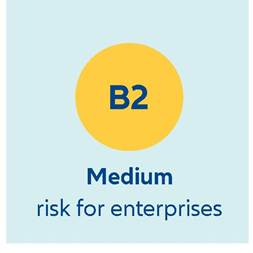
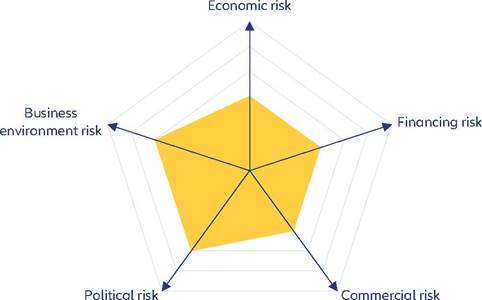
Economic growth within reach, with risks tilted to the downside
| GDP | USD134.2bn (World ranking 60) |
| Population | 37.5mn (World ranking 40) |
| Form of state | Constitutional Monarchy |
| Head of government | Aziz Akhannouch (PM) |
| Next elections | 2026, Legislative |
Strengths & weaknesses
Economic overview
Water scarcity and subdued demand from major trading partners continue to weigh on short-term prospects
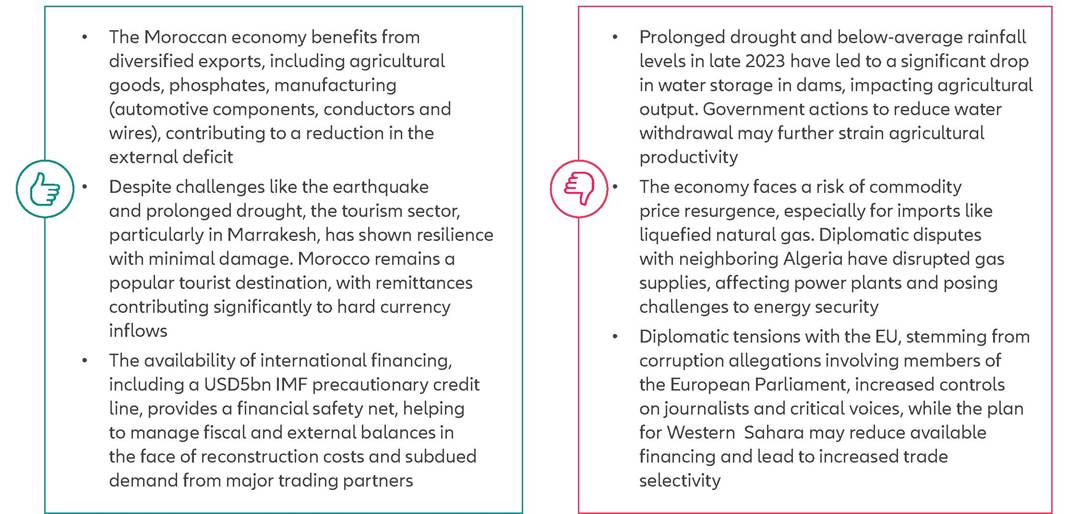
Together with the September earthquake that struck the surroundings of Marrakesh with significant losses, the Moroccan economy suffered from prolonged drought that caused limited agricultural output with GDP growth estimated at +2.6% in 2023.
A similar pace, slightly below the regional average of +3.6%, is likely to be maintained in 2024, reflecting weak demand growth from its major trading partners, with reconstruction costs weighing on the fiscal deficit. However, international financing is available, including USD5bn under an IMF precautionary credit line. The fiscal and external balances should remain manageable and the damage to Marrakesh, a popular tourist destination, has been minimal.The export of agricultural goods, phosphates and manufacturing (automotive components, conductors and wires) will reduce the external deficit, while food-related inflationary pressures are likely to normalize in the first half of 2024. However, the level of rainfall in late 2023 remained below the 10-year average and water scarcity usually determines actions from the government to reduce the amount of water that is withdrawn from artificial basins to irrigate farmland.
The water storage in dams plummeted to a mere 23.5% in December 2023, down from 31% recorded 12 months before.Another risk to the outlook is a resurgence of the price of commodities that Morocco imports due to international prices and trade bottlenecks. Morocco entered the liquefied natural gas market in late 2023 to counter the loss of pipeline supplies from a neighboring exporter, Algeria, due to a breakdown in diplomatic relations. Algeria, which has sufficient alternative export capacity, used gas as economic leverage in its dispute with Morocco and Spain over Western Sahara, cutting off gas supplies to Spain via the Maghreb- Europe pipeline, which passes through Morocco, in the fourth quarter of 2021. Morocco had received a small portion of the transit gas as royalties and as a result found itself unable to supply its two gas-fired power plants. Together, these power plants have 1.7 gigawatts (GW) out of a total installed capacity in the country of just over 11 GW.
Finally, diplomatic tensions with the EU following the 2022 corruption allegations involving members of the European Parliament could also reduce available financing and increase trade selectivity by the EU, which accounts for almost two-thirds of the country's exports. The EU is also the largest foreign investor in Morocco, with more than half of the country's stock of foreign direct investment.
Relations with the West and the social contract will determine capital flows and the fiscal balance
Tourism, remittances and exports remain the main sources of hard currency. Net receipts from tourism exceeded USD7bn in 2022, up from USD2bn a year earlier and even surpassing by 16% the record year of 2019. Remittances also show a continuous improvement (+4.4% in the first 11 months of 2023) and may have reached USD11.5bn at year-end, around 8% of GDP and almost double the value of 2019.
While the main export item, phosphates and derivatives, is highly dependent on international prices and competition from merchant producers, the diversification of the Moroccan economy supported a generalized expansion of exports of automotive and textile goods in 2023, favoring additional investment in these sectors.
Tackling poverty and enhancing social inclusion remain key to driving long-term growth. Government subsidies as well as price-controlled sugar, cooking gas and wheat continue to play a role in the social contract, together with periodic subsidies to transport operators.
Latent variables retain the potential to shape the business environment
The steps taken to reform state-owned enterprises, as well as the activation of the Mohammed VI Fund and the implementation of the new Investment Charter, are widely seen as potential catalysts for foreign direct investment. While much remains to be done to address water scarcity, progress in liberalizing the electricity market should accelerate the transition to renewable energy. On the other hand, the business community is keeping a close eye on the protection of property rights and the independence of the judiciary.
The country remains in the world's second-to-last decile for the employment rate (39%, equivalent to 10.7mn people). The shift towards services, increased crop volatility due to drought and limited prospects in rural areas are increasing urbanization trends and labor-related claims. The services sector is the largest employer, with 47% of the workforce, followed by agriculture (29%), manufacturing (12%) and construction (11%). Traditionally, the unemployment rate is higher in urban areas, reaching 16% in 2022, down from 17% in 2021. Unemployment is lower in rural areas (5%) and remains higher among young people aged 15 to 24 (33%), university graduates (19%) and women (17%).
The relationship with the EU has slightly deteriorated in recent months, following increased controls on journalists and critical voices, uncertainties surrounding Morocco's plan for the Western Sahara and corruption investigations involving current and former members of the EU Parliament. Negotiations for a deep and comprehensive free trade area with the EU were launched in March 2013 but were put on hold the following year at Morocco's request.
The king is less likely to be blamed for economic problems than the government, although his personal wealth is likely to come under increasing criticism and public scrutiny. The likelihood of large and organized riots as well as targeted boycott campaigns in response to increased living costs, such as those conducted in 2018 and 2020, remains elevated. Hotspots include major city squares, the parliament, ministries and local government offices.
More on the topic Morocco:
- Author Biography
- REFORMS IN FAMILY LAW
- The revolutionary role of the Constitutional Court as protector of freedom, individual rights and human rights
- 47 Muscateers and Mogadorians
- AppendixA: Data
- From one crisis to the next, 1905-13
- Index
- Courts are cornerstone institutions of liberal-democratic constitutionalism.
- The first of the five phases was by far the longest, lasting roughly three and a half centuries.
- Index