The effect of information privacy concern and security concern on online purchase decision among university students
S. Windiarti
Parahyangan Catholic University, Bandung, Indonesia
ABSTRACT: The aim of this research was to acknowledge the effect of privacy and security concern on the online purchase decision among university students.
Data were gathered through the questionnaire from accountancy students at University of Achmad Yani regarding online purchase experience, before being analyzed by SPSS. The results show that both information privacy concern and security concern impact the online purchase decision. In order to reduce risk of insecurity among the online buyers, the privacy and security data problems should be handled carefully. E-commerce companies need to consider their company regulations related to the information privacy problems and develop their security apps in order to incline the online purchase decision.1 INTRODUCTION
Technological developments in the world are increasing rapidly. The existence of the Internet is very supportive of all forms of activities, including commercial activities for a company or independent business (SWA 2017). Currently, no business can compete without digital marketing. The Internet has become a place where everyone on the earth interacts, learns, works, and exchanges information with each other.
Based on the APJII (Association of Indonesian Internet Service Providers) survey released in 2014, Internet users in Indonesia reached 88.1 million. When compared with the population of Indonesia reached 252.5 million people, it can be said that the penetration of Internet users in Indonesia reached 34.9% higher. The high level of Internet user penetration in Indonesia is also followed by the growth of e-Commerce in Indonesia. In years 2013-2015, the average growth of eCommerce reached 33%, and as predicted, in 2016, the value of e-Commerce reached US$ 24.6 billion or Rp. 332 trillion (SWAOnline 2016a).
Annual report issued by We Are Social shows that the percentage of Indonesian people who buy goods and services online in a month in 2017 reached 41% of the total population, an increase of 15% compared to the year 2016 which is only 26%. Recently, ShopBack conducted a survey of more than 1,000 respondents in Indonesia, to see the online purchasing pattern of Indonesian society. From the survey, 70.2% of respondents admitted that the existence of online stores affected their shopping behavior (Iskandar 2018). E-commerce provides convenience to consumers where they can shop anytime, anywhere indefinitely. Nevertheless, the issue of information privacy concern and security concern has become a troubling issue. Government and industry organizations have stated that the problems of information privacy and security concern have become a major obstacle in the development of consumer-related e-commerce (Fernandez 2001). There are some surprising facts about e-commerce in Indonesia. From all that is summarized from the results of a survey conducted by MARS Indonesia, one is the issue of consumer trust in online shopping which is found to be still low (Prahadi 2017). Although consumers explore online shopping, there are concerns about trust regarding sharing personal information and bank information with third parties who may send unwanted emails to customers (SWAOnline 2016b). Lack of protection against fraud can reduce the trust in online purchases (Goldsmith & Wu 2006). Therefore, protecting consumer privacy is an important factor for e-commerce success (Liu et al. 2004). Furthermore, when viewed from the perspective of individual and consumer behavior, in turn, the issue of privacy concern encourages accounting information system (AIS) researchers to see the beliefs and attitudes of people about privacy, ways such as attitudes affecting intentions and consumer behavior as well as how individual behavior can be affected by the organization’s privacy policies and practices (Kauffman 2011).The issue of information privacy and security concern is treated as a single construct in most of the privacy literature (Liu et al. 2004, Xu et al. 2012). Belanger et al. (2002) mentioned that privacy and security issues should be conceptualized as two different things. As for other researchers who agree with Belanger et al. (2002) revealed, that the issue of information and security privacy are two different constructs (Chang et al. 2005, Vijayasarathy 2004). In response to two different views, this study attempts to provide a clear picture of the impact of privacy and security issues as two different
constructs. Further information privacy and security concern issues will impact consumer decisions in purchase products on e-commerce.
2 RESEARCH METHOD
2.1 Privacyconcernandrisk
The issue of privacy or reluctance to disclose personal information is seen as a major threat to e-com- merce and the digital economy (Culnan 2000, Malhotra et al. 2004). The perceived control over personal information is a key factor in influencing privacy concern (Xu et al. 2012). Consumers may have concern over the flow of personal information between online consumers and websites and concern about how personal information is managed by websites (Hong & Thong 2013). The effect of privacy concern on online trust may depend on consumer characteristics such as gender, age, and education (Riquelme & Roman 2014). Measures taken to protect consumer privacy include industrial policy and procedural fairness (Culnan 2000, Culnan & Armstrong 1999).
The problem of privacy refers to individual view about fairness in context of information privacy (Campbell 1997). Consumber have possibly a different opinion about what is fair and what is not when the company uses consumers’ online personal information (Malhotra et al. 2004). Liu et al. (2004) proposed that the risks of this kind of information system depend on the consumer’s trust that their privacies have been maintained.
In the e-commerce context, positive relationship between privacy and risk is showed (Malhotra et al. 2004). The Internet user with high-level privacy concern tends to have high-level risk. Risk perception related to online purchasing can reduce consumer’s control perception and, thus, possibly negatively influences to online purchasing (Jarvenpaa et al. 2000).HI: Information privacy concern has positive impact on risk.
2.2 Security concern and risk
E-commerce has been associated with risky purchases, due to privacy issues and security issues (Miyazaki & Fernandez 2001). Case points out the importance of security payments and money-back guarantees. Other factors affecting consumer evaluations and decisions regarding online purchases involve consumer concern about the security and reliability of corporate processes in online settings (Miyazaki & Fernandez 2001, Wolfinbarger & Gilly 2003).
These security and reliability concern have also been suggested to influence consumer perceptions of risk (Olivero & Lunt 2004). Consumers have found distrust in online shopping because they worry about merchants who are unscrupulous and dubious and thereby susceptible to ineffective security from shopping using the Internet (Hoffman et al. 1999, Lee & Turban 2001).
Security practices are also seen in information privacy concern instruments developed by Smith et al. (1996). Bansal and Zahedi (2014) reported in their research about customers revealing that when security issues are high, customers prefer to transform sensitive information only to trusted websites, thus demonstrating a higher risk perception.
H2: Security concern will have a positive impact on Risk.
2.3 Risk and trust influence on each other and on online purchases decision
According to Bauer (1960), consumer behavior generally contains certain risks, because the actions performed produce consequences which can’t be predicted accurately. In the e-commerce literature, two risk categories are identified: product risk and transaction risk (Chang et al.
2005). Product risk refers to the uncertainty that the purchase will match the level of acceptance in buying with a goal. The risk of a transaction is the uncertainty that something unfavorable and unpredictable may occur during the transactional process. Transaction risks include authentication, privacy, and transactional security.In order to reduce the risk perception, creating the trust has been admitted as an important point (McKnight et al. 1998). The trust has yielded many researches in organizational study. The trust of e-commerce consumer and perceived risk have strong impact on the decision of online purchase (Kim et al. 2008). However, the trust is also considered subjective since it is formed by social factors which are strange in certain contexts. (Webster & Martocchio 1992).
Perceived Risk has a negative relationship with trust (Eastlick et al. 2006, Kimery & McCord 2002). Greater confidence is likely to reduce perceived Risk. Jarvenpaa et al. (1999) suggest that higher trust in online sellers reduces perceived risk so as to increase buyer desire to buy online.
H3: Perceived risk has a negative impact on trust.
H4: Information privacy concern, security concern, and risk have a positive impact on trust.
H5: Trust has a positive impact on online purchase decisions.
H6: Information privacy concern, security concern, risk, and trust have positive impact on online purchase decision.
id="Picutre 23" class="lazyload" data-src="/files/uch_group77/uch_pgroup301/uch_uch7191/image/image023.jpg">
Figure 1. Research method.
3 RESULTS
3.1 Profileofrespondents
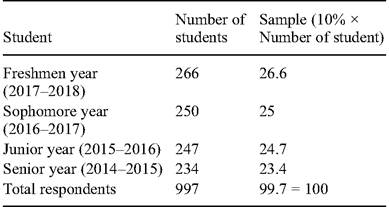
Respondents are all accounting students of Achmad Yani University consisting of men and women. The data of respondents is presented in Table 1.
The data were analyzed using the path analysis method by SPSS 21. The population in this research came from the undergraduate student of Economy Fa culty, enrolled in the period of 2014-2017. The population in this research can be categorized as the finite population, which implies that the amount of population can be quantified exactly.
The sampling technique used in this research was probability sampling with the 100 respondents per class and gathered using the proportional random sampling technique.• Information privacy concern, security concern, and perceived risk.
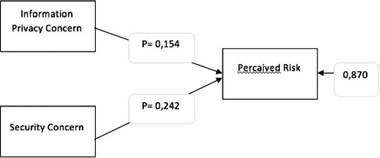
Figure 2. Information privacy concern.
The R square number also shows that the information privacy concern and security concern affect the risk by 87 percent. The results of F calculation (7,219) are also way bigger than the F table (3,090), which implies that H0 must be rejected and accepting H1 and H2. The privacy issue refers to an individual’s view of fairness in the context of information privacy (Campbell 1997). If a consumer is too concerned about privacy, it will affect how he or she will see the risks in buying from (Gurung 2016), and thereby a positive relationship between privacy and risk issues is demonstrated (Malhotra et al. 2004). Internet users with high levels of privacy concern tend to have high risk perceptions. Bansal and Zahedi (2014) reported in their research about customers that when security issues are high, customers prefer to transform sensitive information only to trusted websites, thus demonstrating a higher risk perception.
• Perceived risk and trust.

Figure 3. Perceivedriskandtrust.
The magnitude of effect given by risk to the trust that stands on the R square column is 0.019 or 1.9 percent. Hence, it can be concluded that risk affecting the trust is 1.9%. Sitkin and Pablo (1992) suggest that perceived risk may mediate the influence of trust on purchase intentions. Several studies have investigated the effect of trust on perceived risk.
• Information privacy concern, security concern, perceived risk, and trust.
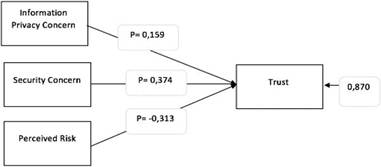
Figure 4. Perceived risk and trust.
The magnitude of the effect given from information privacy concern, security concern, and perceived risk to trust in the R square column is 0.229 or 22.9%. Hence, it can be concluded that the influence of information privacy concern, security concern, and perceived trust on trust is 22.9%. The value of F arithmetic of 9.492 is greater than F table of 2.698. Therefore, H0 is rejected and H3 is accepted.
Table 1. Respondents.
• Trust and online purchase decision.

Figure 5. Trust and online purchase decision.
The result of R square value is 0.041 or 4.1%, so it can be concluded that trust influences online purchase decision by 4.1%. The results of F calculation (4.221) are also way bigger than the F table (3.938) which implies that H0 must be rejected and H5
accepted. In the online purchase environment, favorable relationships have been found between perceptions of consumer confidence and attitudes in purchases (Verhagen et al. 2006). Online companies can build trust if they convince consumers that online transactions will happen as expected by consumers (Culnan & Armstrong, 1999).
• Information privacy concern, security concern, risk, trust and online purchase decision.
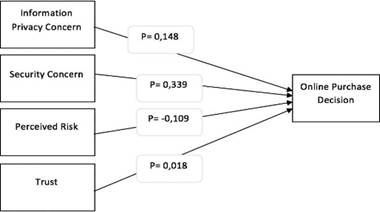
Figure 6. Information privacy concern, security concern, risk, trust and online purchase decision.
The magnitude of the effect of the privacy, security, risk, and trust of online purchasing decisions in the R square column is 0.185 or 18.5%. It can be concluded that the information privacy concern, security concern, risk, and trust affect the purchasing decision online by 18.5%. The F value of 5.398 is greater than F table of 2.467. Therefore, H0 is rejected and H6 is accepted. Van der Heijden et al. (2003) reported that reducing perceived risk can increase trust and attitudes toward online purchases, which in turn increases buyers’ willingness to purchase online.
3 CONCLUSION
The study of e-commerce adoption is largely centered on the website usability features. The main obstacles that need to be addressed before the consumer reaches the adoption level are the concern of privacy and security. This study is one of the first attempts to develop an integrative framework of e-commerce adoption with the construction of privacy and security issues. The results of the study show information on privacy concerns and security concerns affecting online purchasing decisions through risk and trust of university students. The managerial implication of this research is that the usability features of the website can be improved not only aesthetically but also by adding security features. As consumers become more experienced with their online habits, issues about privacy and security features can be a problem for businesses. Further, deficiencies in securing personal information can even lead to serious consequences such as loss of consumers.
REFERENCES
Anil Gurung, M. R. 2016. Online privacy and security concerns of consumers. Information & Computer Security.
Bansal, G. and Zahedi, F.M. 2014. Trust-discount tradeoff in three contexts: frugality moderating privacy and security concerns. Journal of Computer Information Systems 55(1): 13-29.
Bauer, R.A. 1960. Consumer behavior as risk taking, in Hancock, R.S. Ed., Dynamic Marketing for a Changing World, American Marketing Association, Chicago, IL.
Belanger, F., Hiller, J.S. & Smith, W.J. 2002. Trustworthiness in electronic commerce: the role of privacy, security, and site attributes. The Journal of Strategic Information Systems 11 Nos ¾: 245-270.
Campbell, A.J. 1997. Relationship marketing in consumer markets: a comparison of managerial and consumer attitudes about information privacy. Journal of Interactive Marketing 11(3): 44-57.
Chang, M.K., Cheung, W. & Lai, V.S. 2005. Literature derived reference models for the adoption of online shopping. Information & Management 42(4): 543559.
Culnan, M. 2000. Protecting privacy online: is self-regulation working? Journal of Public Policy & Marketing 19(1): 20-26.
Culnan, M. & Armstrong, P. 1999. Information privacy concerns, procedural fairness, and impersonal trust: an empirical investigation. Organization Science 10(1): 104-115.
Eastlick, M., Lotz, S. & Warrington, P. 2006. Understanding online B-to-C relationships: an integrated model of privacy concerns, trust, and commitment. Journal of Business Research 59(8): 877-86.
Fernandez, A. D. 2001. Consumer Perception of Privacy and security Risk for Online Shopping. The Journal of consumer Affairs, 35.
Goldsmith, J. & Wu, T. 2006. Who Controls the Internet? Illusions of a Borderless World. Oxford University Press: New York, NY.
Hoffman, D., Novak, T. & Peralta, M. 1999. Building consumer trust online. Communications of the ACM 42(4): 80-85.
Hong, W. & Thong, J.Y.L. 2013. Internet privacy concerns: an integrated conceptualization and four empirical studies. MIS Quarterly 37(1): 275-298.
Iskandar, E. D. 2018. Retrieved 05, 23, 2018, from SWA: https://swa.co.id/swa/listed-articles/prediksi-tren-e-com merce-indonesia-2018
Jarvenpaa, S.L., Tractinsky, N. and Vitale, M. 2000. Consumer trust in an internet store. Information Technology and Management. 1(2): 45-71.
Jarvenpaa, S.L., Tractinsky, N., Saarinen, L. & Vitale, M. 1999. Consumer trust in an internet store: a cross- cultural validation. Journal of Computer-Mediated Communication. 5(2): 1-35.
Kim, D., Ferrin, D. & Rao, H. 2008. A trust-based consumer decision-making model in electronic commerce: the role of trust, perceived risk, and their antecedents. Decision Support System. 44(2): 544-564.
Kimery, K.M. & McCord, M. 2002. Third-party assurances: mapping the road to trust in e-retailing. Journal of Information Technology Theory and Application. 4(2): 63-81.
Lee, M.K.O. & Turban, E. 2001. A trust model for consumer internet shopping. International Journal of Electronic Commerce. 6(1): 75-91.
Liu, C., Marchewka, J., Lu, J. & Yu, C. 2004. Beyond concern: a privacy-trust-behavioral intention model of electronic commerce. Information & Management 42(1): 127-142.
Malhotra, N.K., Kim, S.S. & Agarwal, J. 2004. Internet users’ information privacy concerns IUIPC: the construct, the scale, and a causal model. Information Systems Research 15(4): 336-355.
McKnight, D., Cummings, L.L. & Chervany, N.L. 1998. Initial trust formation in new organizational relationships. Academy of Management Review 23(3): 473-490.
Miyazaki, A.D. & Fernandez, A. 2001. Consumer perceptions of privacy and security risks for online shopping. Journal of Consumer Affairs 35(1): 27-44.
Olivero, N. and Lunt, P. 2004. Privacy versus willingness to disclose in e-commerce exchanges: the effect of risk awareness on the relative role of trust and control. Journal of Economic Psychology 25: 243-62.
Prahadi, Y. Y. 2017. Retrieved 05, 23, 2018, from SWA: https://swa.co.id/swa/trends/business-research/ini-dia- fakta-mengejutkan-e-commerce-di-indonesia
Riquelme, U. & Roman, S. 2014. Is the in uence of privacy and security on online trust the same for all types of consumers?. Electronic Markets 24(2): 135-149.
Robert J. Kauffman, Y. J. 2011. A Survey of Consumer Information Privacy From the Accounting Information Systems Perspective. Journal of Information System 25.
Sitkin, S.B. & Pablo, A.L. 1992. Reconceptualizing the determinants of risk behavior. Academy of Management Review 17(1): 9-38.
Smith, H.J., Milberg, S.J. & Burke, S.J. 1996. Information privacy: measuring individuals’ concerns about organizational practices. MIS Quarterly 20(2): 167-196.
SWA, M. 2017. swa. Retrieved 5, 23, 2018, from https:// swa.co.id/swa/business-update/seberapa-penting-peran- website-dalam-peningkatan-sebuah-bisnis-mari-kenali- manfaatnya.
SWAOnline. 2016a. SWA. Retrieved 05, 23, 2018, from https://swa.co.id/swa/trends/business-research/tren-trans aksi-e-commerce-di-indonesia.
SWAOnline. 2016b. Retrieved 05, 23, 2018, from https:// swa.co.id/swa/my-article/memahami-perilaku-belanja- online.
Van der Heijden, H., Verhagen, T. & Creemers, M. 2003. Understanding online purchase intentions: contributions from technology and trust perspectives. European Journal of Information Systems. 12(1) 41-48.
Verhagen, T., Meents, S. & Tan, Y.-H. 2006. Perceived risk and trust associated with purchasing at electronic marketplaces. European Journal of Information Systems 15(6): 542-556.
Vijayasarathy, L.R. 2004. Predicting consumer intentions to use on-line shopping: the case for an augmented technology acceptance model. Information & Management 41(6): 747-762.
Webster, J. & Martocchio, J.J. 1992. Microcomputer playfulness - development of a measure with workplace implications. MIS Quarterly 16(2): 201-226.
Wolfinbarger, M. and Gilly, M.C. 2003. eTailQ: dimensio- nalizing, measuring, and predicting etail quality. Journal of Retailing 79(3): 183-98.
Xu, H., Teo, H.-H., Tan, B.C.Y. & Agarwal, R. 2012. Effects of individual self-protection, industry self-regulation, and government regulation on privacy concerns: a study of location-based services. Information Systems Research 23(4): 1342-1363.