United Kingdom
Defying a hard landing
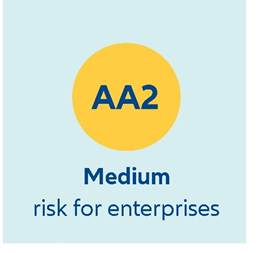
| GDP | USD3070.7bn (World ranking 6) |
| Population | 67.0mn (World ranking 22) |
| Form of state | Constitutional Monarchy |
| Head of government | Rishi Sunak (PM) |
| Next elections | 2025, Presidential and legislative |
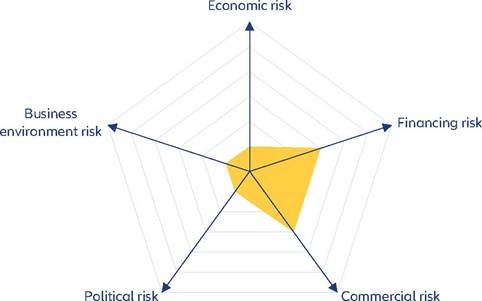
Strengths & weaknesses
Economic overview
Recession dodged, caution ahead
The UK's economy is likely to have narrowly sidestepped a recession in 2023, though the economic outlook remains far from optimistic, reflected in subdued confidence among consumers and businesses alike.
The external environment has been a recent drag, with exports remaining below prepandemic levels, an outlier among G7 countries. A bright spot has been the resilience of domestic demand, particularly from consumers buoyed by significant savings amassed since the pandemic but also strong consumer credit growth, which builds up risks in the medium run. This buffer has propped up an economy that leans heavily on private consumption amid a tough international environment, helping it surpass its prepandemic real GDP by close to 3%. Moving ahead, this domestic cushion may thin, undermined by falling real wages over 2022-23 and negative wealth effects, pushing consumers to save more. While we expect the UK to avoid a full-blown recession, GDP growth will remain low at +0.6% in 2024, followed by 1.5% in 2025.While inflation is gradually trending downwards, it continues to linger significantly above the BoE's target and a return to below 2% is not expected before 2025.
This sluggish decline stems in part from ongoing pressures in the services sector and a labor market that - despite signs of cooling - remains tight. Wage increases in the UK, which have surpassed those of peers, fuel the risk of a wage-price spiral. In the context of these ongoing inflationary pressures, it is anticipated that interest rates will stay higher for longer with no foreseen rate cuts until Q4 2024.After a hiatus during the pandemic, corporate risk in the UK is back with a vigor as insolvencies are set to remain 30% above prepandemic levels. Unlike their European and American counterparts, which are grappling with diminishing margins, UK companies have showed resilience, managing to grow their margins even amidst the pressures of increasing labor costs. Nevertheless, this resilience is counterbalanced by a concerning trend of reduced corporate cash reserves. The outlook ahead is sobering, with forecasts suggesting a continued uptick in annual insolvencies in 2023 as well as 2024.
Excessive imbalances need to be reduced
Since Brexit, the UK economy has been exposed to negative structural changes. First, in 2022, labor shortages soared to record levels. Although these vacancies have subsequently decreased, they continue to exceed their long-term trends, indicating ongoing challenges in the labor market. Additionally, youth employment continues to be a concern, with the employment rate for those aged 18 to 24 significantly trailing behind that of other age groups.
Second, post-Brexit, the EU's share of UK imports remains below prereferendum levels, continuing a longer-term decline. In 2022, China solidified its position as the UK's largest single import market, accounting for a significant 13.4% of its total merchandise imports. The UK's dependence on imports from outside the EU presents a potential risk to its production sector. This was exposed in 2021, when global supply shortages highlighted vulnerabilities in the global supply chain and pushed inflation above that of peers, underscoring the potential implications of the UK's shift in import sources.
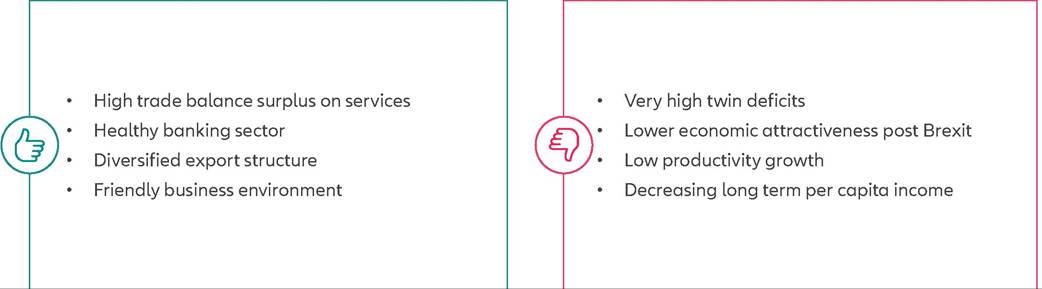
Third, the economy has accumulated high twin deficits, exceeding -4% of GDP, which coupled with fickle market confidence and elevated borrowing costs are expected to push the next government to switch to fiscal consolidation in the medium term.
In the short term, however, the fiscal deficit is anticipated to remain wide, with the current government expected to maintain high spending levels in the lead-up to the 2024 election. In 2023, the Bank of England shifted from its cautious approach of the previous year, adopting an “aggressive, early hiker” stance. This strategic pivot was not only aimed at addressing persistent inflation but also at reinforcing the nation's faltering currency. The UK economy is particularly vulnerable to fluctuations in foreign exchange rates, with around 50% of its import prices being influenced by currency dynamics, notably higher than in countries like France and Germany. This high sensitivity in import prices is in stark contrast to the export sector, where the benefits of a weaker currency are limited due to a substantially lower passthrough effect. These growth benefits are further reduced by the current international context of sluggish global trade growth, which is projected to modestly exit recession in 2024 (+3.3%). Despite a recent recovery, the GBP still remains below prereferendum levels, though there is some potential for further appreciation. It is expected that the loss of favorable EU trade terms will continue to weigh on exports in 2024, but this will likely be offset by reduced import costs, which will prevent the UK's current account deficit widening significantly.Strong business environment but weaker since Brexit
Political volatility may be on the horizon in 2024. Under Prime Minister Rishi Sunak, who assumed office in October 2022, the Conservative Party has made modest gains in opinion polls but still significantly trails the Labor Party. The next election, expected in late 2024, is likely to be a challenging one for Sunak and the Conservatives. Forecasts are currently pointing towards a Labor victory, with a narrow but absolute majority. A transition to their governance will likely bring an initial honeymoon period of public goodwill. However, maintaining this support will depend on their capability to effectively tackle the country's economic and social challenges.
In this evolving political landscape, policy towards investment remains favorable and the UK maintains an overall probusiness policy stance. Despite the rise in corporate tax from 19% to 25% in 2023, the UK's rate is still lower than that of the EU's largest economies. However, Brexit has worsened the UK's terms of trade, notably as foreign direct investment has adjusted on the downside and the sterling has suffered from a strong depreciation.
The UK continues to negotiate further trade agreements post-Brexit, seeking to strengthen its global trade network. A notable advancement is an anticipated Free Trade Agreement (FTA) with India, though negotiations remain ongoing. This effort is part of a broader strategy as the UK adapts to new trade dynamics outside the EU. A number of FTAs have been established in recent years, including with Australia (December 2021) and New Zealand (February 2023). In addition to these, the UK joined the Comprehensive and Progressive Agreement for Trans-Pacific Partnership (CPTPP) in July 2023, linking it with an important Asia-Pacific trade bloc of 11 countries.