United Arab Emirates
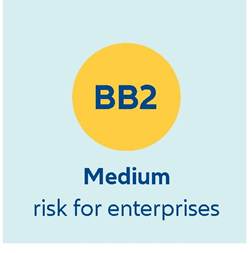
Growth at all costs - a calculated gambit?
| GDP | USD507.5bn (World ranking 29) |
| Population | 9.4mn (World ranking 96) |
| Form of state | Constitutional Monarchy |
| Head of government | Mohammed bin Zayed Al-Nahyan |
| Next elections | 2027, Legislative |
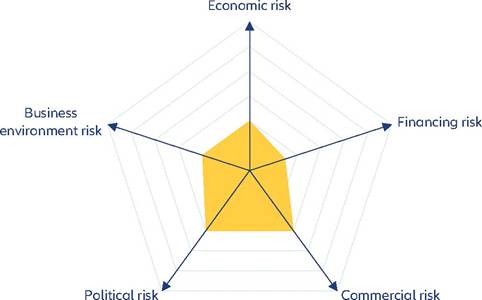
Strengths & weaknesses
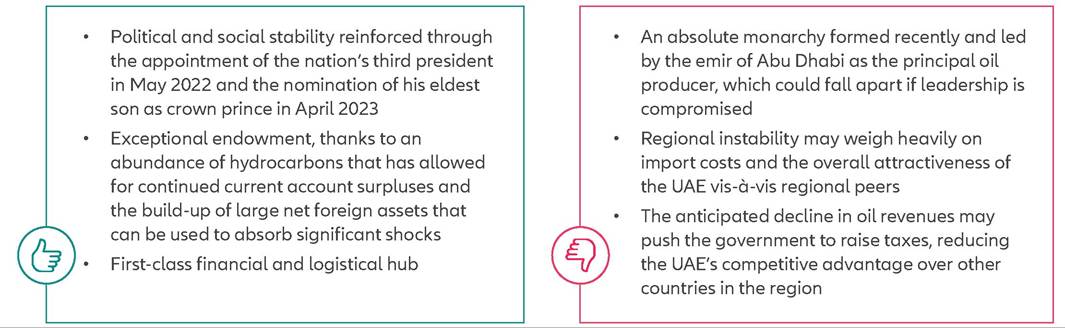
Economic overview
An oasis of growth in a troubled region?
The UAE economy grew by around +3% in 2023, thanks to moderately favorable hydrocarbon prices, higher revenues from tourism and continuous growth in the real estate and construction sectors at large.
This year, growth is expected to reduce to around +2.3%, with the non-oil economy losing some grip because of the resurgence of conflicts in the region and increased caution by foreign investors. Despite such headwinds, the overall performance is likely to post among the best results across the Gulf.Resurgent energy demand following the pandemic, along with a steep spike in international oil prices, led to a rapid increase in oil output and exports in 2022, fueling rapid development in the non-oil economy alongside the full reopening of non-oil industries such as tourism. The latter, along with real estate and logistics, has risen significantly after the pandemic. These trends have continued into 2023, with occupancy rates of hotel rooms in Dubai exceeding 90% and partially offsetting the fact that oil demand growth slowed down and OPEC+ set stricter production quotas.
The UAE has been the most vocal opponent of OPEC+ output cuts and the implementation of a 9% corporate tax rate in July helped increase much-needed non-oil revenues.Consumer demand remains robust as federal and emirate governments spend extensively on capital programs and resident assistance to alleviate cost-of-living constraints. Government efforts such as easing residency rules for foreign nationals, inflation-relief initiatives and private-sector support are driving economic prospects.
Contingent liabilities remain a concern but fiscal stability is progressing
In recent years, a business-oriented approach has led the way to weaning the economy off oil rent and expanding services. Expat attraction and foreign investment policies are key to consolidating the construction sector, which continues to account for nearly 20% of bank lending as well as services. Construction kept rising in the first three quarters of 2023, with real estate activities also increasing at a slower pace. Together, these two industries accounted for 13% of the UAE's GDP in 2022. Property prices have seen a significant rise only in the past two years, following a lengthy period of rebalancing as the housing stock moved toward equilibrium. In 2021, the UAE's largest construction company filed for bankruptcy and was liquidated, indicating some imbalances in such a flamboyant sector. Since the bankruptcy law went into effect at the end of 2016, government-related firms, including construction conglomerates, special-purpose vehicles and developers, have increasingly entered official restructuring and liquidation processes. Costs for contractors and project developers are rising again because of increasing loan rates and this trend is expected to slow the market temporarily despite the presence of many cash buyers.
Fiscal stability is also progressing. In September, Dubai began repaying a USD20bn bailout loan from Abu Dhabi and the country's central bank as part of an effort to reduce its debt burden, almost 15 years after the sheikhdom teetered on the brink of default.
Contingent liabilities remain a reason for concern as the size of the financial industry remains elevated, with total assets equaling 220% of GDP. At the same time, the total debt of government-related entities (i.e., banks and non-banks with at least a 20% government stake) amounts to around 75% of GDP. Large sovereign net foreign assets are still greater than the entire banking sector, but the impacts of even a partial rescue would be visible, given the financial industry's disproportionate size in contrast to the rest of the economy.Abu Dhabi remains the UAE federation's primary financial backer, although support should not be taken for granted. Over the last decade, Abu Dhabi's contribution to the UAE federal government has averaged 13% of the emirate's GDP (8% of UAE GDP), or more than 35% of Abu Dhabi's government spending, in the form of direct donations and spending on behalf of the UAE federal government.
The cost of playing the field
The UAE is a young federation with a history dating back to 1971-1972 and faces typical succession dynamics that may raise concerns despite a general sense of stability perceived by foreign investors. In April 2023, President Mohammed bin Zayed nominated his eldest son Khaled as crown prince, ending the kingdom's succession dilemma. MbZ was appointed as the UAE's third president in May 2022 after becoming the country's de facto ruler in 2014. The appointment took 10 months and involved creating internal consensus with his five full brothers.
Aside from its role in the Israel-Gaza crisis, the UAE has also been sparring with Riyadh over key mediation topics such as Sudan and the Yemen crisis, oil-production strategies and geostrategic dominance in the Red Sea. In May 2023, the UAE suspended participation in a US-led maritime alliance to protect shipping in the Persian Gulf after Iran seized two oil tankers.
Relations with Russia have improved, sparking skepticism from Western partners. Over a million Russians visited the UAE between January and October 2023, representing a +67% increase over the previous year.
Tens of thousands of Russians have also relocated to the UAE, establishing businesses and purchasing real estate. Western governments are concerned that the influx may conceal the involvement of sanctioned oligarchs and have been pressuring the UAE to restrict relations with Russia. However, major corporate and financial institutions have taken a more cautious approach than authorities.Insistent allegations that the UAE is becoming a transit point for products like electronics and semiconductors that can be repurposed to support Russia's war campaign raise reputational risks and may trigger sanctions. Exports of electronic parts from the UAE to Russia rose by more than seven-fold last year, making it the largest type of commodity delivered in that direction. Triangulations to bypass trade sanctions and increased concerns over limited money laundering and counterterrorism controls may restrain diplomatic and commercial relations with key partners and ultimately alienate Western businesses.
More on the topic United Arab Emirates:
- Allianz Research. Country Risk Atlas 2024: Assessing non-payment risk in major economies. Allianz,2024. — 179 p., 2024
- Key Facts about Long-Run Economic Growth
- The Last Century
- Oman
- United States
- Monocameral Parliaments
- Tanzania
- The Long Nineteenth Century
- THE IMPACT OF INTERNET ARCHITECTURE ON THE ECONOMIC ENVIRONMENT FOR APPLICATION INNOVATION
- INEQUALITY: TRENDS