1900: Parallels and Differences
At the end of the nineteenth century the age of imperialism and thus the colonization of the world had reached a new height. While the colonial race between the imperial powers was marked by intense competition, a brief moment of rare unity prevailed among them in East Asia in 1900.
Here the great powers reacted with vehement determination against the so-called Boxer (Yihetuan) Rebellion that raged in northern China during that summer. In its suppression, two new actors appeared prominently alongside the usual suspects in the imperial game for the first time: Japan and Germany. When it came to providing relief to those foreigners who were entrapped in Peking's (Beijing's) diplomatic quarter, it was the Japanese who contributed by far the largest contingent of troops. Since the German envoy to Peking had been murdered, it was the German state, however, who had assumed the overall command of the allied campaign. Yet, more was at stake. The German Empire's economic interests in its coastal foothold Kiaochow (Jiaozhou) and the surrounding Shandong Province were also threatened by the rebellion. The German emperor Wilhelm II saw an opportunity not only to present Germany as taking part in “European policing on a world stage,” but also to set an example in dealing with rebellious Chinese subjects. Infamous was his “Hun speech” to German troops in Bremerhaven in 1900: “Should you encounter the enemy, he will be defeated! No quarter will be given! Prisoners will not be taken!”[2524]The colonial war in northern China unfolded in 1900 before the eyes of a closely watching media audience worldwide. On the heels of the victory by the allied Great Powers followed excessive violence in the colonies, in which the Germans particularly excelled. However, the events in China should not be interpreted simply as evidence of the self-assertion and solidarity of the Great Powers during the so- called Imperial Age.
Competition and over-ambition were omnipresent. At the same time, another even more important development revealed itself: anti-colonial movements, as evinced in the specific form of the Yihetuan Rebellion, would pose ever more intractable challenges to every major imperialistic endeavor over the course of the following decades. It would be the two newcomers, Japan and Germany, who developed very specific answers to these challenges in the first half of the twentieth century.Yet, how did the Germans and Japanese end up in Peking in the first place? In the case of Germany, a formal period of extra-European colonial rule, starting in 1884 and lasting for only a few decades, is pitted against a much longer history of German overseas ambitions and often failed projects that started as early as the sixteenth century.[2525] At the same time, Prussia also possessed elements of a continental empire in Europe, similar to Russia and Austria, turning the Kaiserreich into a multiethnic polity with multiple and competing nationalisms.[2526] While significant differences existed between the legal status of indigenous populations in the colonial empire and ethnic minorities in Germany's eastern provinces (e.g., regarding access to German citizenship), certain strategies of “Germanization” were applied in both realms.
Germany's late and short-lived overseas colonial project was nonetheless an essential part of the era of high imperialism before 1914. After national unification under the leadership of Chancellor Otto von Bismarck in 1871, which was in many ways a precondition for effective overseas expansion, Germany had acquired by the turn of the twentieth century the fourth-largest colonial empire of the time after Britain, the Netherlands, and France. With Bismarck presiding over the Berlin
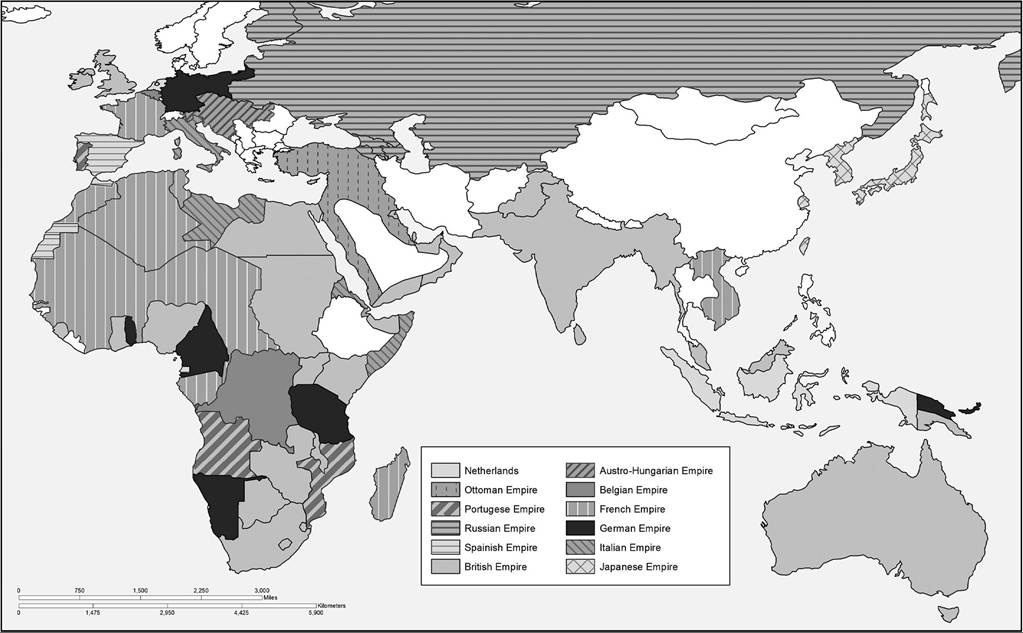
Map 41.1. The Japanese and German Empires among Their Rivals on the Brink of World War 1.
Copyright: Moritz von Brescius and Daniel Hedinger with Jonathan Weiland.THE GERMAN AND JAPANESE EMPIRES 1127
Conference (1884-1885), Germany came to play a central role in the Scramble for Africa. Consequently, Germany received significant colonial possessions in what is today Tanzania, Namibia, Cameroon, and Togo. These were complemented in the 1890s, under the slogan of German Weltpolitik, by the acquisition of territories in the Pacific, including a series of small islands, but also the larger possessions of New Guinea and Samoa. In 1897, Germany leased Kiaochow as a naval base on the Chinese coast, adding it as a “model colony,” under the jurisdiction of the navy, to the colonial empire that now stretched across parts of three continents.
Japan's path to becoming an imperial power was different in many respects. The intensifying presence of the Western powers, including Russia, Great Britain, and the United States, in East Asia from the early nineteenth century onward had subjected the country, by 1860, to a series of unequal treaties and therefore a semicolonial position. Building up an empire played a major role in Japan's efforts to consolidate political power as a modern nation-state and to assert itself within the international context of the late nineteenth century. To reform its army and legal system, to write its first national constitution, and to engage in other acts of national modernization, the Meiji government both sent study expeditions to various Western powers (including Prussia), but also enlisted the service of paid foreign government advisors, the oyatoi, among them a number of German military specialists, doctors, and legal experts. Moreover, the rise of industrial capitalism and the emergence of Japan as the first non-Western great power were both backed by imperial expansion.
For a long time, the literature had Japan's colonial history begin with the first Sino-Japanese War of 1894-1895. Yet already the first decades of the Meiji era (1868-1912) proved to be directional and formative for future expansion.
In 1874, Japan sent a punitive expedition to Taiwan following the murder of Okinawa fishermen on the island. This initial military undertaking by the imperial Japanese navy and army was defining, even though no territorial gains were involved. The enterprise revealed the military weaknesses of the Qing dynasty in China, and the door now seemed to stand wide open to the mainland. The action also cleared the way to the full territorial integration of the Ryukyu Islands (Okinawa), a previously semi-autonomous kingdom. At the other end of the archipelago similar events were taking place as Hokkaido was integrated into the empire through settler colonialism.Thus, within the first decades of Japan's modern history, national integration and colonial expansion prevailed, intensified, and consolidated the national borders as we know them today. This was, however, a violent and painful process. It not only encompassed the borders lands, and the indigenous population of the north, the Ainu, were not its sole victims. National integration also had an impact on all those who had yet to become Japanese. Against the backdrop of the predominant “enlightening and civilizing discourse” of the early Meiji era, this national process of unification can be understood as a type of internal colonization.
The dynamics with which domestic social changes and challenges were immediately transferred outward are particularly evident in the case of Korea, the next target of Japanese expansion. In the context of uprisings and civil wars on Japanese soil, an attack on Korea was discussed. Finally, in 1876, the Meiji government turned its gunboat diplomacy on Korea and forced the country to sign an unequal treaty. More important than the economic advantages for Japan provided by this treaty was Korea's crucial geopolitical function. Korea was to serve as a buffer zone to keep Russia and China at bay.
New borders, however, brought new enemies and new conflicts. Eventually war did break out with China by way of Korea in 1894.
Among other things, the price China paid for losing to Japan was Taiwan, which became Japan's first formal colony. At the same time, China recognized the “independence of Korea” and thus the Japanese control over the peninsula. The Chinese government was even prepared to surrender Liaodong Peninsula as reperations. This would have extended Japan's influence deep into Manchuria. For several Western imperial powers, such a move simply went too far. With the so-called Triple Intervention, Russia, France, and Germany forced the Japanese Empire to relinquish Liaodong Peninsula. At home in Japan, where many had enthusiastically supported colonial expansion, the outrage was great over the actions of the Western imperial powers, all the more since Germany had taken advantage of the moment to secure control over Shandong Province. Even stronger was the disapproval of Russia's actions, for it now occupied Liaodong Peninsula in place of Japan. From this point on, it was only a matter of time before the next war broke out in this region of increased imperial competition.Around 1900, people in Japan could look back on three decades of imperial expansion. In 1902, the Anglo-Japanese alliance was signed. This implied Japan's admission to the club of the great powers and ended the era of the unequal treaties once and for all. Until the pact with Germany and Italy, this would be Japan's only formal alliance.16 Thus, during the height of Western imperialism, the Japanese empire had not only succeeded in maintaining its independence and subsequently reinstating its sovereignty, it had itself advanced to become an influential colonial player. Japan resorted to the entire gamut of means connected to formal and informal imperialism: punitive expeditions and unequal treaties were as much a part of its expansionist politics as were the creation of protectorates, the annexation of colonies, or the creation of spheres of influence. Among the methods used were also settler colonialism, military-base colonialism, and internal colonization.
This outlined the thrust, patterns, and diversity of further expansion to come. But it also revealed the contradictions and problems that evolved from this imperial endeavor: with each additional step, it became increasingly difficult to justify such expansionism by referring to the threats posed by the Western powers.16
Paine 2017, 52.
While Japan had become an empire to fend off Western encroachment, such a defensive reasoning for expansion did not stand behind Germany's long-held imperial visions, fuelled by an increasingly organized colonial movement since the 1840s.[2527] Yet, in some ways similar to the Japanese case, before German unification, “the nation's (fictitious) colonial empire served as a screen onto which ideas about national unity and national greatness could be projected.”[2528] As in the case of Japan, the invention and creation of the nation also occurred by way of imperial ambitions. And in both cases the problem of emigration was important because it was interpreted as dissipating and weakening the nation. So evolved the dangerous view that German emigrants, who in the 1840s had been leaving in numbers reaching as many as 250,000 per year, would become a “fertilizer of the peoples” and at the same time weaken their own nation.[2529] This led to increasing calls for settlement colonies to which the outward flow of emigrants could be directed, thereby enabling emigrants to keep their “Germanness.” The comparable emigration of Japanese in search of work flowed primarily in the direction of Hawaii and the American East Coast, whereby the ever-present discrimination of these “non-white” immigrants harbored a persistent potential for conflict with the United States.
Being in the midst of industrialization in the 1880s, one key motive for German overseas expansion was the search for raw materials and new markets for domestic production. Besides the economic competition among imperial powers (which would soon include Japan and the United States), Germany's push for empire was also fueled by a pan-European belief in global racial differences and Europe's supposed civilizing mission to uplift the world according to its own standards. Likewise, the rise of ideologies such as Social Darwinism significantly influenced German Weltpolitik around 1900.
While global economic and political rivalry, transcontinental migration movements, and cultural contacts greatly influenced German imperial activities overseas and at home, it is important to note that the formal empire never set the boundaries for Germany's engagement with the wider world. German colonialism was decisively more than the history of its protectorates. Rather, it included forms of “informal empire” and financial, commercial, and settlement activities in the Middle East and the Ottoman Empire (Baghdad Railway), Iran, China, and different regions of South America and elsewhere. Even in Africa, trade links bound the Kaiserreich much closer to countries like Egypt, Morocco, or South Africa than to its own colonies, which did not absorb even 1 percent of Germany's foreign trade and only a similarly tiny percentage of its foreign investments.[2530] Before the outbreak of the Great War, none of the German overseas colonies had become economically successful. They contributed, in 1913, a mere 2.55 percent of Germany's total gross domestic product, even if colonialism left a deep cultural imprint on metropolitan society.[2531]
Furthermore, Germany's empire abroad was territorially a highly fragmented polity, with the dispersed possessions in Africa, China, and the south Pacific impossible to defend in case of a war against its imperial rivals. Real administrative powers were, especially in Africa, also often merely yielded in pockets of sovereignty. To acknowledge the limited power of the colonial state can explain, to some extent, the German Empire's systemic violence.[2532] In any case, Germany's status in 1900 as a great industrial power did not depend on official colonial possessions. And yet, many thought it necessary to have an overseas empire, despite its doubtful economic and political benefits; in the national imagination, to have imperial possessions was a matter of principle and prestige rather than utility and survival.
Despite these particularities and differences around 1900, the positions of Germany and Japan were similar in many respects. Their place in the competition for colonies was relatively precarious. Both needed and wanted to prove themselves and both were, as newcomers, under close scrutiny by the other powers. Moreover, expansion was seen as necessary, yet it occurred without any sort of master plan.[2533]
According to the mantra of national prestige, immense pressure often came from below to react to opportunities and crises. Thus a pattern ensued: the governments, well aware of their relatively limited resources, let themselves be drawn into a conflict every now and then. However, although the states often preferred informal structures, they were prepared to pursue their aims with full force and determination once no other alternative existed. This pattern is illustrated in the Korean case, where Japan had long exercised a type of informal imperialism, only to finally annex Korea as a colony in 1910. Similar things occurred in the German case, if under other portents. There, men on the spot played a significant role in launching the colonial project. Adventurers and mavericks were often creating faits accomplis on the ground, as typified by Carl Peters, the “founder” of German East Africa. The initially favored model of imperial rule through private companies was abandoned once it failed after a series of colonial scandals and bankruptcies. Consequently, the German government was forced to step in and take over the administrative control of costly overseas possessions, as in East Africa or German New Guinea.
In trying to distinguish themselves from older imperial powers like Great Britain or Spain, Japan and Germany at least claimed that their annexation of overseas territories was not pursued solely for reasons of economic advantage or power politics. While all powers sought to rationalize their colonial projects at the time, the Japanese and German pursuit of this ideal led to comprehensive modernization projects in their colonial territories, such as large- scale infrastructural undertakings (as in German Africa after 1907 under the new reform-oriented colonial policy of Bernhard Dernburg).[2534] However, this postulated ideal of a supposedly efficient “scientific colonialism,” grounded in the application of science and the evolve- ment of positive developmental dynamics, was hardly implemented. The close association of German rule with violence and genocidal warfare, as in the case of the annihilating war against the Herero and Nama peoples in German South West Africa (1904-1907) underscores this discrepancy between aspiration and reality. For the Japanese, in turn, it was precisely their idea of scientific colonialism that in many cases rationalized and thus permitted the use of force in the first place.[2535] With regard to this shared civilizing mission they claimed for themselves, it is possible to identify a significant and direct transfer between the two countries. Goto Shinpei, a doctor and the first civilian governor of Taiwan, was one of many Japanese colonial officials who had studied in Germany. His idea to turn the newly captured island into a colonial laboratory was one he had brought back from the Wilhelmine Reich.
The German and Japanese cases can also throw a new light on two general trends of the age of imperialism around 1900—the “intensification and extension of colonial rule.”[2536] Yet there are clear differences between them, as with regard to the intensity of colonial pervasion. With time, hundreds of thousands of Japanese were to settle in Taiwan and Korea. In comparison, the German presence in East Africa was 60 times smaller.[2537] In contrast to Japan, German colonial possessions were also not concentrated regionally. Nor did they serve the same function. Germany did not become a great power because it had colonies; it worked the other way around. As a European great power, it was convinced that it had a right to colonies. This logic was reversed in Japan: the position it achieved around 1900 as the only non-Western great power resulted directly from imperial wars and territorial expansion.
Regarding the motives of empire-building, there existed another striking contrast: for Japan, what was at stake was nothing less than its own sovereignty. This was not a problem that Imperial Germany shared because it was deeply entrenched in the European power order. In this sense, imperial expansion was a far more existential task for Japan. Thus, around 1890, one of the main architects of Meiji-Japan, field marshal Yamagata Aritomo, developed the concept of “forward defense.” The idea was to create spheres of influence in “concentric circles” around the motherland, at the center of which would be sovereign zones that directly ensured the survival of the nation, while on the periphery an informal form of dominance prevailed.[2538] This implied that the Japanese Empire was, from the start, to be a mixture of a continental (with regard to internal colonization) and maritime empire, stretching its influence across East Asian waters.
The preservation and expansion of these circles was to remain an essential element of Japanese imperialism until 1945. This is why the forefront of Japanese policy was not the possession of colonies, but the protection of imperial spheres of influence that immediately surrounded the main Japanese islands. This also explains why the wars of the late Meiji era were not conducted primarily for territorial expansion—even though that was precisely the side effect that resulted. Thus, the Japanese Empire was shaped by geopolitical strategies earlier and to a far greater degree than were all others.[2539] Ironically, imperial expansion and the safeguarding of national sovereignty never brought about the desired security. On the contrary, it always spawned new fears. At the same time, it combined trends that would shape imperialism worldwide for the first half of the twentieth century: the creation of contiguous and autarkic continental empires, consciously different from the former system of often far-flung overseas colonies, and the belief that a nation's survival would depend on the existence of an empire. In this sense, Japan's path to empire was not at all an anomaly. Instead, Japan was a trailblazer for the twentieth century.
For their part, the Germans closely watched events unfold in the Far East and drew far-reaching conclusions with regard to their own imperial future. Here, too, the project was marked by fears for the country's future. From his observations of imperial competition and expansion in East Asia, Navy Minister von Tirpitz, stationed with the German fleet in China in 1896, concluded: “The accumulation of giant nations like Panamerica, Greater Britain, the Slavic Race or the Mongolian Race under the leadership of Japan will destroy or almost extinguish Germany... in the course of the next century, if Germany does not become a great power outside the borders of the European continent. The imperative basis for that... is a fleet.”[2540] Tirpitz's experience with Japanese imperialism and his encounter with the alleged “yellow peril” were thus reflected in his imperial project, convincing him of the necessity to turn his fatherland into a global power.
In light of realpolitik, conflicts of interest, or the specter of the “yellow peril,” the imperial politics of Germany and Japan in 1900 appear at first glance to be as far apart as foreign to each other. Yet it was precisely the desire for imperial greatness, derived from an existential fear, in which we can ex post facto identify, if not much cooperation, then indeed parallelisms. Concurrently, the notion of Lebensraum [living space] developed in German thought, which linked the notions of race, space, and imperial expansion in new ways. It was closely connected to the work of the influential human geographer Friedrich Ratzel, who had argued since the 1890s “that Germans should also strive to fashion a strong state that would naturally expand,” especially into parts of Eastern Europe.[2541] Therefore, Japan and Germany were not simply two imperial latecomers bent on catching up with existing developments. Their appearance on the international stage caused the geopolitics of empire to change fundamentally around 1900.
II