Capital cities of the raj
From around 1780 and over the next four decades, Calcutta was transformed into a monumental imperial city with a European look that was preponderantly neo-classical and Georgian in style.
It so impressed the traveller and artist William Hodges that in the early 1780s he described its broad streets and the line of buildings on the esplanade as ‘magnificent’ and of ‘superb appearance’. His hyperbole did not stop there:The general approach to the houses is by a flight of steps with great projecting porticoes, or surrounded by colonnades or arcades, which give them the appearance of Grecian temples; and indeed every house may be considered as a temple dedicated to hospitality.10
India’s new capital city reflected what was considered the best English taste, that of metropolitan London. It had many similar appurtenances: a large park, the maidan; a major town square, the old Tank Square or Dalhousie Square; and churches such as St John’s, which, like a multitude of others throughout the colonies of the British Empire, drew heavily on James Gibbs’ masterpiece St Martin-in-the-Fields, in London’s Trafalgar Square. Overall Calcutta had a spaciousness that was distinctive and suited to its official importance. Much of the grand spatial quality characteristic of nineteenth-century Calcutta derived from the fact that its public buildings and the mansions of the kind praised by Hodges stood outside the walls of the fort, whereas in the other presidency towns fort walls surrounded the urban settlement, and so considerably confined its official and unofficial buildings.
There also appeared oversized monuments to British rule. A 48-metre tower, the Ochterlony Monument, was completed in 1828 to celebrate his role in the winning of the Nepal War and there was, of course, Fort William, relocated after 1757, rebuilt, and finally completed in 1781.
No shot was ever fired from it in battle. Later, the 1780s large building that had housed the clerical staff of the Company, known appropriately as the Writers’ Building, was likewise renovated in 1880 and turned into an imposing structure exuding Victorian-style monumentality.For sheer grandeur nothing matched the new Government House commissioned by Governor-General Wellesley and completed in 1805. Replacing both the existing Government House and the Council House, it was a grand Georgian structure with four enormous wings and giant columns surmounted by a large shallow dome. An acknowledgment to English metropolitan taste, the building drew on the notion of country seats in England. In particular its floor plan was inspired by Robert Adam’s Kedleston Hall in Derbyshire (1759-1770).11 The directors of the Company back in London were not impressed by this Calcutta expression of grandeur and even less by its expense. Possibly in consequence they recalled Wellesley in 1805. Others had different views. Lord Valentia, who saw the building shortly before it was finished, maintained the expense was a necessary part of ruling empire and particularly so in Asia:
The sums expended upon it have been considered as extravagant by those who carry European ideas and European economy into Asia, but they ought to remember that India is a country of splendour, of extravagance and outward appearances... In short I wish India to be ruled from a palace, not from a counting house; with the ideas of a Prince, not with those of a retail-dealer in muslins and indigo.12
Valentia’s Orientalist contextualising of the new building has an underlying ambivalence and tends to disguise the fact that it was not only Indians who were impressed by splendid buildings. His enthusiasm suggests that the predilection for pomp and show was not limited to an Indian audience. Many other fine buildings of varying sizes were built in the city after the completion of Wellesley’s Government House; extensive changes and additions reconfigured the Presidency Township and earned Calcutta its sobriquet of the second city in the empire.
Its townscape had an impressiveness matching the wealth, power and size of the territories it controlled. As Valentia again pertinently notes: ‘The hearts of the British in this country seem expanded by opulence: they do everything on a princely scale’.13 Nevertheless the culmination of such attitudes and the ultimate summation of Calcutta as India’s great capital city only happened considerably later, one century on.After Queen Victoria’s death in 1901, the viceroy, Lord Curzon, wanted to build an appropriate ‘stately’ memorial to her memory and to the British Empire. It was to be built without government funding and only from moneys raised by voluntary public subscription. Work began in 1906 and was not finished until 1921. The result was an ambitious domed structure built of white marble from Makrana in Rajasthan. It sat like an iced cake in the maidan surrounded by gardens and was filled with memorabilia of the queen and items relating to the British presence in India, the British version of their story of conquest and acquisition. In many ways it was a requiem for what had passed. Its Indo-Saracenic form related back to the glories of Mughal buildings, but it did not quite manage to attain the magic or the achievement of the Taj Mahal with which it was inevitably—and sometimes unfavourably—compared. Though it may have been an appropriate building for the capital of the British Indian Empire, by the time the Victoria Memorial was finally completed the British government had relocated the capital to Delhi, and Calcutta’s glory days in the empire were past.
At Calcutta’s height, the form of its buildings linked the city to London style and to London trends and gives an illustration of the nature of a provincial relationship with a distant metropolis. Where it was positioned within the empire was another matter: Calcutta had a large population, it was wealthy and powerful. Yet, as Valentia hints, the size and grandeur of Calcutta’s cityscape was not only about expressing a European character and creating a European world, it was an inherent acknowledgment of the pomp and splendour of the Mughals and other Indian princes.
This was ambivalently so until the popularity of Indo-Saracenic modes of architecture in the later part of the nineteenth century broke from the almost total domination of European exemplars. Through that style it was inevitable the Victoria Memorial would pay reference to the classic form of Mughal buildings. Further, Britain’s Indian Empire was one where position and hierarchy, privilege and power, were paramount. The Mughals had provided sophisticated examples of how to express such realities through their cities and public space, something which Calcutta similarly achieved through its structured townscape, ranked officialdom and administration, and the social categorising of its inhabitants.Britons were always only a small proportion of the city’s inhabitants and generally remained apart from them. Separation occurred not only in regard to national origin, race, class, caste, work or social situation, but also in Calcutta’s highly gendered universe. The world of the official and the administrator was almost exclusively male, and the proportion of women among its European population was markedly skewed, as indeed it was among the city’s Indian workers, many of whom had homes out of town. Indian workers of course enabled the city to function and the elites to rule. Calcutta was entirely dependent on them no matter how European a city it appeared to be or how seductive its lime plaster facades were.
The East India Company had changed the political geography of the country when in the late 1700s it made Calcutta, balanced on the coastal rim of India and the delta of the Ganges, the capital of its territories. In doing so the Company followed the logic of its acquisitions of territory and the needs of its trading and mercantile interests rather than observing the customary practice of earlier dynasties, who located capitals in the north near or on the main land routes and among the largest concentrations of population.
The role of Calcutta as capital, however, was significantly amended in 1864 when Governor-General Sir John Lawrence took the government to Simla in the foothills of the Himalayas.
The idea was to escape the hot summer, the heavy monsoon that followed and the inevitable excessive humidity thereafter. Lawrence provided an example that his successors were more than happy to follow. So every year until the end of British rule, around the middle of April, the viceroy, his staff, fellow officials and their clerks, their papers and boxes of documents, and large numbers of attendants (to say nothing of personal luggage), would take the long and slow journey into the mountains. Connected to the rest of India only by a tortuous curving road up a steep mountainside and, after 1905, by a narrowgauge (less than a metre in width) tiny mountain railway, Simla nevertheless became the country’s summer capital. From there the governor-general ruled India for usually around six months each year. Simla was psychologically and physically far distant from the hot summer plains and difficult to access, perched high above the people below. Inevitably and not surprisingly, Simla over the years drew criticism for its aloofness, and the hill station appeared a symbol of the arrogance, remoteness and wastefulness of British rule.14 The governor-general in his mountain eyrie two to three thousand metres above the plains was too obvious a symbolism for comments not to be made.Photographs of vice-regal parties picnicking among mountain fir trees inevitably also aroused comments about its being a ‘government by picnic’.15 If it was, it continued to be so well into the twentieth century and even became the viceroy’s chief residence for the entire year from 1912 to 1929, the period from when a new capital was begun in Delhi until the Viceroy’s House was finally ready for occupation.16
Simla did not present itself as a grand capital city, nor did it have many equivalents to Calcutta’s imposing buildings apart from a Vice-regal Lodge built in 1888. The residence was much like a Scottish highland country house, dark-stoned and dour, and inadequate in space for the dinners, balls and dances that the governor-general and his wife regularly hosted during the season.
Otherwise Simla was full of cottages and bungalows with gardens all trying to recreate the feel of an English world different from the London stylishness so much a part of Calcutta. The dominant architectural mode in Simla was Tudor Elizabethan, and the sought-for appearance was that of the English village. Invariably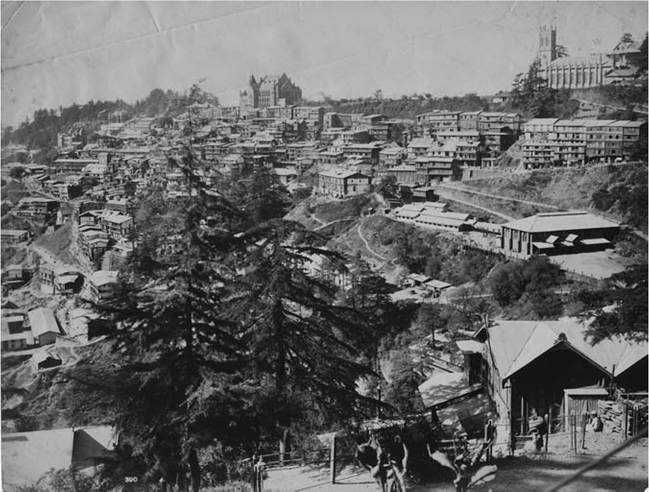
Figure 22.1 View of Simla, probably late nineteenth/early twentieth century. Photo: Portvale Collection, Sydney.
there was also the usual complement of churches. As befitted the semi-resident European population, there was an amateur dramatic society and a proper, though small, Gaiety Theatre in which to perform. Signalling the presence of privilege and separation even on The Mall (the main thoroughfare along the ridge on the top of the mountain) was a ban on the use of carriages or cars except by the viceroy and the commander-in-chief. Everyone else had to walk or be carried in a dandy (a kind of slung hammock) or be pulled or pushed along in a rickshaw.
Simla was both an official city and a social one. It stood as one place where the gender balance among Europeans was approximately equal and where European women could relax in a social and domestic environment something like the society to which they were accustomed back in England. Wives and children came up along with husbands deputed to Simla while others came alone, leaving their husbands to sweat it out on the plains at their jobs. The presence of young military officers and aides meant the social whirl was flirtatious and could be romantic. Ira Portal, who had been a teenager in the Simla of the raj, remembered what fun it all was:
In the two summers I spent at Simla I never thought about doing anything but amusing myself. It was excessively gay. My record was twenty-six nights dancing running, at the end of which I could hardly keep awake, but I had to attend an official dinner that my mother was giving and was severely reprimanded for falling asleep in the middle when talking to a very woolly old judge.17
It was not only the Government of India that took its capital to the mountains. When summer came every provincial governor, lieutenant governor or other important administrator around the country trekked to nearby mountains. Bombay’s government moved to Mahableshwar on the Western Ghats, Madras to Ootacamund in the middle of the Nilgiris (Blue Mountains), others to Mt Abu, Nainital and Darjeeling. All were difficult to access and the travel to them time consuming. But the rewards justified the effort for those who made the journey. Therein a social whirl replicated Simla’s, albeit probably not as large or as frenetic. There was also the official world and the work conducted at the various hill stations. For up to six months each year India was ruled from on high—from distant and out of the way townships very much apart from the people on the plains, the bulk of the population. It would seem that the hill stations had a greater role in the fortunes of empire than would first appear from accounts of the frivolities of life in the hills, the rumour and gossip, the liaisons and parties that Rudyard Kipling captured so sardonically in his stories about Simla in Plain Tales from the Hills.18
Another kind of urban settlement more directly asserted the British raj at its most powerful. The British had acquired India by force of arms, mainly through armies from the three presidencies. When they were not fighting or were between campaigns, the armies were housed in cantonments, which in British Indian usage denoted permanent military camps somewhat akin to the highly organised encampments of the peripatetic armies of the Mughals. Likened to ‘a petrified camp’,19 a British cantonment was a physical township with wide, straight streets, well-spaced bungalows, expansive drill grounds, churches, clubs and proficiently run municipal facilities. Military proficiency and pride ensured that all the physical needs of the cantonment were efficiently satisfied so that they invariably appeared spick and span, clean and sparkling.
The cantonment was military space and under exclusive military control. It was usually located adjacent to a town or city, but some kilometres away, and was not subject to any of the town’s municipal regulations, taxes or other aspects of town governance. Nearest to the civil township were the Indian lines of the cantonment, where the Indian soldiers of the army were stationed; beyond were the lines for British soldiers—and then the officers’ quarters and administrative buildings. The cantonment was physically separate from, and soldiers were usually kept out of, the Indian town. Geographical exclusion was thus reinforced by limiting the possibility for fraternisation.
British cantonments had begun to appear as such in the late 1700s, among them Barrackpore close to Calcutta—the hybridity of its name (literally barracks town) indicates its function. Others were spread throughout northern India. The concentration of cantonments in the north near vulnerable foreign borders is a sign of how British decision-makers contextualised their land-based empire and where possible threats might come from—the nineteenth century was, after all, the time of the Great Game with all its devious machinations to control nearby central Asia. But there also existed cantonments, though fewer in number, in the south. Virtually every large town or city had a nearby cantonment, well over a hundred of them scattered around the country. Among the largest were Rawalpindi, right beside the north-west frontier, and Meerut in the centre of northern India; others included ones at Benares, Nasik, Roorkee, Poona (Pune), Agra, Dum Dum and Delhi. Significantly they had little to do with their twinned towns, near but not connected to them. Nor did cantonments absorb the characteristics of their locales; one cantonment was much like another, impressive though its sparkling layout and neat street grid format may have been. While there was a considerable difference between a cantonment and the nearby town, an overriding similarity characterised cantonments throughout India.
Like Simla and other hill stations, the cantonment showed the spatial and social separation between rulers and ruled, but unlike the hill stations the cantonments were physically bedded down into the country among the civil population. The army in the nineteenth century did not govern beyond the perimeters of its cantonments but was there for defence—a phrase that could be ambiguous and have many connotations.
There was one area of significant crossover between Indian civil society and the British world: the interchange of vocabulary. Military terms like mess, canteen and station crept into the English of elite Indians, while chai, dekho and, of course, bungalow became common parlance in Anglo-India speak among all levels and classes of the British rulers. And of course the cantonment proved an exemplar for Indians concerned with such matters as how a township or city should function, antiseptically Spartan though the cantonments were. At hand was a model for what a well-organised town could be, although it was one not necessarily followed.