The colonial port city
The notion of the capital city had acquired a European facade under the raj while the hill station and the cantonment represented new kinds of urban concentrations suited to the purposes of foreign rulers.
As for the Company factories and presidency towns, their coastal locations altered the urban geography of the subcontinent in the eighteenth and nineteenth centuries in that they formed a counterweight to the large cities of inland India. But the presidency towns as they expanded over the nineteenth century changed into something different, a new kind of city. Bombay, along with Calcutta, was the great urban success story of Britain’s Indian Empire, especially after the opening of the Suez Canal in 1869, which strengthened Bombay’s place on world shipping routes. That, combined with the linking up of an India-wide railway system (from 1870 onward), efficiently transformed all of India into Bombay’s hinterland or alternately turned Bombay into the city at the end of the line for towns in the mofussil, a metaphorical pot of gold at the end of a rainbow.Getting to that point had been a slow process. The original low-lying seven islands were joined up and land reclaimed from the sea to create a single island that, along with the urban settlement, was known during the nineteenth century and later as Bombay Town and Island. After 1803, when a disastrous fire in the original walled city destroyed many trading, artisan and commercial buildings and markets as well as domestic houses, a new planned settlement (‘The New Town’) was located outside the town walls, the place where Bombay’s growing population was housed over the coming decades. Space was needed given the size to which the city grew. In the 1660s its population was probably around 10,000, in the 1760s 60,000 to 80,000, and in the 1870s 650,000 to 800,000.20 Estimates vary because census-taking was not yet particularly accurate—and also because of the large temporary, ‘floating’, population of sailors and others that a maritime settlement necessarily acquired from time to time.
Another break with Bombay’s past and a sign of its commitment to the future was an extensive town-altering exercise—the pulling down of the town walls around the 1860s. The result was a swathe of empty land to be occupied by broad avenues, a public park (the maidan) and government buildings. Facing the maidan and looking over the Arabian Sea, the array of massive Gothic-influenced buildings—a high court, a university and
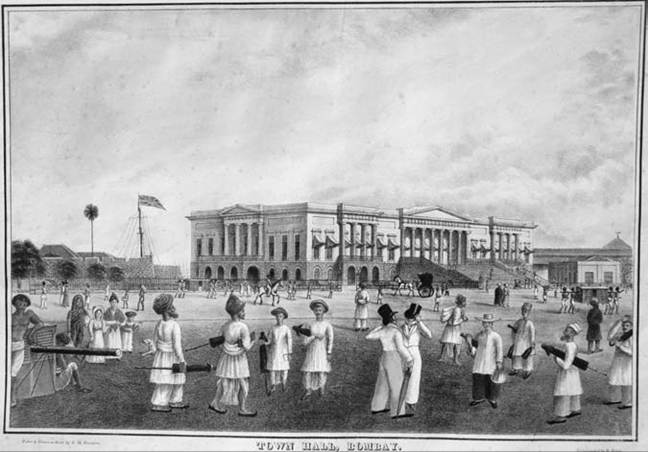
Figure 22.2 J.M.Gonsalves, Town hall, Bombay. Coloured lithograph c. 1833. The original fort/castle is in the background next to the ‘modern’ Town Hall. In front is a cosmopolitan mix of people enjoying the open space of what was earlier the city’s cotton green. Photo: Portvale collection, Sydney.
a government secretariat—asserted the importance of the law, learning and governance under the British raj. They were structures designed with all the grandeur appropriate to a capital city, one that controlled most of coastal western India. At the same time Bombay was still an entrepot, a trading centre, and continued to be so. But during the century its trading concerns were conducted on an immensely larger scale than had ever occurred when it was a Company factory. Nevertheless in the nineteenth century Bombay was a typical and prosperous colonial port city much like others scattered along sea links around the world.
Bombay was also becoming a new kind of city during the century. Apart from its Indian elites winning virtual self-government for its municipal corporation in the 1870s,21 and continuing to be a population magnet, it was changing into a city of new machines and technologies. And it benefited from the productivity and profits they brought. Bombay had been a leading maker of naval ships for the Company in the preceding century, and the Indians who had presided over the dockyards and built the ships had done well out of them, as indeed many had done from Company rule generally.
However, the dockyards could not adapt to the changes that came in with iron ships and steam power and were unable to build the new kinds of ships. Indian entrepreneurs filled in the hiatus by joining in on the opium trade out of Bombay and Calcutta to China in the first half of the nineteenth century. After a disastrous bout of land speculation in the early 1860s, Bombay’s wealthy Indians moved their capital (or at least those who survived the pricking of the boom and were not bankrupt did so) to a new industry just starting in the city, a cotton mill industry. It proved a great success, an Indian success, and grew rapidly. Mill owners and investors made fortunes. By the end of the century Bombay rivalled Manchester and Birmingham as a centre for cotton production, both cloth and yarn—and Bombay remained the major cotton mill town till the 1960s.22 Industrialisation was not only limited to Bombay: over the century other places inland acquired cotton mills and developed into mill towns starkly different from the settlements that had been there before.Bombay’s elites were proud of their city and of the wealth it generated, and proud too of their own achievements. It was a place of change and new ideas, one deserving of its motto: urbs prima in Indis, or first city in India, though rival cities elsewhere may have had different ideas as to which city was prime. Bombay was among other traits the industrial city par excellence. It epitomised the modern city, a new kind of urban phenomenon with a trajectory not determined exclusively by the interests and wishes of foreign rulers.
More on the topic The colonial port city:
- The colonial port city
- While cities have always been important in the fortunes of the Indian subcontinent, most of India’s vast population has lived in villages and hamlets whether in pre-colonial, colonial or even post-colonial times.
- Modern Formations
- Company towns
- The “colonial impact”
- Conclusion: Crossing the Sea
- Conclusions
- Conclusion
- Contents