Conflicting Concepts of Empire
King James VI of Scotland may be considered the first “British” monarch of modern times because when he succeeded Queen Elizabeth in 1603 to become also King James I of England and Ireland, he took to describing the resulting Union of Crowns as the Empire of Great Britain, thus signifying that within this composite monarchy he owed allegiance to no external secular or spiritual potentate.
As a humanist he was also aware that the word “empire” had expansionist connotations,1 but he distanced himself from these because he considered his second great achievement as a “British” monarch to have been the negotiation, in 1604, of peace with Spain, which ended a conflict between England and Spain that had flared since the 1560s. Spanish aggression toward recalcitrant and frequently Protestant subjects in Flanders had first provoked that conflict, which had assumed an oceanic dimension when some radical English Protestants, joined by co-religionists from France and the Netherlands, assailed the imperial authority that Portugal and Spain had established over many of the indigenous populations there. The Protestant assailants believed that attacking Spain's Atlantic Empire and shipping was the most effective means to weaken the power of Spain in Europe, which they considered a threat to Protestantism everywhere.2Few English people, besides those involved with Newfoundland cod fishing, and even fewer people in Scotland and Ireland, had had dealings with America, previous to this Protestant onslaught upon the Iberian maritime interests that was officially endorsed by Queen Elizabeth in the 1580s. While the English participants in this conflict were ostensibly concerned to make contact with the native populations of America and to erect peaceful colonies among them, they were principally engaged upon a campaign of privateering, plunder, and piracy that ended officially when King James signed the Treaty of London in 1604.3 James was anxious for
1 Koebner 1961.
2 Andrews 1967; Canny 2012.
3 Andrews 1984.
Nicholas Canny, The First British Empire In: The Oxford World History of Empire. Edited by: Peter Fibiger Bang, C.A. Bayly, Walter Scheidel, Oxford University Press (2021). © Oxford University Press. DOI: 10.1093/oso/9780197532768.003.0032. peace with the Spanish Habsburgs because he had inherited a near-bankrupt state from Queen Elizabeth in 1603. He continued to favor peace because he later faced the possibility of having to enter the Thirty Years' War to support Frederick V, Elector Palatine, husband to his daughter Elizabeth, who had precipitated that war by accepting an invitation from the Protestant nobility of Bohemia to become their king, thus defying the Austrian Habsburgs who considered the crown of Bohemia to be theirs.
Because King James had made peace with Spain, he lacked enthusiasm for British involvement in the Atlantic that might threaten that peace. Therefore, his principal imperial ambition was to consolidate his position within his domestic kingdoms at the expense of those he considered a risk to security. Already, as king of Scotland, James had been attempting to civilize the Highlands and Islands by planting some compliant Scottish Lowlanders to displace recalcitrant clans.[2128] Then, after 1610, King James took a personal interest in the extensive plantation scheme that his officials had previously devised for the rebellious province of Ulster in Ireland. He accepted that the estates of the former rebel lords should be declared forfeit to the crown and assigned to “British Protestants” who would populate them with Protestant artisans and farmers instead of the native tenants, who were to be resettled on other estates designated either to specified Irish proprietors or to Protestant clergy and English servants of the crown. King James modified the plantation program devised by English officials only in two respects: first he insisted that Scottish Protestant lowlanders, who would settle their estates with Scottish Protestant tenants, should have equal entitlement with his English subjects to become proprietors in Ulster.
Second, he also persuaded the Merchant Companies of London to plant one entire Ulster county where they would establish an inland and port town to enable the enterprising British settlers to link with the commercial world.[2129]These two undertakings (one in Scotland and one in Ireland) marked the highwater mark of King James's ambition to expand the authority he had inherited. Even then, he insisted that plantation in Ulster should be ethically justified and monitored by the London government. The king had grave doubts over the resumption of sixteenth-century style Atlantic ventures because these would have threatened the tenuous peace with Spain. Therefore he limited himself to chartering some companies to exploit the natural resources of, and to promote trade in, those parts of North America not occupied by the Iberian powers. In doing so, he and his advisors considered all such Atlantic engagement to be secondary to their involvement with Ireland. The philosopher and statesman Francis Bacon remarked that plantation in Virginia compared with the Ulster plantation as did Amadis de Gaul with Caesar's Commentaries, while the king's governor in Ireland preferred to “labour with his hands in Ulster than dance and play in Virginia.”[2130]
The views of King James, on what a British Empire might be, contrasted sharply with those of the explorer Sir Walter Raleigh, who advocated a more narrowly English, but a more aggressively expansionist, vision of empire to be pursued in the Atlantic as well as in Ireland. Raleigh's ambitions were invariably laced with Elizabethan-style anti-Spanish and anti-Catholic rhetoric to justify the creation of a Protestant empire in the Atlantic to supplant that of Spain, thus diminishing the military power of Spain in Europe.[2131]
In his advocacy, Raleigh employed what Islanoglu and Perdu have termed the “vocabulary of deficit” to argue that the natural resources with which America and Ireland had been endowed by God were being underutilized because indigenous populations lacked the skills to exploit them.[2132] This shortfall would be made good in America through plantation, as was already happening in Ireland, and the native populations of both places would learn how to share the resources with English planters within a civilizing framework of government.
While Protestant ambitions in America and Ireland could together be represented as redemptive and utilitarian, they could also be shown to be justified by precedent by reference to the twelfthcentury Norman conquest of Ireland, contending that “one hundred will do more now among the naked and unarmed men of Virginia, than one thousand were able to do in Ireland against that armed and warlike nation in those days.”[2133]These two early seventeenth-century concepts of empire continued to complement and collide with each other for generations. That favored by the king, his advisors, and London's wealthier merchants envisaged King James consolidating his imperial authority within his three kingdoms. This was to ensure both the integrity of his inheritance and the prosperity that his subjects might enjoy from the pursuit of trade with international partners with whom they would be at peace. Therefore it was incidents such as the so-called Amboina massacre of 1623, associated with a Dutch effort to exclude the English East India Company from the trade in cloves, and Dutch trespassing upon traditional Scottish fishing waters in the North Sea, which suggested that the Dutch, rather than the Spanish, presented the immediate threat to Britain's maritime interests.[2134]
The second concept of empire, which we have identified with Walter Raleigh, envisaged an empire centered on England that would take little account of Scottish, much less Irish, interests and sensitivities. Such an empire would be “British” to the extent that it envisaged England imposing its cultural and religious hegemony over all peoples in Scotland and Ireland. The remit of this empire would extend across the Atlantic, with England displacing Spain as the prime imperial authority in America. The extension of English authority throughout Ireland, where Raleigh had been a planter in the 1580s, was consistent with this policy because as long as Catholicism remained dominant there, he contended that Ireland would be a satellite of Spain, thus endangering the security of Britain.
Raleigh's various enterprises in the Atlantic had always been justified on the grounds that they were bringing civility to primitive peoples, but they were intended also to increase the wealth of England by exploiting the resources of the areas being conquered. Raleigh always considered himself to be pursuing the course set by fellow adventurers Sir Francis Drake and Sir John Hawkins, and his proposed actions, popular with zealous Protestants, would have led to an inevitable breach of the international treaty no matter how much he represented the Spanish as the aggressors.[2135]In the event, the wishes of King James prevailed until 1625, when King Charles I succeeded him. For the time being, therefore, Britain's appetite for expansion was satisfied with what we might describe as its Hibernian involvement, which provided opportunity for Scottish as well as English people. Adventurers and settlers from England and Scotland were attracted by these prospects, and it appears that, over the full course of the seventeenth century, something like 280,000 English and Scottish people went to settle in Ireland, as compared with 357,500 who traveled to all American destinations combined.[2136] Ireland initially also seems to have been a more attractive destination for skilled farmers and artisans from England, and for women.[2137] However, not all English people were interested in the possibilities that Ireland offered. London's leading merchants become planters in Ulster only because they were so persuaded by their king. Left to themselves, they would have concentrated on recovering, and expanding upon, their customary European trades, and augmenting them with direct trade with Asia to acquire commodities suitable both for re-exporting to European ports and for exchanging for African goods.
British expansion into the Atlantic previous to 1650 was therefore tentative and was promoted by various companies chartered by the crown for particular purposes.
Among these were English Puritans wishing to construct a religious Utopia; fishermen who now worked off the coast of New England as well as in Newfoundland; lesser English merchants (excluded by guild regulations, or lack of resources, from European markets and risky Asian trades) who experimented in America with commodities such as tobacco, sugar, or indigo; seamen who had been involved with privateering, or even piracy, during the years of war with Spain who now became traders; and whatever English indentured servants could be found to meet the labor requirements of these various groups.Scots continued, as before, to find opportunity in the Baltic region, where they pursued military careers in the armies of Denmark and Sweden after the commencement of the Thirty Years' War in 1618. However, Scots now also looked westward in increasing numbers, but to Ireland rather than to America, as Ireland, and particularly the province of Ulster, became the destination for perhaps up to 100,000 Scottish settlers during the century 1610-1710. Of these, perhaps 20,000 had settled in Ulster previous to 1641, but migration to Ulster resumed after the Restoration in 1660 and peaked during the 1690s when the Scottish rural economy collapsed.[2138] The number of Scots who took a direct interest in America was tiny by comparison, and early Scottish colonies on Cape Breton Island and in Nova Scotia were miniscule.[2139]
These various English and Scottish projects held few attractions for the Catholic populations of Ireland who were obviously more the victims of, than beneficiaries from, British imperial expansion. However, despite rampant anti-Catholicism in Britain, some Irish Catholic adventurers joined with English Protestants to establish a presence in the Amazon region, against the express wishes of the Iberian authorities.[2140] This served as a precedent for other Irish Catholics to become involved, either as partners, servants, or conscripts, in subsequent English-sponsored ventures in the Atlantic.[2141] However, most Irish Catholics who were motivated either by desire or compulsion to pursue a career outside their own island looked eastward either to England, to which there was a continuing migration of Irish poor through the seventeenth century, or to the European continent, where Irish soldiers in the service of Spain became the Catholic counterparts of Scots serving in the Protestant armies of the Thirty Years' War. Some who migrated to Spain made their way into Spain's Atlantic Empire, as was brought home to Walter Raleigh in 1591 in the sea battle off the Azores that led to the destruction of the Revenge and the death of Raleigh's close associate Sir Richard Grenville. Among the opponents of the English were some of the Irish that Raleigh had helped expel from Munster in the 1580s. These, he remarked, behaved more cruelly than the Spanish toward the English captives by haranguing them in English to renounce their faith and convert to Catholicism.[2142] Many Irish Catholic exiles of future generations would prove similarly hostile to English opponents, but others, as was noted, aspired to be involved as equals with other subjects of the British monarchy in Britain's imperial projects.
While opinion was divided on how ambitious such projects should be, the wishes of King James prevailed until his death. Because of this, British state power was greatly strengthened in Ireland, as those lords who had been most opposed to crown authority had either been killed in Elizabeth's Irish wars, or had been forced into exile after James came to the throne. This left extensive lands available for plantation by British Protestant settlers who, with the aid of provosts martial and troops in garrisons, came to dominate those areas of Ireland where the crown writ had not previously run. At the same time, the more compliant Irish Catholic landowners wished to profess loyalty to their monarch through an oath of allegiance, while they continued to negotiate for greater tolerance of Catholic worship. The opening up of opportunity in Ireland, and in the distant Atlantic, also contributed to the
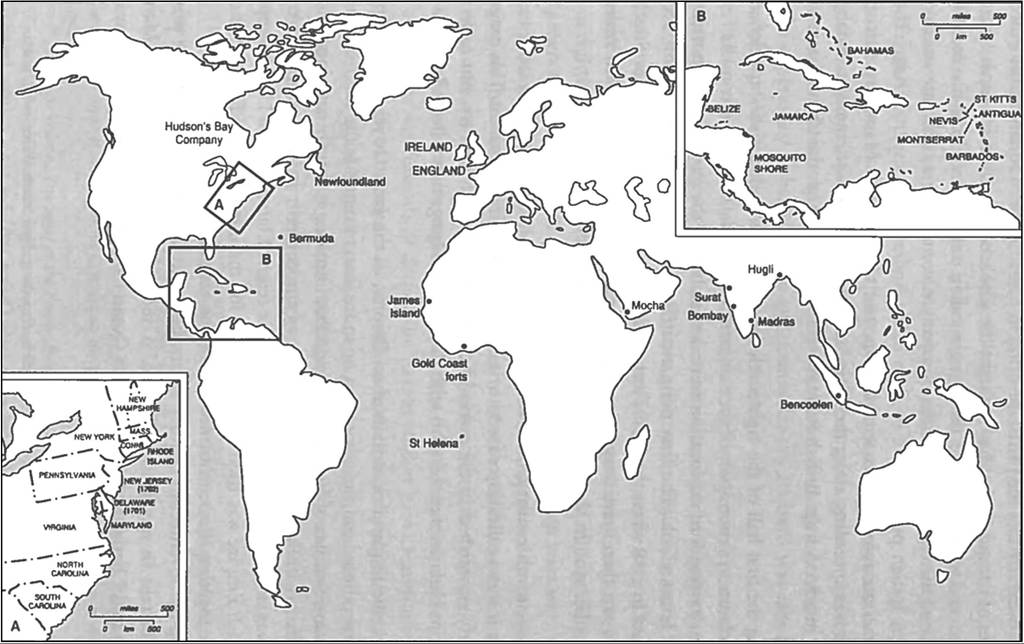
Map 32.1. The British Empire, Seventeenth Century.
Source: Marshall and Louis, 2001, The Oxford History of the British Empire, vol. II, The Eighteenth Century, map 1.1, p. 3. Copyright: Oxford University Press.
THE FIRST BRITISH EMPIRE 889
stability of Britain because the demobilized soldiers from Queen Elizabeth’s armies, and Scottish soldiers who returned from Continental conflict, had the opportunity to become landowners or tenants in the Irish plantations, while former English privateers and pirates could become planters in America.[2143]
More on the topic Conflicting Concepts of Empire:
- Conflicting Narratives
- Conflicting multiple intended meanings
- The inquiry on al-ta'adul wa-l-tarjih or al-ta‘arud wa-l-tarjih in Islamic theoretical jurisprudence addresses, in general terms, what jurists should do when they encounter in their legal research what appear to be conflicting arguments of equal strength.
- CHAPTER 3 Bride Ship, Brothel Ship: Conflicting Images of War Brides Arriving in New Zealand in the 1940s
- The Achaemenid Persian Empire was something new in history: a hyper-power without serious rival, a world empire on an unprecedented scale.
- Key concepts
- An overseas empire gained is not necessarily an empire retained.
- Three (More) Concepts of Atlantic History
- Legal Concepts and Issues
- Legal Concepts and Issues
- Roman law entered medieval political reflection in the late eleventh century as the law of the universal Roman empire, an organization foretold by Old Testament prophecy as the last empire to rule the world before Apocalypse and hallowed by Christ himself who had lived under the Caesars.
- 2.1 CONCEPTS