COOPERATION ACROSS SECTORAL LINES
As in the empire-building era, so too during the years of colonial consolidation institutions specializing in power, profit, and proselytization worked in mutually supportive ways.
That their autonomy spurred experiments in cooperation across sectoral lines rather than constituting a barrier to it goes far to explain the longevity of colonialism. Cross-sector networks produced a structurally integrated arrangement more powerful and flexible than the sum of its parts. Networks focused Europeans’ attention on shared interests in maintaining colonial rule despite their differing motivations for doing so. Cooperative ties allowed Europeans to project the appearance of a united front even when there was none. The image of unity impeded colonized peoples’ efforts to undermine the system by playing factions within the dominant elite against each other.Government support for the private profit sector took several forms. When officials could ensure order and the safe movement of people and goods throughout a colony, they created conditions conducive to long-term investment in productive assets. Soldiers and police protected traders, land-hungry settlers, and missionaries from physical attack. Gendarmes helped provide low-cost labor for private enterprises, if need be by evicting locals from their land and turning them into a dependent labor force on the same land, now placed under European ownership. Official edicts and court decisions affirmed the private property claims of Europeans while frequently denying that indigenous peoples had comparable rights, especially against settlers’ land claims. When roads and railroads were preconditions for profitable activity back of coastal areas, governments bore the heavy initial cost of constructing them. A high portion of the burden was then passed on to the subject population through forced labor and direct taxes.
Government-administered botanical gardens and agricultural research stations tested whether species imported from one area would flourish elsewhere and improved yields on plantation crops like cinchona, coffee, rubber, and palm oil.Through the chartered company mechanism and grants to groups of merchants, metropolitan rulers assigned private actors monopoly powers over a colony’s imports and exports. Officials favored European firms when awarding contracts to carry the mails and construct public buildings, port facilities, roads, railroads, and utilities.15 Metropolitan banks profited from loans colonies took out to finance infrastructural improvements. Government regulations prevented non-Europeans from growing lucrative cash crops,16 taking designated high-paying jobs, and otherwise competing for a more equitable share of gains from capitalist activity. At racially restricted social dubs government officials and businessmen discussed the terms of their alliance, usually over drinks at da/s end.
Colonial governments assisted missionary bodies by enforcing social order and making it safer to set up mission stations and easier to launch mass conversion campaigns. Many regimes allotted tax revenues for the educational and health work of religious agencies. In 1618 the Spanish Crown, ever anxious to spread the Roman Catholic faith abroad, exempted laypersons with designated church responsibilities from paying tribute and meeting personal service obligations. This aided recruitment of indigenous church officers like fiscales, whose task was to see that the congregation attended Sunday mass.17
European control of government may have been an indirect stimulus to conversion. With few exceptions top officials were nominally Christian; many were genuinely and deeply committed to the faith. Christianity was thus closely associated in the minds of colonized peoples with worldly power. A convert might have a better chance to partake of power than a nonconvert, especially when rulers openly preferred Christians to fill government jobs.
Did not political realities prove that the Christians’ God was more powerfill than indigenous pantheons of spirits and deities? If so—and missionaries were only too eager to assert that it was—here was one more reason to convert.The private profit sector’s principal contribution to colonial government was the taxes that financed public sector functions. By combining natural resources, capital, advanced technology, and labor in efficient, productive ways, European capitalists helped generate an unprecedented volume of wealth compared to other empires. Because so many commodities were involved in international trade, colonial and metropolitan governments could collect taxes on these items easily and at relatively low cost. It stretches the point to describe tax payments as a form of cooperation with government. Private actors had an obvious interest in keeping rates low, passing on more of the costs of government to non-Europeans, and, if possible, evading their assessed share. Still, in the vast majority of situations European private interests acknowledged, however grudgingly, the appropriateness of transferring some portion of accumulated gains. The reason was straightforward: their taxes enabled government to help them carry on with business.
Willingness of the private profit sector to support missionaries was by no means universal. The two sectors had grounds for mutual suspicion, given the conflicting priorities they placed on material acquisition and devotion to spiritual matters. Suspicion often verged on open antagonism in settler colonies, for settlers feared that non-Europeans would rebel if given too much Western learning and the “wrong” interpretation of the Bible. Settlers nonetheless recognized that missions turned out literate, numerate young people whom they could then employ. Wealthy individuals made donations and bequests to religious bodies. Of course, when Christian denominations functioned as support groups for settlers—as did Protestant sects in bna and Dutch South Africa—the community reciprocated by enthusiastically supporting the church’s work.
Missionaries, though critical at times of other sectors for exploiting and neglecting colonized peoples, assisted them in several ways.
First, mission schools trained indigenous youth for low-level posts in a wide range of institutions. The products of these schools were linguistic and cultural intermediaries between rulers and ruled, extended the penetrative reach of all sectoral institutions, and worked for considerably lower pay than Europeans in the same posts would have tolerated. Second, missionaries provided services in education, health, and social welfare that the colonial government might have otherwise had to cover from its own resources. Religious bodies recouped a high proportion of operating expenses through their own revenue collection system, including donations from churches in Europe and Sunday offerings and school fees from local congregants. Missionaries limited personnel costs by living, in general, more simply than Europeans in other sectors. Catholic priests kept expenses unusually low by their commitment to celibacy and austerity. In these ways mission agencies reduced pressures on government to take the unpopular step of raising taxes to pay for basic services.Third, missionaries often felt that a frontal assault on other people’s beliefs was required for mass conversion to take place. To the extent that this assault succeeded, it called into question the legitimacy and effectiveness of other aspects of life closely linked to indigenous beliefs. The disintegrative multiplier effect of mission preaching probably made it harder for indigenous political and religious leaders to organize sustained popular resistance movements.18 Familiar ways of life were further disrupted when converts were urged to abandon their homes and form new settlements of believers. This was a particularly important objective and accomplishment of phase i Catholic missionaries in the New World. Convert communities were called aldeias in Brazil and reductiones in Spanish colonies. Phase 3 Protestant missionaries likewise founded communities around their churches and schools; a well-known example was Livingstonia in Nyasaland.19 Relocating people from widely dispersed, often highly mobile rural settings into villages and towns made it easier for government to tax them, force them to supply labor for various projects, and regulate their behavior.
A policy inspired by proselytizing motives thus aided political consolidation.Fourth, many missionaries delivered a message justifying colonialism on theological and moral grounds. The rationale might be based on a specific biblical passage. The statement in St. Paul’s Letter to the Romans (13:1-4) that existing authorities “have been instituted by God” was cited. Or the rationale might be linked to more general features of the Christian faith. Through its most important symbol, a cross, Christianity posits the centrality, unavoidability, and redemptive potential of suffering. The suffering colonized peoples experienced at European hands could be interpreted as an opportunity to gain individual and collective salvation by bearing patiently with tribulation.
Missionaries preached a more secular gospel as well: that of the culture from which they came. They associated civilization with polities ruled by Christians and with a private sector whose driving motive was generating wealth by making the most of the world God gave human beings. As many missionaries saw it, colonial rule granted precisely these benefits. Consider the dismal alternative: in its absence non-Europeans would be consigned to the anarchy of statelessness or the despotism and idolatry of pagan rulers. In either case the option of sustained economic development was foreclosed.
These justifications of colonialism doubtless failed to convince many people who heard them in churches and mission schools. There was a suspiciously high coincidence between the way biblical passages were interpreted and the self-interest of the interpreters. Jesus warned against an obsessive, never-satisfied desire for material possessions—the very thing the colonizers’ behavior epitomized. And the libera- tory and egalitarian aspects of the biblical message pointed in a strongly anticolonial direction (see chapter 15).
Nonetheless, missionaries performed a vital role in the normative pacification of colonized peoples.
In so doing they complemented the coercive forms of pacification used by government police and settler vigilantes. Whatever the reasons for conversion, when non-Europeans took this step they became in varying degrees converts to the larger European civilizational agenda colonialism was pledged to advance. Converts found it more difficult to reject all aspects of colonialism once they accepted the religion that accompanied it.Religious justifications for colonialism may have had a more pervasive impact on the colonizers than on the colonized. Imposing political, economic, and cultural changes from above systematically violated the moral injunction to treat fellow human beings fairly and respectfully. Members of the dominant racial group needed a constant infusion of messages validating their behavior. They felt better about pursuing self-interested goals when preachers praised the imperial project for improving the lives of subject peoples. How reassuring to hear from the pulpit, “Whatever you are doing, it is the Lord’s work! Keep on with it!”
Figure 10.1 visualized sectoral penetration of colonial society as a series of vertical lines. Figure 12.2 superimposes upon these a series of horizontal lines across sectoral boundaries with arrows pointing in both directions to signify mutual support.
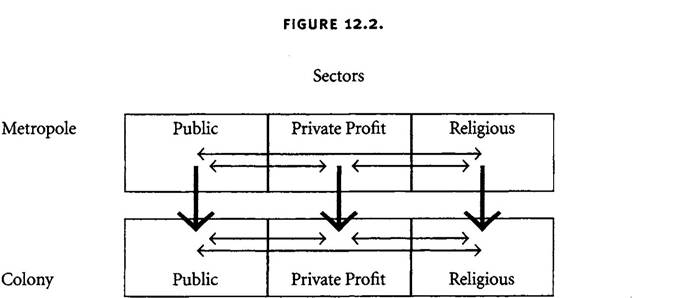
The resulting institutional grid combines functional pluralism, structural strength, and tactical flexibility. Once imposed upon a society, it can remain in place for years.
More on the topic COOPERATION ACROSS SECTORAL LINES:
- 21 LINES ACROSS THE SEA
- CROSS-SECTORAL LINKS
- NON-COOPERATION AND COOPERATION
- Islamist opposition and shari'a 'red lines'
- Sectoral Banks
- SECTORAL AUTONOMY
- NONGOVERNMENT SECTORAL INSTITUTIONS
- DRAW-DOWNS/REMAINING PRINCIPAL/FACILITIES AND CREDIT LINES
- Gulf Cooperation Council
- The disputes we have discussed in chapter 2 do not draw the lines youd initially expect.
- Article 7.2 Bulgaria lines up €3.5bn bond issues as crises ease
- What role has the Organization for Security and Cooperation in Europe played in monitoring the conflict?
- SECTORAL INSTITUTIONS
- Introduction: Rethinking international development cooperation
- 1938: Cooperation
- A Model of Political Economy: Embedded Coordination, Cooperation, and Conflict
- SECTORAL INSTITUTIONS: ROLES AND INTERRELATIONSHIPS
- Sectoral Institutions and Techniques of Control